
Sand Hill Farm
Water Street Townhomes Update
I’ve been remiss in posting project updates, but you can always see what’s been posted in the past using the search box at that shows up on most pages. You can click here and see what’s been posted.

This project has had some struggles getting off the ground. Despite having funds from READI and the City of Plymouth to invest, getting a construction loan and securing permanent financing proved a challenge. Construction costs remain high and getting to an acceptable debt service ratio was challenging. We spoke to nine financial institutes before settling on Interra Credit Union for this project. Even after making that decision, the commitment process was slow. All of the financial institutes seem skittish about committing to long term financing in the current market.

We have made our first draw request to READI on January 15th and currently are being told it may be another 30-45 days before we see funds released. We made our first draw request to the City of Plymouth on January 8th to start the process for approval with the Redevelopment Commission meeting on the 21st, but despite approval there, the bond fiduciary has not released funds to us. It is hard to complain about the injection of funds that make this project possible, but the delays mean we will incur additional interest expense to cover costs until the payments come in.
We broke ground on the project December 17th, 2024. Those gold shovels have traveled to a lot of sites over the years! Mayor Listenberger asked us to delay actual construction until after Christmas to keep the parking lot open for holiday shopping. We literally broke ground December 26th, with excavation starting that day.

Excavation is mostly complete for the building footprint. We have been fortunate that most of the debris we have uncovered has been relatively easy to remove. As always, there was some “fun” stuff, like an active waterline that ran back under the parking lot, through the excavation, from Water Street before it was capped. That made for a muddy day before being resolved. As of now, footings are in place for the townhomes and a large percentage of the basement walls are complete. We should see basement waterproofing start this week and backfill shortly after that. We’re working through the framing shop drawings to get the wall panels released.
We are still looking for completion in late Fall of ’25. We would love to accelerate that if we can!
Water Street Townhomes Groundbreaking Article from Pilot News 12-19-24


Sand Hill Farm Apartments – Blast from the Past
I was going through some old posts and ran across this video the Culver Visitors Center created when Sand Hill Farm Apartments first opened: https://drive.google.com/file/d/1ejjSup5eoh-Rfs266NGxjJ2d42b35t21/view You can tell it was early on because the joy john was still in the parking lot! Ha!

Since opening, we have tried to continue to make improvements. We installed an Amazon Hub, a bike rack, a fire pit and firewood rack (which we periodically fill), some pines to hide the ugly Culver lift station, some trees, a new site sign and this year we mulched the parking lot islands and planted creeping thyme, and will be planting some more trees. We’ve also set things up so the residents can access Surf Internet as well as the Mediacom service, which was there originally.
I would still contend that the construction of the Damore Amphitheater and Sand Hill Farm Apartments are what tipped the scale for Culver’s Stellar designation. We want to maintain Sand Hill Farm Apartments with that same leadership going forward.
LaPaz Commons Ribbon Cutting
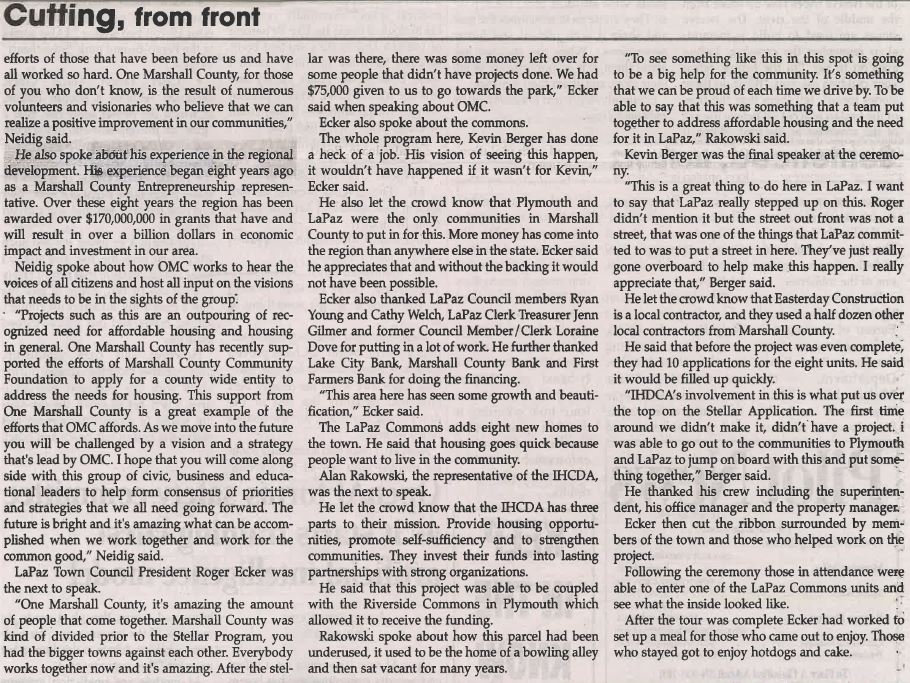
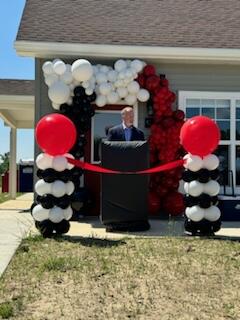
On Thursday, May 23rd, we had the Ribbon Cutting for Riverside Commons Apartments in Plymouth and LaPaz Commons Apartments in LaPaz. This project resulted from Marshall County Crossroads‘ Stellar Designation.
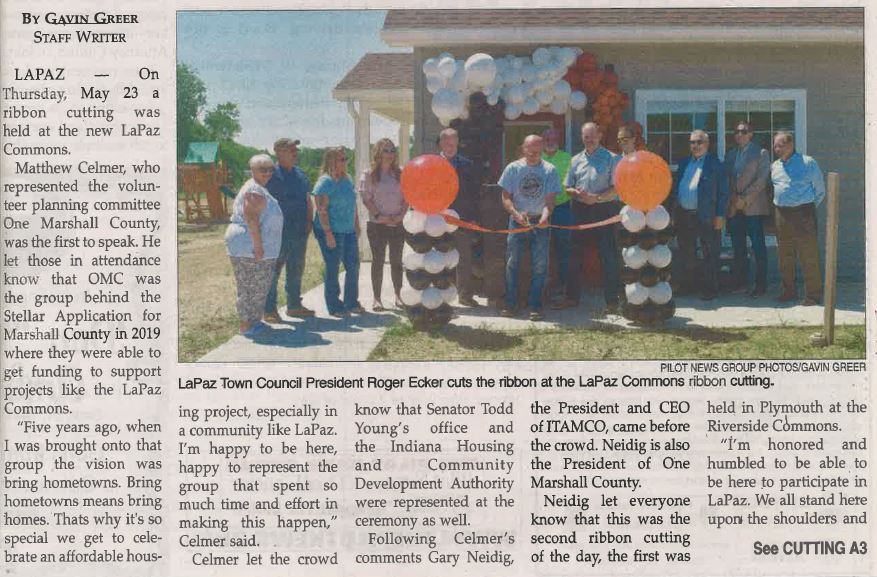
In LaPaz, Matthew Celmer spoke on behalf of the Crossroads committee. Gary Neidig spoke on behalf of One Marshall County, the new reiteration of Crossroads. Roger Ecker, LaPaz Town Council President, spoke on behalf of the Town of LaPaz. Alan Rakowski, Director of Real Estate Acquisition, for IHCDA spoke as well. It was also nice to see Council member, Ryan Young; Clerk Treasurer, Jenn Gilmer; Former Clerk Treasurer, Lorraine Dove; and some of the town employees there as well. All of them praised the new development and the what it would do for the Town of LaPaz. (Marty Oosterbaan was there as a former Crossroads’ leader. He was also responsible for a lot of help in pulling the Ribbon Cutting together.) Thanks also to Easterday Construction Co., Inc. Project Superintendent, Bob Cooper, and Office Manager, Julie Heise for their help throughout the project and at the Ribbon Cutting. Thank you to Gavin Greer for his coverage in the Pilot News on May 29th.
When we have a project like this, I try and attend all of the local town council meetings. I hit most of them and the council made me a standing agenda item. My time there helped me understand the struggles LaPaz is going through and the good people that are involved in the town’s government, contributing their efforts. This made it all the more significant that LaPaz stepped up to help make this project happen, understanding their tight budget. LaPaz punched above their weight, providing more assistance than we received for Riverside Commons in Plymouth and for The Paddocks in Culver.
The LaPaz Council helped find a suitable site and made initial contacts with the owner. They also obtained an appraisal for the property.
The site required a variance. LaPaz Council President, Roger Ecker, appeared with us before the Marshall County BZA and spoke in favor of the variance request. (That was a late night and much appreciated!)
Troyer Street was not much more than a cow path before this project. The town provided and installed stone where the “street” had become a mud hole. Later, the town was able to grade and stone the remainder of the street in-house and then applied for Community Crossings funds to pave it and provide storm water infrastructure. This didn’t just benefit LaPaz Commons, but since these improvements, there has been steady traffic from the other apartments to the east. This was a great improvement for LaPaz.
LaPaz also waived tap fees for the sewer hook-up. A small thing, but helpful to project costs.
And as a final gesture of support, the LaPaz Council provided a picnic lunch at the Ribbon Cutting. That was a touching gesture!
LaPaz and Plymouth were the only communities that stepped up to the challenge for this project. We approached Argos, Bremen and Bourbon (Culver was not eligible), but they either did not have a site available or wanted terms that didn’t fit the IHCDA application. It took courage and a lot of effort for LaPaz to do this and they should be commended. As Alan Rakowski from IHCDA stated in his speech, including LaPaz strengthened the overall application and probably made the difference in it being awarded. I also think that including these projects made a difference in Marshall County Crossroads receiving the Stellar designation and all the ancillary that came from that.
LaPaz Commons is an eight unit townhome project. There are 6 townhouse units and two ADA accessible flats. All of the units are ADA visitable. Before we were even done with construction, there were 10 applications for the units and at the Ribbon Cutting, there were four units filled. This is the first new housing in LaPaz since we did the LaPaz Garden Court senior housing in 2010.
LaPaz has suffered with the Highway 31 bypass literally bypassing them. They are working hard to keep their community thriving, using the limited resources which they have. We are happy that we could make a dent in this and provide some much needed housing. Fingers crossed that this helps kickstart some other positive additions for LaPaz!


Our Customers Say…

Ronald W Liechty - President, Garden Court, Inc.
LIHTC & Stellar
December 20, 2023
Kevin Berger
Commentary, Culver, LaPaz, Marshall County, MCCF, MCEDC, Plymouth, Sand Hill Farm, Stellar
Community, Culver, Culver Redevelopment Commission, government, LIHTC, Marshall County Crossroads
At the December meeting of the Culver Redevelopment Commission (CRC), Linda Yoder, Executive Director for the Marshall County Community Foundation (MCCF), made a presentation on One Marshall County. One Marshall County is the new umbrella organization that Marshall County Economic Development Corp (MCEDC) has spearheaded. Linda and I serve on the collaborative council discussing this new initiative and Linda had volunteered to make the presentation of the need for One Marshall County before the CRC. This also included a request for funding.
There were a few math errors in the presentation, but one of these jumped out at me was during the discussion of Stellar and the investment that Marshall County Crossroads brought to local communities. The numbers quite clearly did not include the investment from tax credits provided by IHCDA. The Low Income Housing Tax Credits (LIHTC) provided by IHCDA amounted to the biggest single project investment from any of the State agencies involved in Stellar. In all, through the tax credits and loans, Plymouth and LaPaz shared $14 million dollars of investment in their communities with Riverside Commons. That investment didn’t show up in the presentation numbers. This is no shade on Linda! She didn’t prepare the numbers…
This isn’t the first time for this. Culver received approximately $10 million in tax credits and loans for The Paddocks, but that number rarely shows up in their Stellar discussions. These would be huge contributors to the ROI discussion, since local investment in these projects was largely limited to in-kind waivers and some inhouse work. (Culver contributed nothing to The Paddocks project. Plymouth gave waivers on improvements to surrounding alleys. LaPaz waived sewer tap fees and secured matching INDOT funding to improve the street serving the project.)
I think there are a couple of reasons for this lack of acknowledgment: 1) The Stellar Committees don’t really understand the program and 2) Unlike many of the project which were directly municipal projects, i.e. parks, trails, etc., that required more active involvement, the LIHTC portion of Stellar is directly administered by the project developer, so there isn’t a pass-through of dollars. The LIHTC award creates a private project. Where there was some shifting of dollars amongst the other municipal projects within the Stellar awards, that was not an option with LIHTC.
Despite the success of The Paddocks in Culver’s Stellar Community program, Marshall County didn’t even include a LIHTC request in their first application for Stellar Region. I had lobbied for its inclusion and felt that the group slighted IHCDA by not accepting their offer. I lobbied a little harder in their second attempt and Riverside Commons was included in that application, which was successful. This was probably not the only reason, but I firmly believe it contributed to the success of the second application.
There have been some complaints about The Paddocks, but The Paddocks has met or exceeded all of the metrics set forth for it. The same can be said for Sand Hill Farm Apartments, the precursor project that made Culver Stellar and The Paddocks possible. It’s too soon to document that for Riverside Commons, which has different goals, but I have no reason to believe the results will be different. As far as community acknowledgement, the LaPaz and Plymouth councils have done a great job of recognizing Riverside Commons. They each have a Stellar agenda item on their council agendas and request updates for each meeting. Culver did not include The Paddocks in their Stellar reports to the council.
I think it’s a missed opportunity when the LIHTC investment is not celebrated and included in the ROI… But then, I’m obviously biased!
0 comments