I had written a blog post a couple of years ago about Pocket Towns. Recently Brent Martin of SRKM Architects sent me a link discussing Pocket Neighborhoods by a different architectural firm with a similar concept. Brent alluded to this as a possible Affordable Housing solution for Culver. As with my previous blog post, I can see this having potential in Culver and for Sand Hill Farm. Currently there is a similar concept, though not an attempt at Affordable Housing, winding its way through a PUD approval at the Culver Plan Commission. It is a development under consideration on the north side of town that I’m watching with interest. The PUD framework would allow for the necessary zoning adaptations, but does require a commercial element. I think the PUD under current consideration is stretching that concept, but technically meets it. I think it can be done more effectively though.
I continue to think the pocket neighborhood idea is intriguing and while I do not see this working for a large development, I do see how it can be a part of a larger development and could be adapted to an Affordable Housing model. Below is a sketch from the Pocket Neighborhood website that shows the concept. Very interesting.
At a meeting Thursday evening I was asked why MCEDC (Marshall County Economic Development Corporation) is included in the Affordable Housing Task Force for Culver and I didn’t give you the best answer. Let me see if I can do better here.
One of the things that came from the MCEDC BEAR meetings was the need for more good employees. In the last six months the unemployment rate in Marshall County has dropped another percentage point to 4.5%. (Doug Anspach, former PEDC Director, used to say that at 4% unemployment everyone that is able and willing to work is working.) Since no one is stepping up to address this employment issue, we have added “Workforce Development” as one of our four main action items in the MCEDC strategic plan. Housing is just one of the issues that needs to be addressed under workforce development.
I haven’t written anything about the Sand Hill Farm property in a while, but there have been some things happening there.
Last year the Town of Culver negotiated a new storm water easement through the property. There was an existing easement that ran diagonally through the property and exited through the Culcom property on Jefferson Street. The old easement wasn’t a problem when it was planned to be just farm land, but the new easement follows the property lines putting the majority of it within the setbacks. This frees up additional land for development. It also provides several access points for future storm water control within the property. I basically negotiated this as a no cost swap with the Town. They removed the old easement which was actually a county easement in exchange for the new easement. It worked out as a win-win for both parties. The easements allow access and road construction over them, etc.
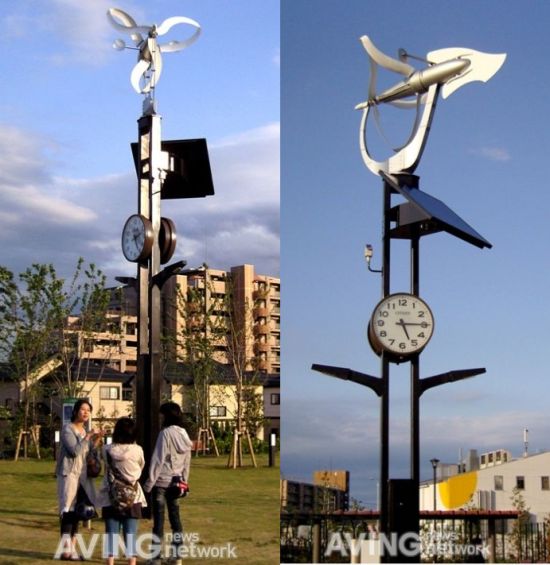
In doing the previous post on alternate WECS’s (Wind Energy Conversion Systems) I ran across some interesting options for street lights that are powered by wind, solar or a combination of the two. Some are more decorative than functional, but I thought they would be interesting to consider for the Sand Hill Farm project. I’ve collected a list of interesting links below showing some of the innovations that are out there. I’ve also included some pictures gleaned from the net.
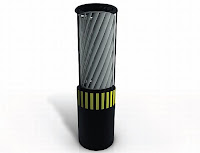
E-Turbine image borrowed from alternativeenergyecogreen.blogspot.com
I also was impressed with the idea of the E-Turbine. This bollard size WECS is designed to be installed along roads and take advantage of the constant rush of air caused by passing vehicles. I would imagine these would be extremely efficient in underpasses and tunnels where that energy can be directed to the turbines and then employed to light the surrounding areas. Each Turbine has a built in battery to store the energy produced. This is similar to the idea previously posted here regarding paving tiles that steal the energy created by foot traffic.
With the currently proposed ordinance these may well be banned too. 0.5 Kilowatts (low end of proposed ordinance WECS definition) is 500 Watts. Street lights use bulbs averaging from 35 to 250 watts per hypertextbook.com That means for a fixture using bulbs at the upper end of this scale, each bulb would require its own turbine to stay under the mandated wattage.
Of these, I think I like the UGE version with the banner option and wind/solar combination power. Some of the links above talk about 400 watt bulbs, but assuming there is a battery to charge too, the wattage may well exceed the 0.5 Kilowatt limitation being proposed. The wattage restriction would also limit the option of one turbine powering several lights.
The kind of creative thinking that creates these things won’t be stifled by Culver banning WECS’s. The ban just stops the use of the new technology that’s out there. This is what I tried to suggest at the Plan Commission with limited success.
A recent post on the SRA Blog talked about the new HepCat Loft Development in Warsaw, Indiana. It’s an interesting concept and one I might consider including in our Sand Hill Farm Development when it moves forward. There is not much in the way of what I would call “loft space” developed as such in Culver. Most of the spaces above the downtown buildings have been developed as more traditional apartments such as what Susie Mahler has created above Cafe Max. (Listing with pictures here.) Jan Nanini’s building at 110 North Main Street took the old Masonic Lodge on the second floor and subdivided it into apartments as well. (You’ll need to go to Jeff Kenney for better history of that building. He tells us it’s haunted here.) Others, such as the space above Fisher & Co. have been left undeveloped and have been relegated to storage.
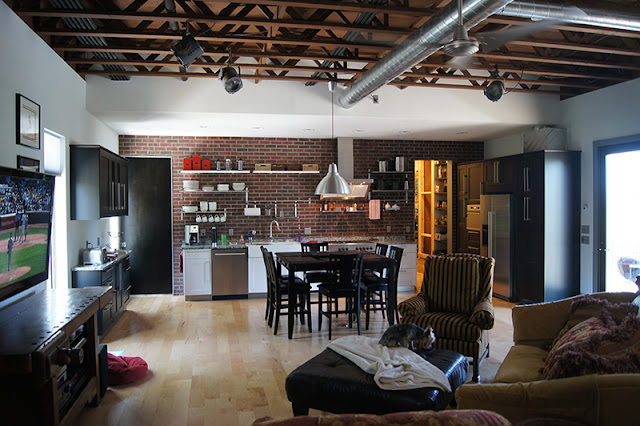
When I think of “Loft Space” I think of open concept and high ceilings, generally having exposed trusses and often having spiral duct HVAC systems. (I love Google Image search, but it’s frustrating when I look through so many pictures and don’t find exactly what I want. This time I came pretty darn close!) It is very much the look Larry Surrisi went for in the original design of The Edgwater Grille (now The Lakehouse Grille) in Culver. There are more of these spaces in Plymouth. We worked on a loft space at the site of the old Moose Lodge and George Schricker has developed some loft apartments above the former Vine Restaurant as well.
This is very much what RW Kidd Construction has gone for in their concept design; the difference being that instead of rehabbing existing abandoned second floors of buildings, they have used “Loft Space” as a style for their new construction. It is somewhat of a minimalist style that should lend itself to some cost savings. It looks like RW Kidd had outfitted them at a fairly high level though to go along with the HepCat theme, which has reintroduced costs.
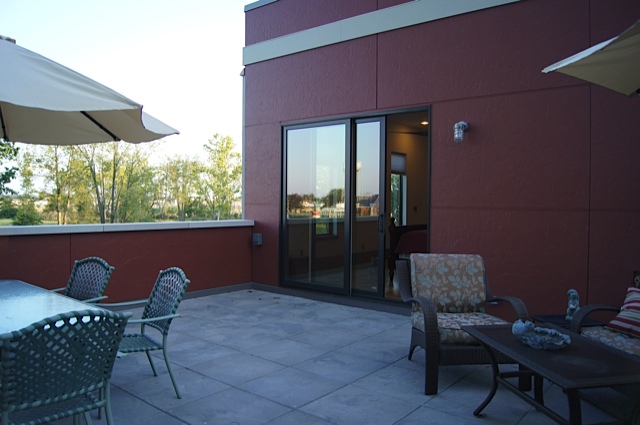
I like the flat roof patios. I’m picturing them along the east property line of the Sand Hill Farm Development where they would look out over the baseball diamonds. It could be an interesting concept there. I also like the multifamily format. I think some limited mix of this type of building could fit well in my mixed use scheme. As mentioned above, it would be something different for Culver. I also wonder if it could be modified to work with a more traditional loft theme where there could be some home-based retail on the first floor, possibly moving the garage entrance to the back off of an alley. There’s potential here!
I’m in Warsaw enough that I will need to swing by and see them in person. There are quite a few pictures at the HepCat Loft Development site listed above, so check them out if you’re interested. Let me know what you think. Is this something that could work in Culver?

 I had written a blog post a couple of years ago about Pocket Towns. Recently Brent Martin of SRKM Architects sent me a link discussing Pocket Neighborhoods by a different architectural firm with a similar concept. Brent alluded to this as a possible Affordable Housing solution for Culver. As with my previous blog post, I can see this having potential in Culver and for Sand Hill Farm. Currently there is a similar concept, though not an attempt at Affordable Housing, winding its way through a PUD approval at the Culver Plan Commission. It is a development under consideration on the north side of town that I’m watching with interest. The PUD framework would allow for the necessary zoning adaptations, but does require a commercial element. I think the PUD under current consideration is stretching that concept, but technically meets it. I think it can be done more effectively though.


.jpg)


 A recent post on the
  When I think of “Loft Space” I think of open concept and high ceilings, generally having exposed trusses and often having spiral duct HVAC systems. (I love Google Image search, but it’s frustrating when I look through so many pictures and don’t find exactly what I want. This time I came pretty darn close!) It is very much the look Larry Surrisi went for in the original design of
  This is very much what
  I like the flat roof patios. I’m picturing them along the east property line of the Sand Hill Farm Development where they would look out over the baseball diamonds. It could be an interesting concept there. I also like the multifamily format. I think some limited mix of this type of building could fit well in my mixed use scheme. As mentioned above, it would be something different for Culver. I also wonder if it could be modified to work with a more traditional loft theme where there could be some home-based retail on the first floor, possibly moving the garage entrance to the back off of an alley. There’s potential here!