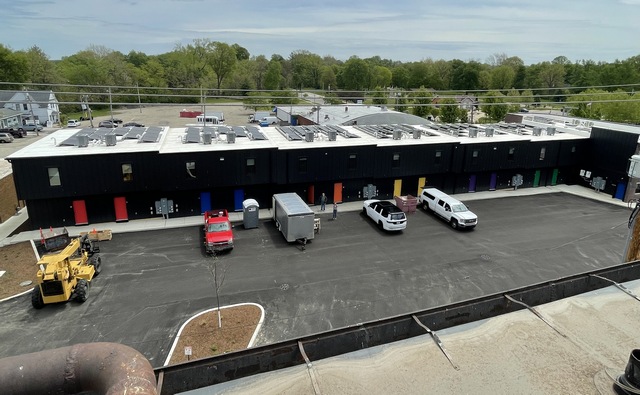
Hard to believe it’s been 10 years since Becky decided that she could provide better service to her patients on her own than through her previous employer. At that time, her employer began dictating maximum 20 minute appointments, not understanding that a hearing test takes an hour. That was the straw that broke the camel’s back. She is not able to spend the time she needs to with her patients. It’s not nearly as lucrative, but she’s pleased to be able to provide better care.
Jamie Fleury did a nice article on Dr. Becky’s Berger Audiology 10 year Anniversary Open House last Thursday. Somewhere around 34 attended. She is planning a second event for Physicians and professional colleagues next month.
City of Plymouth, IN-Mayor’s Office was represented by Mayor Robert Listenberger and City Attorney Jeff Houin. Future Marshall County Sherriff, Les McFarland, was there as well as Matt Hovermale from the Plymouth Chamber. Seven nuns from the The Poor Handmaids of Jesus Christ also attended. Naomi Peacock won the award for the youngest attendee. We won’t disclose who was the oldest! Becky was pleased with the turnout! Thanks to all that attended. ![]()
![]()

At the last Culver Town Council meeting, Greg Hildebrand, President of the Marshall County Economic Development Corporation (MCEDC), made a presentation on 2024’s accomplishments and some overall accomplishments through the last several years. Culver’s representative to the MCEDC board turned in his resignation that night as well. Greg told the board he was researching their question about public officials as MCEDC representatives.
As Culver’s first MCEDC representative and as such, a founding member of the MCEDC Board, I found the question surprising. But then I checked the MCEDC website and there is only one board member still there from the early days. Greg is the 6th person in the staff leadership role, so he has no knowledge of the start-up.
Every institution, whether public or private, must evolve. Unfortunately though, when institutional memory is lost, that evolution can involve back-tracking, repetitive spending, and potential repeating mistakes. In the case of MCEDC, the original representatives met for nearly a year before actually forming the corporation and hiring staff. We met with multiple existing Local Economic Development Organizations (LEDOs), which were set up with various structures in order to try and determine what was best. These ranged from local government departments to quasi-government /private partnerships to independent private corporations. We met with site selectors to determine with which form they preferred to work. We met with the State economic development arm, to get their take on what was most effective. Once we determined that the private corporation structure was most flexible and preferable, we researched various corporate forms before deciding on becoming a 501c(6) corporation. Then we hired Ice Miller, one of Indiana’s leading law firms in the area of economic development to help craft our by-laws. Three key take-aways from this:
The decisions made and the reasons for making them were lost with the retirement of the original board members.

The loss of Institutional Memory has been demonstrated to me in the past from other boards on which I have served too. A new board member has a “new idea” or one they’ve used elsewhere. Institutional Memory could demonstrate how something similar was tried in the past with the associated success or failure. That doesn’t mean the idea may not be worthy of implementation or in the case of past failure, trying again, but maybe it can be improved by past experience or there may be unique reasons why it didn’t work in the past. It could even have left a bad taste in the mouth of donors/supporters and that alone is a reason to avoid it. Board turnover may prevent that experience from moving forward. Sometimes with strong-willed, long-serving staff leadership, the Board gets overshadowed, deferring to staff leadership when staff leadership’s tenure exceeds that of any board member. The Staff becomes the Institutional Memory for better or worse…
I don’t have a great solution for this. Board minutes would be the first line of defense, but there is a wide variety in the way organizations keep minutes, ranging from the bare minimum required by Robert’s Rules, to copious detail on every side conversation. Each has its uses and there are differing schools of thought on which is appropriate for different organizations. Minutes rarely catch everything though.
So here are a few suggestions from my experience on multiple boards:
I believe strongly in refreshing boards and the regular influx of new blood. I think term limits are a reasonable approach to allowing board members a way out as well as a way to encourage new blood, even though this is at the expense of Institutional Memory. But that doesn’t change the fact that the loss of Institutional Memory causes mistakes to be repeated, costs to be repeated and some people to be re-offended. There is a balance for which we should strive, else like MCEDC above, we lose the benefit of the work done in the past.
βThose who cannot remember the past are condemned to repeat it.β β George Santayana, The Life of Reason, 1905

Marshall County is five months into a two year moratorium on construction of Solar Farms, Battery Storage Facilities, Carbon Capture and Data Centers. This has been due to a small, but vocal group of NIMBYs. This has trickled down to restrictions in Culver and consideration of these issues in other Marshall County communities. As per a previous post here, I maintain that communities are either growing or dying. Setting that aside, there may be additional costs to our leadership’s decision to limit or stop development.
The recent actions of the state legislature and new governor has reimagined our tax structure. This means that local governing bodies have to figure out how to do more with less tax income. Turning away new development, with the associated additional tax income, is not a proactive way to address this.

All of the development associated with the construction under the moratorium has minimal long-term impact on county resources. As with any construction, there will be short-term impacts on roads, but those can be mitigated or negotiated as part of the development package. These are not projects that will employ hundreds of people (though the few they do require will be highly-skilled and well-paid), so they will not require acres of parking lots, they will not increase traffic counts on our roads post-construction, they will not cause any increase to our current housing shortage… What these developments will do is pay a lot in taxes, donate to local charities and provide resources for other development where we can look to additional high wage jobs.
Of the four moratorium targets, Data Centers in Indiana have specifically been touted by President Trump and our State government. Turning our backs on any of these initiatives makes us look provincial. That’s not the way I want our county to be perceived.
I am not saying that these should be given free rein and there should be no restrictions on their construction. I don’t know that a short (very short) moratorium isn’t appropriate while research is done, but a two year moratorium likely means that nothing happens for 18 months or more. We don’t have to reinvent the wheel here. Other communities have these and would happily share what they have learned. To my knowledge, there has been little time spent working on new regulations by Marshall County, let alone trying to reduce the length of the moratorium… of which 5 months have passed already… The recent changes to tax laws should make this a priority, not to mention the possibility that we are missing opportunities while other communities take advantage. Those opportunities could be gone if the needs are filled elsewhere.
/taxes-increase-636251470-5a7b1367a18d9e0036f31d2c.jpg)
The tax cost is just one effect on the NIMBYs (and the rest of us). A Department of Energy (DOE) report from December of last year found, “…data centers consumed about 4.4% of total U.S. electricity in 2023 and are expected to consume approximately 6.7 to 12% of total U.S. electricity by 2028. The report indicates that total data center electricity usage climbed from 58 TWh in 2014 to 176 TWh in 2023 and estimates an increase between 325 to 580 TWh by 2028.” As Data Centers consume more power, there will be costs to all of us as power production is ramped up (more costs), and competition for power drives the price up. Our moratorium stops two of the ancillary developments, solar and battery storage, that could help mitigate this too.
Allowing these facilities won’t reduce our electric bills. They could keep us from getting a double hit from higher taxes and higher electric bills and if done right, maybe lower taxes to help mitigate those higher electric bills.
One more time, for those in the back of the room… Communities are either growing or dying! This doesn’t mean we shouldn’t assure that it is smart growth, but extending an open hand in friendship is probably better than showing a closed fist. Our vocal NIMBYs may well cost us all in the end…
The Town of Culver (TOC) and the developer at The Dunes have mostly stated that the project is like the movie Field of Dreams. To paraphrase the movie, “If you build it, they will come.” (The original movie line is, “If you build it, he will come.”) I have no grounds to dispute that, nor to dispute TOC’s hope that adding additional housing options will lower costs in Culver. But do we have to just hope “they” are who we want?
At the last Culver Redevelopment Commission (CRC) meeting, the developer had an request before the commission, asking for the release of the next tranche of bond money to begin the next phase. Citing strong interest, they felt the need to get started on an additional 70 units. Several inciteful questions were asked by audience members that were not well addressed by the commission. One stood out to me that I wanted to address here: “Are you targeting who you want to live there?”
In a round-a-bout way, TOC has a goal that these new residents be full-time residents. There is a move to get the “Papa’s to Pinder’s” business district in shape to serve these new residents, but it’s not moving too quickly. That is definitely an important piece. As was brought up at the meeting, can Park ‘n Shop serve the additional residents? Should TOC be talking to CVS about the potential extra need and whether an onsite pharmacist would be justified again? The commission members didn’t have good answers. Hopefully, there is more going on behind the scenes that wasn’t ready for public discourse or alternatively, the discussion sparked some additional goals to strive for.
But the main thing I think is missing is targeting who TOC wants to populate those new homes. Left to their own devices, the developer has only one goal (as he should to satisfy his investors): fill the units as quickly as possible with the residents that will pay the most to be there. The project is somewhat insular by design, turning the back side of homes and apartments toward South Main Street, rather than embracing the existing neighborhoods. TOC will have to make the effort to reach out and make those residents part of the community. Wouldn’t that be easier to do if that welcoming hand were extended before they moved in?
There is a new battery plant under construction in St. Joseph County. There is a new distribution center under construction in Elkhart County. There is a new truck factory going into Kosciusko County. Driving to those sites from Culver seems like a long distance, but compared to living in a larger city, the commute time would be similar, but the drive would be more pleasant! Worst case, if commute distance is too long, those people will still be looking for housing and likely push some existing residents in those counties to look elsewhere. Culver has some nice amenities to offer, if they are promoted. Per the recent UWMC Housing Matters study, Marshall County has a housing deficit of 1,300 dwelling units.
This seems like an area where TOC should be proactive; soon, rather than taking a wait-and-see approach. If nothing is done, I believe the developer will get those homes rented. There is no strong impetus for them to care whether they are rented to full-time residents or not. If TOC does not want more part-time summer residences, part-time Culver Academies‘ parent residences and part-time overflow from lake house residents, then they will need to make an effort to attract who they want.
Innovate Indiana Series
November 3, 2025
Kevin Berger
Commentary, Culver, Marshall County, Plymouth, Politics
Chamber of Commerce, Community, energy, government, Trends, Volunteering
Easterday Construction is a member of the Indiana Chamber of Commerce. As such, I was offered the opportunity to share their table at two Innovate Indiana presentations in South Bend. Both featured Suzanne Jaworowski, Indiana Secretary of Energy and Natural Resources, as the key note speaker. The presentation was moderated by Gerry Dick of Inside Indiana Business, so it presented a pro-growth vision for Indiana. This series was one of several done in various regions of Indiana.
There were a few others from Marshall County present, though I only recognized people from Plymouth and Culver. One of them spoke in the morning round-table session and made the comment that they were afraid that our County is becoming the County of “No”. It was a bit disheartening to hear a titter go around the room followed by one of the people from downstate responding something to the effect of, “Oh, we know that well!” Ugh! Not what you want to hear.
That rolled into Ms. Jaworowski’s follow-up comments. These were the key take-aways for me:
There was a round table discussion at lunch that talked about the need to be forward thinking and support businesses that support the communities. The role of the Regional Development Authority (RDA) was discussed. The RDA has made great strides, but is still far from the goals it has set for itself.
Absent from these meetings were elected officials from Marshall County. Elected officials from our other regional partner counties where there, which puts us at a disadvantage. Marshall County often seems to be treated like the redheaded step child. The failure of our elected officials to participate won’t help that.
0 comments