Steve Gorski, Culver Building Commissioner, has stepped up to the task of updating the Culver Zoning Ordinance. Having served on multiple committees to do this, I know this can be a mind-numbing and somewhat thankless task. This was one of the goals of the 2024 Comp Plan and Mr. Gorski has tackled it. At the last meeting, he presented a lot of the changes and corrections he is proposing. It wasn’t really open to the public for discussion, but was handled as a line-by-line presentation to the commissioners.
For 100% of what he presented, I appreciated what he was trying to do and the clean-up it represented. I think there was 10% that could have been improved by some additional input. My concern with the current approach being taken is two-fold:
- Mr. Gorski is the Building Commissioner, so naturally he tends to look at things from the administration and enforcement side of things. While those are relevant and extremely important, it doesn’t always pick up the implementation side that is important to the citizens when they try to comply with the ordinance.
- In the past, this has been done by a subcommittee, involving Plan Commission members and members of the public. While Mr. Gorski has a good working relationship with the Plan Commission, it’s harder for the Commissioners to question his suggestions since they are more personal than if they were created by a subcommittee. It’s impossible for one person to do this without it being affected by their personal experience. That is tempered by a committee. (Though this can easily double the time it takes to do this work.)
There is also the factor that Mr. Gorski has only held the position for a couple of years. I’ve written about “Institutional Memory” here before. This applied to more than a few items that he suggested changing. A couple examples just in the category of height restrictions:
- In the existing ordinance, there is a restriction that accessory structures in the residential districts have a height limit of 16′. This was added to the ordinance because multiple permits were issued for garages that later had a second floor area remodeled into a second residence, which was not permitted. Mr. Gorski has been questioned multiple times about this and would like it remove it.
- In the existing ordinance, the S-1 district allowed accessory structures to have a height of 50′, above the regular height restriction of 35′ in other districts (except A1 – Agriculture). The 50′ limit is there to accommodate grain elevator legs from before there was a separate A1 district. It was left in the ordinance during the last revision so existing farmers in the S-1 weren’t forced to rezone to comply if they added an elevator to their silos.
The ordinance is meant to be somewhat of a living document, so I am by no means saying that these things are written in stone. But the institutional memory of why they are there, could temper the decision to change them.
A couple larger items I struggled with on the changes were:
- Many of the tweaks, were to address current recurring problems, such a setbacks on small lots. I whole-heartedly agree with the thought process that the ordinance should be changed to reflect the reality of variance being given. Where I struggle with this is in the tweaks being made to setbacks in the R-1 district (as an example) to eliminate current setback issues on existing small lots, without considering how this would affect new lots with the larger lot sizes recommended by the ordinance. If the smaller existing lots are acceptable in R-1, then change the ordinance so new developments mimic the existing. Else, leave them intact as aspirational to what is desired in new construction. Or create new districts and district overlays to accommodate the current needs.
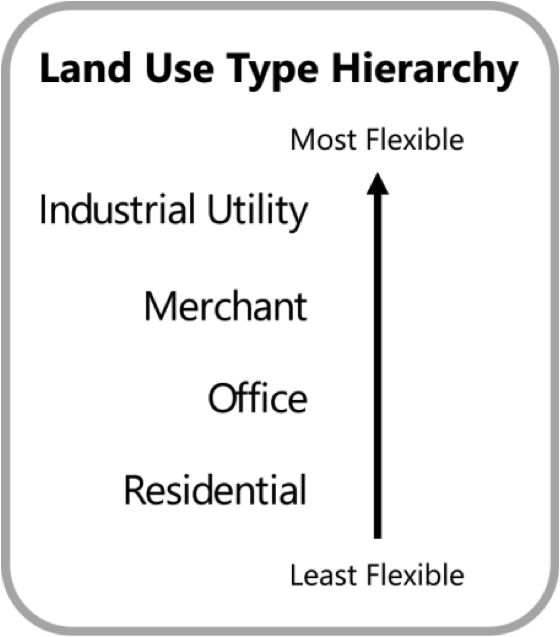
- The Comp Plan suggested some major changes in how zoning is handled. In some ways, it suggests moving away from Euclidean Zoning to more Hierarchical Zoning. This wouldn’t have to be done all at once, but could be done in steps or waves. Much of what is currently being fixed reinforces the current Euclidean Zoning. I did bring this up in the public comment section of the agenda and those that seemed to agree with me felt that fixing what we have is a good first step towards this. I hope that’s true since I know sometimes things get busy and major change is hard.
Overall, I commend Mr. Gorski for taking the bull by the horns and moving something forward. I hope the Plan Commission continues to work on this and takes the next steps recommended by the Comp Plan.