Culver: Nice Scientists Not Welcome

At the October Plan Commission meeting, the discussion on WECS’s continued.  (Previously discussed here.)  The Commission could not come to enough of a consensus to formulate a new Ordinance but they did take a series of votes that defined several of the issues.  It would appear that proponents of banning WECS’s are achieving most of their goals.  If they proceed along their current path, Culver residents would not be allowed to have a WECS that produces more than .5 kilowatts in the lake district, park district, and R1 residential district as well as within 1/4 mile of any of those districts.

I would still contend that the proponents of the ban are too focused on their distaste for the aesthetics of current wind turbine technology and fail to consider the advantages that could come from advances in the field.

Read more

NFIB “Small-Business Confidence Sputters, Again”

Graphic borrowed from www.nfib.com/sbet

I received the results of an NFIB survey today that I thought would be worth sharing.  You can read the entire report here, but the gist of it is contained in this quote:

“After two months of incremental but solid gains, the Index gave up in June.  This appears par for the course, given that there is no reason for small employers to be more optimistic and lots of things to worry about,”  said NFIB chief economist Bill Dunkelberg.  “Washington remains bogged down in scandals and confidence in government’s ability to deal with our fundamental problems remains low.  Economic growth was revised down for the first quarter of the year and the outlook for the second quarter is not looking good.  Nothing cheers up a small-business owner more than a customer, and they remain scarce and cautious while consumer spending remains weak and more owners are reporting negative sales trends than positive ones.

It certainly doesn’t help that the endless stream of delays and capitulations of certain provisions of the healthcare law adds to the uncertainty felt by owners.  Until growth returns to the small-business half of the economy, it will be hard to generate meaningful economic growth and job creation.”

Read more

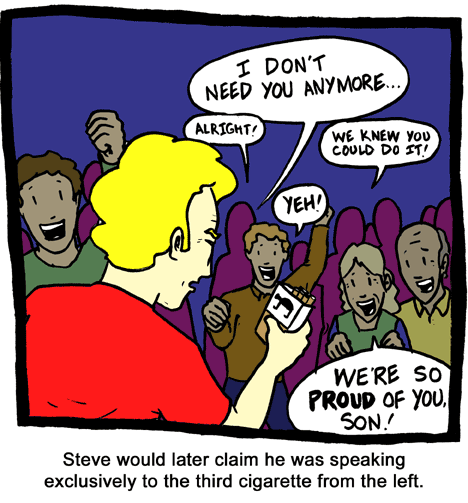
Cigarette Addiction is a Tough Mistress

Comic from Saturday Morning Breakfast Cereal - See more at www.smbc-comics.com

I’ve never been a smoker, so I can’t speak from experience, but from what I’ve seen, quitting cigarettes is hard.  I will always remember a conversation about cigarettes with my grandfather.  He said, “I haven’t smoked in 30 years.  I still get cravings for them.  If I knew I was going to die in 6 months, I would start smoking again today…”

Lifeplex in Plymouth sent out a sign up program for a smoking cessation program.  It is an 8 week program.  The cost is only $40.  As an additional carrot, the program included two free months of membership in Lifeplex.

I thought the Lifeplex program was a good one.  One I was willing to promote with ECC employees, of which we had four smokers that I knew of.  To sweeten the pot, I added  the following incentives:
  1. The class fee would be paid up front by ECC and deducted at $10 per week as a payroll deduction.
  2. The class fee would be refunded when the employee completed the course, plus an additional $20 bonus.  (Where else do you get a 50% return on your investment?)
  3. If the employee remains smoke free for 6 months, he will receive an additional $50 bonus.

    Read more

Excerpt from ABC Construction Economic Update 3-1-13

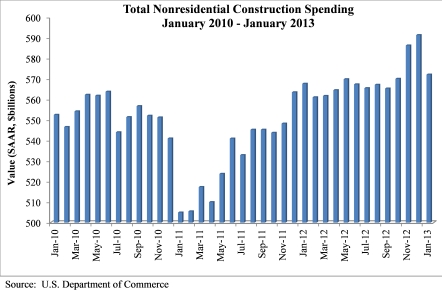
NONRESIDENTIAL CONSTRUCTION SPENDING FALLS 3.3 PERCENT IN JANUARY

As further evidence that the nation’s construction industry continues to struggle, nonresidential construction spending fell 3.3 percent in January, with outlays decreasing to a seasonally adjusted annual rate of $572.1 billion, according to the March 1 report by the U.S. Census Bureau. Year over year, total nonresidential construction spending is up only 0.8 percent (unadjusted for inflation).

Both private and public nonresidential construction spending were down for the month. Private nonresidential construction spending fell 5.1 percent on a monthly basis, but is 4 percent higher compared to one year ago. Public nonresidential construction spending declined 1 percent in January and is 2.7 percent lower than January 2012.

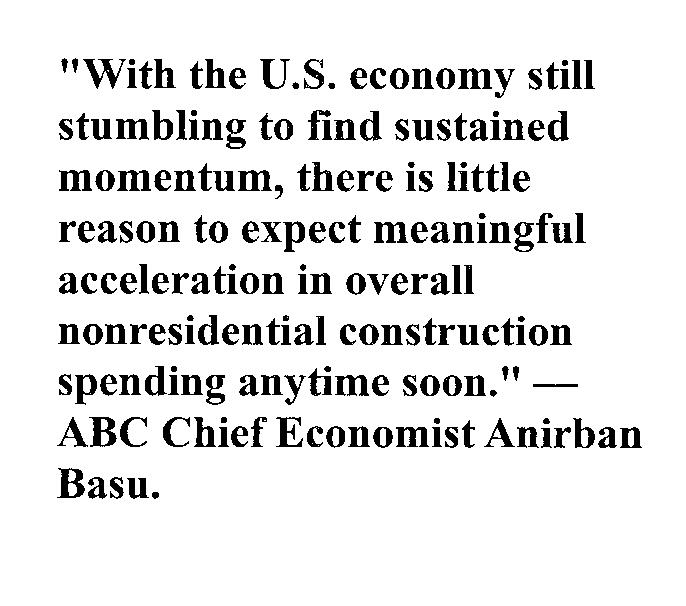
Basu Quote 3-1-13“January’s construction spending decline was particularly alarming because the loss in momentum spread deep into privately financed categories,” said Associated Builders and Contractors Chief Economist Anirban Basu. “In previous months, decreased spending in a number of public spending-oriented sectors like sewage and waste disposal and public safety was roughly counter-balanced by increased spending in intensely private segments, such as power and manufacturing.

“That changed in January, with privately financed segments like power and manufacturing reversing course and experiencing substantial monthly declines in construction spending” said Basu. “The upshot is that nonresidential construction spending is virtually unchanged over the past year.

Read more