Regalia Quote

“…the CBO data shows that since 1979, not only have the income tax shares of the lower four quintiles continued to drop, but the lowest quintile has been in the negative since 1987, and the second lowest has been negative since 2002.  This means that the lowest 40% have not been paying any federal income tax but have, instead, been getting subsidized by the government through such incentives as refundable tax credits.”

From Dr. Martin Regalia:  Econ 101, Tax Facts: Where the $ Comes From in Free Enterprise, April 2010

Paul Ryan Quote

“While exact and precise measures cannot be made, there are estimates that in 2004, 20 percent of households in the U.S. were receiving about 75 percent of their income from the federal government, and that another 20 percent were receiving nearly 40 percent.  All in all, about 60 percent of American households were receiving more government benefits and services, measured in dollars, than they were paying back in taxes.  President Obama’s first budget alone raises this level of ‘net dependency’ to 70 percent.”

Paul Ryan is in his sixth term as a member of Congress, representing Wisconsin’s First Congressional District.  He is ranking member of the House Budget Committee and a senior member of the House Ways and Means Committee.   This quote was taken from an article in the February 2010 issue of Imprimis.

Regalia Quote

“The president’s budget came out last month, and after reading through hundreds of pages of text and tables, I came to the conclusion that this budget was a lot like the “El Gordo” platter at my favorite Mexican restaurant – it contains something for everybody, it’s loaded with pork, but it’s bad for your health, and it totes a hefty price tag.” 

–  From March 2010, Econ 101,  Dr. Martin Regalia, Senior Vice President and Chief Economist, Economic Policy, U.S. Chamber of Commerce

Washington Gibberish

I am somewhat frustrated by the gibberish that is coming from Washington.  Be it Health Care Reform, the so called “stimulus” packages or even just the general budgets.  Many would say it has always been like that and I have read some accounts that discussed arguments over bills that nearly came to blows in the 1800’s.  There are other records that belie that though.  The Homestead Act of 1862 is one such example.  Could such a sweeping document be created and passed in such a succinct form today?  I think not.
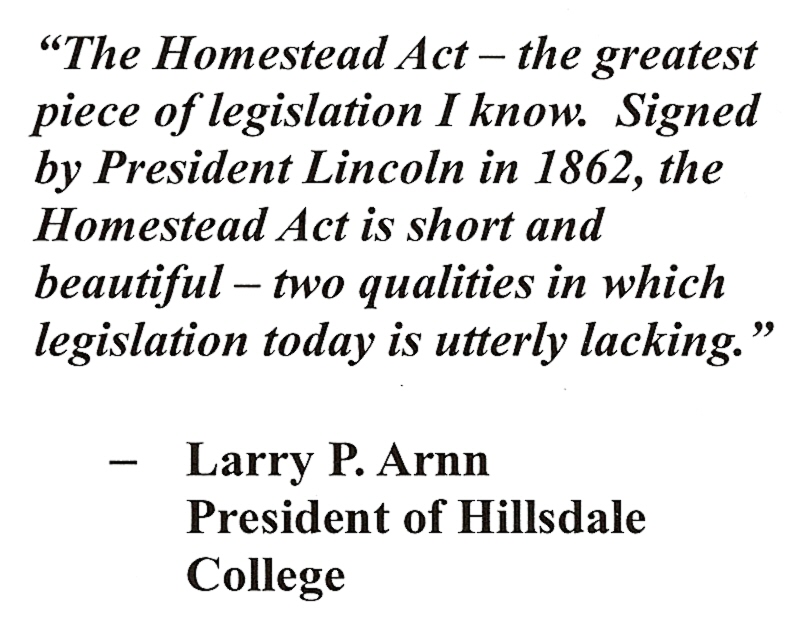
First, if you look at that document (here), which basically opened the West to settlement,  it is only two pages long!  I would wager that President Lincoln didn’t sign his name to it with 15 different give-away pens either…

Read more