Innovate Indiana Series

Suzanne Jaworowski

Easterday Construction is a member of the Indiana Chamber of Commerce. As such, I was offered the opportunity to share their table at two Innovate Indiana presentations in South Bend. Both featured Suzanne Jaworowski, Indiana Secretary of Energy and Natural Resources, as the key note speaker. The presentation was moderated by Gerry Dick of Inside Indiana Business, so it presented a pro-growth vision for Indiana. This series was one of several done in various regions of Indiana.

There were a few others from Marshall County present, though I only recognized people from Plymouth and Culver. One of them spoke in the morning round-table session and made the comment that they were afraid that our County is becoming the County of “No”. It was a bit disheartening to hear a titter go around the room followed by one of the people from downstate responding something to the effect of, “Oh, we know that well!” Ugh! Not what you want to hear.

That rolled into Ms. Jaworowski’s follow-up comments. These were the key take-aways for me:

  1. Energy production is a priority of the current presidential administration and Indiana wants to step up to this challenge.
    • Indiana is promoting an “all of the above” position on energy. We still have coal-fired plants, but most of them have been upgraded and while not environmentally perfect, they are not the dirty coal plants of yesteryear. We also have productive gas-fired plants that perform well. We are expanding solar and wind energy production and looking into nuclear power. None of these are THE solution, but they can all be complimentary.
  2. Data Centers are critical to the growing AI industry and another priority of the current presidential administration. The President has specifically called out Indiana as a State primed for data center construction.
    • Indiana is a prime location for data centers due to our position within the country and our access to the electrical grid. We also have generally good internet infrastructure. The power solutions listed above add to the attractiveness of our State.
    • Indiana has taken a position requiring data centers to provide projections of their ultimate electrical needs and requires them to provide 80% of the upgrades necessary to provide for those needs. Most utility companies are taking this a step further and requiring them to provide 100% of the upgrades before any power is turned on. Locally, in the case of AEP, they require the data centers to pay the ultimate use bill from day one, before they have ramped up to that need, in order for AEP to guarantee that capacity down the road.
    • Ms. Jaworowski indicated that this should lead to rate reductions for current rate-payers in Counties with data centers. An advantage our County of No will not have.

There was a round table discussion at lunch that talked about the need to be forward thinking and support businesses that support the communities. The role of the Regional Development Authority (RDA) was discussed. The RDA has made great strides, but is still far from the goals it has set for itself.

Absent from these meetings were elected officials from Marshall County. Elected officials from our other regional partner counties where there, which puts us at a disadvantage. Marshall County often seems to be treated like the redheaded step child. The failure of our elected officials to participate won’t help that.

Disannexation

A new word! This isn’t one I was familiar with, though the meaning of “disannexation” is pretty self-evident. Here’s an excerpt definition from Justia:

The property in question is part of the 70+ acres owned by Culver Investment Corp which was annexed as part of a mixed use PUD project at the northwest side of Culver. (Outlined in cyan and yellow on the GIS map to the right.) The project proposal included a large residential subdivision for most of the property and a gas station/convenience store on the NE corner of the intersection of SR 10 & SR 17. A preliminary PUD plan was presented and the developer entered into a development agreement with the town, which included the annexation. Since that time, the town has rezoned the property back to S-1, Suburban Residential, The developer has sold the north two parcels which are on the north side of SR 10 to two different purchasers and the remaining property has been on the market for some time.

It will be interesting how the Culver Town Council handles this. Disannexation seem counter to the reasons it was annexed in the first place and counter to the Comprehensive Plan, which includes developed uses for this property as part of Culver and expansion of the extraterritorial boundary based on this annexation.

The suggested disannexation is roughly the middle third of the overall property, parcel 502117203032000022 on the adjacent map, that was in the original annexation. If this goes through, this effectively creates a non-contiguous annexed area north of State Road 10. There are a few exceptions to the contiguous rule during annexation, but the exceptions generally apply to industrial parks and municipal properties. A brief search online didn’t turn up any consideration for creating orphan annexed property no longer contiguous to the town limits.

Disannexation Plat

I wrote about this a while back in a post here: Municipal Services As stated in an update at the bottom of that post, the town believes Culver Investment Corp is still responsible for extending services. I am not an attorney, but I do continue to have questions about that. Allowing this disannexation before having a resolution of the utilities issue would further complicate this in my mind. I would assume the new property owners have an expectation of utilities from the town. The town’s remedy for supplying these utilities would be the Culver Investment Corp Development Agreement. Messy at best…

I know it might be expedient to allow this disannexation and to pursue disannexation of the properties across SR 10, but my opinion is that would be a mistake. Culver should control these areas and particularly the intersection there. Culver is in somewhat of a growth phase, so giving up property control seems counterproductive to that. I hope the Council looks at the Comp Plan and the work that went into it before making a rash decision here. Time will tell…

Post Frame Housing

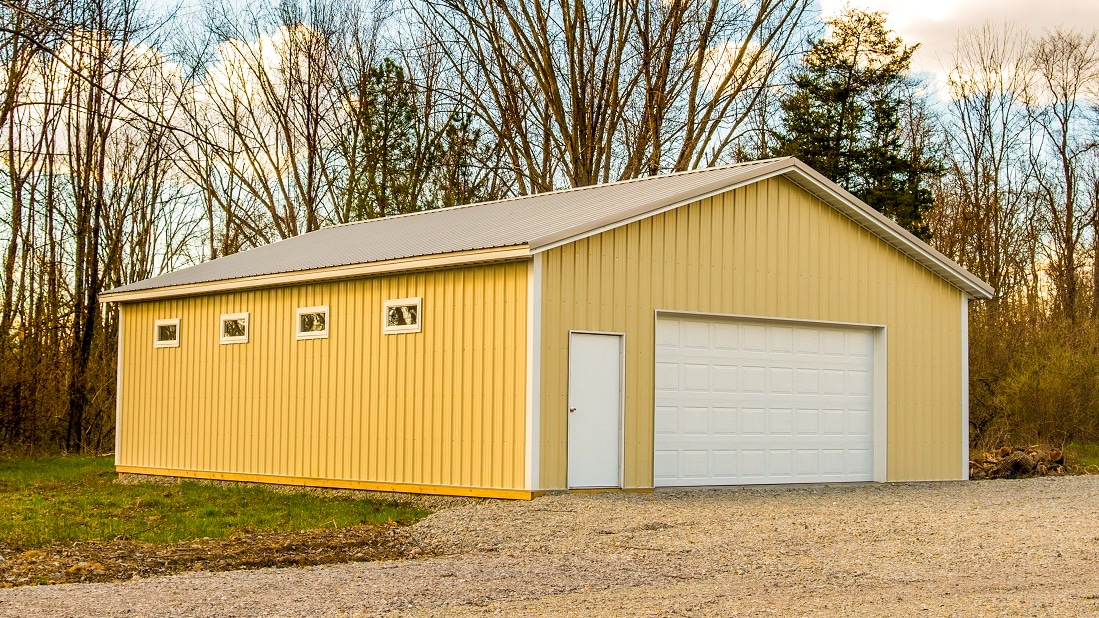
Traditional Pole Barn with vertical steel siding and steel roofing. Image from CMT Components

A few years back, there was an effort to ban post frame (also known as timber frame) housing in Plymouth. A similar ban has been floated a few times in Culver and resurfaced at the August Plan Commission meeting. In both cases, the rational has been that the style doesn’t fit the community. As near as I can discern, (and I could be missing something) it doesn’t have much to do with the post frame construction, but more about the look of vertical metal siding, since these homes can be indiscernible from homes built using standard framing.

Post frame construction is most often associated with the “Shade & Shelter” functionality of Pole Buildings. Where post frame barns are designed to protect farm equipment, post frame homes are generally better insulated, stronger structurally, sealed tightly and have a different aesthetic. It’s just a different framing technique that has recently had a resurgence in popularity.

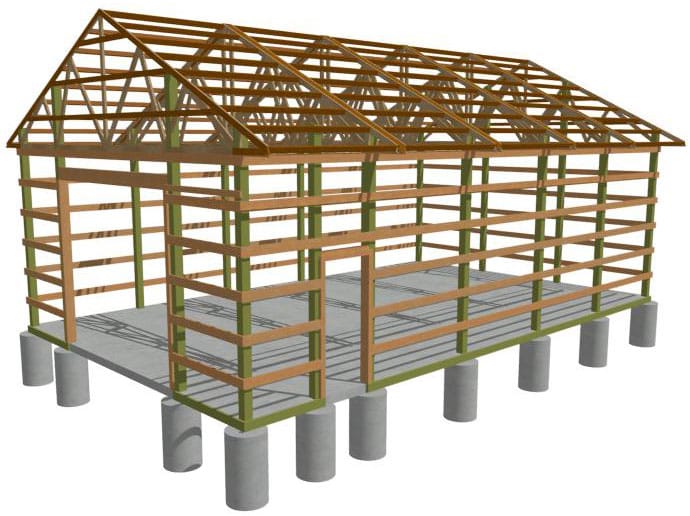
Post Frame Construction showing below grade piers, posts, girts & purlins Image from Roper Buildings

The main difference in this style of construction is the use of posts (poles) to provide the frost protection and uplift protection in lieu of the footings and frost walls used in standard construction. They are nearly always slab-on-grade (SOG) for the first floor. (Many standard construction homes are SOG as well, but standard homes could also have crawl spaces or basements.) Standard construction will use 2×4 or 2×6 studs at 16″ or 24″ on center to form the shell. Post frame buildings have posts spaces as much as 8′ on center with horizontal 2x4s girts to support the siding. Standard construction will have trusses or rafters at 24″ on center, where post frame buildings space out the trusses to bear on the posts and then use 2×4 purlins to support the roofing materials.

For a pole building, the big advantages are the ease and speed of construction. The construction is very forgiving. It is generally a big box to provide the most cubic feet of storage with the minimum of effort. They tend to leak and creak over time, but provide the basic shelter function needed. For a post frame home, there are a lot of enhancements:

  1. In standard home construction, the frost wall is insulated, in our area, down to 3′ below grade. In post frame home construction, insulation is added under the slab extending 3′ – 6′ from the perimeter to provide a similar thermal break.
  2. In standard home construction, there is continuous sheathing, generally OSB or plywood spanning the studs and providing the exterior diaphragm framing stiffness. In post frame home construction, this is provided by the wall girts which also support the vertical metal siding. Sheathing would still need to be added if a horizontal finish such as traditional siding or a brick veneer is used.
  3. In standard home construction, interior wall finishes such as drywall or wood paneling can be applied directly to the studs. In post frame home construction, it will be necessary to add interior girts to provide support for the interior finishes.
  4. In standard home construction, the wall depth is based on the stud depth, so in general there is a cavity of 5-1/2″, if 2×6 framing is used. Each stud is a thermal transfer point as there is no insulation between the interior and exterior at stud locations. In post frame home construction, the exterior wall thickness is determined by the post thickness (6″ or 8″) plus the 2×4 girt thickness on the interior and exterior, giving a wall cavity of 8-1/2″ or 10-1/2″. Unlike studs that create a thermal transfer from top to bottom, post frame construction reduces the transfer points to just the locations where the girts bypass the posts. This allows for super insulation, more than doubling standard exterior wall R values.
  5. In standard home construction, the roof framing is generally webbed trusses with OSB or plywood decking to tie things together and provide a substrate for shingles. In post frame home construction, either the trusses need to be moved closer together (generally requiring a collar beam) to allow sheathing on the trusses or the sheathing is installed over the purlins.
  6. In standard home construction, interior walls are often load-bearing. In post frame home construction, interior walls are non-bearing, allowing doors without headers, allowing standard slab thicknesses and often, greater stud spacing.

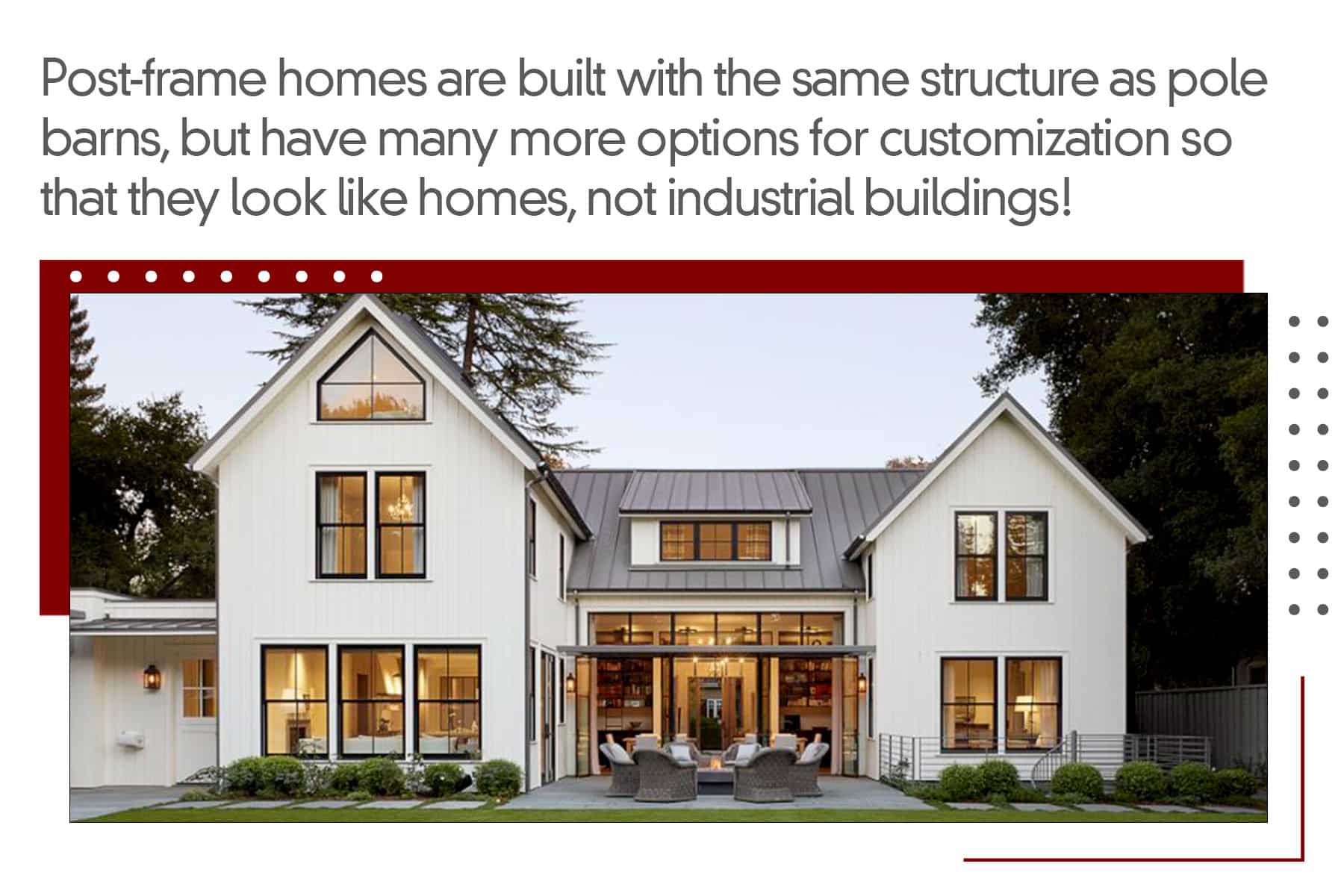
While some of these homes embrace the barndominium style, such as the one to the right that even includes a simulation of a silo, they often are hard to distinguish from their neighbors. It’s not the framing that determines the exterior aesthetic, and in many cases you wouldn’t know the framing style if you didn’t see it under construction. Three of the apartment buildings at The Paddocks have a definite barn aesthetic, yet they were stick-built.

Stating that the style doesn’t fit the community seems a particularly curious thing to say about a home in Culver. Culver has a myriad of building styles ranging from traditional to bungalows to A-frames to geodesic domes. Culver has exterior finishes ranging from siding to painted concrete block to limestone to fieldstone. The siding breaks down to various styles including vertical, horizontal and diagonal. We have buildings with vinyl, steel, aluminum and wood siding. Culver is allowing new construction to expand in size to the point that they encourage replatting/combining of small lots to accommodate the larger construction.

Some communities establish aesthetic requirements. Culver doesn’t have these. As it stands, they’re zoning decisions are based mostly on safety. Post frame verses traditional framing is more of an issue for building codes and as of this time it is allowed. Many would object to the use of vibrant colored residential standing seam roofs as not fitting the traditional aesthetic, but nothing has been said about banning those. Personally, I’m fine with the diversity. Culver shouldn’t stoop to the level of a group of Karens. A flock of Karens is known as an HOA. Culver shouldn’t go there. (Neither should Plymouth…)

Water Street Townhomes – Firemen, EMS & Fire Sprinklers

Plymouth Fire & EMS at Water Street Townhomes for a framing tour

Last Month, Chief Holm, allowed us to host the Plymouth Fire Department for a tour of Water Street Townhomes in Plymouth. This was done over three days to cover all three fire department shifts.

We have done this in the past at Sand Hill Farm Apartments and The Paddocks in Culver. We also did this at LaPaz Commons in LaPaz. We generally try and do this at least once during the framing stage so the fire fighters get the opportunity to observe how the framing goes together in case the worst happens and they are fighting a fire in the building or rescuing someone. We generally try and invite EMS as well since it’s a good opportunity to see how to access the building.

In the case of Water Street Townhomes, we showed them where the electric service entrances are with the associate disconnects, where the electrical panels are, where the Knox Box will be and other pertinent information. For emergency access we showed why entrance from the rear might be a better choice due to tight access with a 90 degree turn at the front door.

The buildings are wood framed using modern framing techniques such as engineered wood products. They react differently in a fire than dimensional lumber. We also have 2-hour rated, double 2 x 4 stud, insulated fire walls between the units. These walls have minimal penetrations and have two layers of Type X, fire rated drywall on each side.

In the commercial space on the end, we were required to install sprinklers on the second-floor apartments because those units were over commercial space. While showing this to the firemen, one of the firemen asked why the entire building wasn’t sprinkled? Ah! A teaching moment!

As discussed in this post last week, municipalities charge a fee for buildings to have a sprinkler system. This is a somewhat random fee, for no actual service. Plymouth Water Department Utility Superintendent, Donnie Davidson, said this when asked what the fee covers: “What service is provided is providing water and pressure to the system, the city does nothing else. Everything from the property line is private.”

I took the opportunity to suggest the fireman advocate for the removal of this fee. Municipalities should be doing things to encourage fire sprinkler systems, not discourage them. In the case of Water Street Townhomes, the cost to sprinkle the two 1-bedroom units is $15,800. This is just the installation fee, then there is the $1,500 tap fee and the $537 annual inspection fee. Now on top of all of that, Plymouth charges $54 in its annual Fire Sprinkler Fee. The fee goes up by line size, so this is low as a 1-1/2″ line. Culver would charge their current flat fee of $1,200 + tax (or the new proposed fee of $2,199 + tax) for these two apartments, just as they would for 8, 24, 100 units, etc.)

There is a cost to install the fire walls between the units too, but it is a one-time cost which is less than the cost of installing a fire sprinkler system. (It also does double-duty by providing sound dampening between units.) I won’t leak or require maintenance or inspections. It is one and done. Is the protection as good as what you get with a fire sprinkler system? Probably yes as far as unit to unit spread, but probably not for saving the unit that catches fire. Plus, much more water is used in fighting a fire from the exterior of a building than that used to when a fire sprinkler system douses the fire at the source when it first starts. But as demonstrated with the two flats at Water Street Townhomes, this is only a solution when there is a horizontal division of units, not a vertical division.

I hope the fire fighters I spoke to speak up to City officials and suggest that this fee be removed. The huge and unjustified increase being contemplated in Culver is why these types of fees are scary to developers and building owners. The fact that they are a regressive fee on renters and discourage additional protection for fire-fighters just adds to the negatives.

Cadence

From my days in marching band, the cadence was the music played by the drumline that set the marching pace. It’s also defined as, “the beat, time, or measure of rhythmical motion or activity”. The definition that fits this post is, “a rhythmic sequence or flow of sounds in language”.

I attend a fair number of public meetings each month and many of them include the Pledge of Allegiance. With the advent of online meeting participation, you occasionally have someone’s disembodied voice from the ether, trying to participate, but because of the lag, it is just a little off. Is there much that’s more jarring? With the Pledge being removed from schools in some places, I wonder if that portends the future. I don’t remember learning the cadence of the pledge, but I do remember learning and reciting it from early in grade school. I can only imagine how jarring it was when Dwight Eisenhower signed the bill adding “Under God” to the Pledge in 1954!

Cadence shows up in other areas where we often don’t recognize it until it’s missing. Have you ever heard someone rattle off their Social Security number without a pause after the third and fifth number? Or even worse, can you even write down a phone number someone gives you if they don’t pause after the third and sixth digit? If you ever want to really throw someone off, give them your phone number with a pause after the fourth and seventh digit. Watch the brain melt that occurs! Ha!

The Lord’s Prayer also fits this description. Most of us know the cadence and can recite it by rote. Though Catholics and Protestants say it slightly differently to trip up any outliers in the congregation. Some of my nieces and nephews attended a Catholic school that tacked on, “Please provide for those with nothing to eat”. Nothing wrong with that sentiment, but it does kinda throw you off when you’re not expecting it.

The Pledge of Allegiance is variously described as a poem or lyrics. Since it doesn’t rhyme, I don’t hardly recognize it as such, but then my taste in poetry is limited to bawdy limericks… (There once was a man from Nantucket…) While the pledge doesn’t rhyme, it does have a rhythm. It’s the little things in life like this that are crutches that make things easier and bring us together. If I’m walking and hear a drum cadence, I can’t help but fall into step. I’ve never really considered myself a conformist, but I do think we need more of the things that bring us together. The little daily occurrences of cadence are one of those things. There is a downside though. All of us continue to recite the pledge and say the word “indivisible”, but more and more it is being said by rote without taking the meaning to heart.