Blast from the Past: The Culver Second Century Committee

This is mostly a historic reference piece from my memory. I can’t find much in the way of documentation. Forgive me if I misremember and as always, I’ll update it if better documentation comes along. Out of curiosity, I checked Judy’s history page and there wasn’t even a mention of the Second Century Committee, but I know her focus is on older things.

I served on the Culver Chamber of Commerce board of directors from 1990 to 2002, holding every office except chairman. John Thompson worked at the Culver Academies and served on the board and as board chair for several years in the mid 90’s. Jim Dicke II‘s purchase of properties around Culver had not gone unnoticed by the Chamber. He had purchased, demolished, and cleaned up multiple properties around town, but there hadn’t been any movement towards development. (To this day, there are several vacant properties that he still owns.)

Through his connections at Culver Academies, John arranged a meeting with Jim in New Bremen, Ohio. A delegation from the CCC went, including John Thompson, Erik Freeman, Pam Fisher and myself. Jim was a gracious host, giving us a tour of his company, Crown Equipment Corporation, their offices in downtown New Bremen and a general tour of the Town. Over a lunch at a New Bremen restaurant, Jim shared what he had done with New Bremen.

The Village of New Bremen is very much a Crown Equipment Corporation Company Town. Crown Equipment is the main employer in the area and it was in Crown’s best interest for New Bremen to thrive. But as a small town with only one large employer, this was difficult. This was made more challenging by their rural location without direct connections to any major highways. Jim made the decision to invest in the community. Houses were purchased and renovated as Bed & Breakfasts for use by Crown Equipment visiting guests and consultants. A downtown block was purchased, preserving the facades to maintain the local charm, but completely rebuilding everything in the back half to serve as corporate offices, bringing Crown employees and visitors into the downtown. An older car dealership in the downtown was purchased and moved to the edge of town, to allow for more appropriate use of the downtown streetscape. The restaurant we were meeting in was upgraded and kept viable through subsidies in order to be there when Crown Equipment needed a place to take guests.
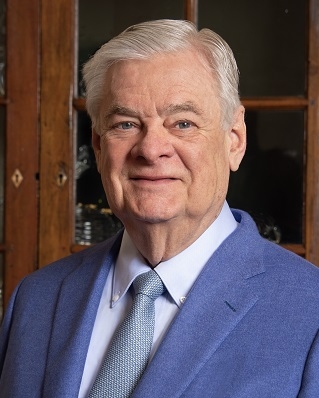
James Dicke II Photo from https://horatioalger.org/

It was during this meeting that Jim made what I considered an iconic statement, which I have repeated for decades now: “Towns are either growing or dying. They can’t stay the same.” I don’t know if this was an original statement, but I’ve not seen it anywhere else. (There is a version of it from Lou Holtz about individuals that I found, but I’ve always attributed the town version to Jim.)

Jim said his vision of Culver was to see Culver Academies become more integrated into the community as Crown Equipment had done with New Bremen. He said he wanted to see the town of Culver thrive, as he thought it was important to the Culver Academies. You can see his fingerprints on this through the move of some Culver Academies administrative offices to the former Mr. T’s Drug Store at 820 Academy Road and to the former Culver Community School’s administration building at 222 North Ohio Street.

John asked the big question, “What would it take for you to invest in Culver like you’ve invested in New Bremen?” Jim responded that obviously he already had, through some of his property purchases and clean-up, but there wasn’t a clear path for Crown Equipment to have a Culver location. He did say he was happy to continue his efforts to involve Culver Academies in the Town of Culver and would support efforts to bring more industry to Culver. But he added the caveat: the town needs to show they are organized, have a plan and are ready for changes.

Our group was pensive on the return trip to Culver. While we felt we had made progress with the things the Chamber of Commerce was doing, Jim had pointed out some community shortfalls, the most obvious being a lack of collaboration. From this discussion, the Culver Second Century Committee was born. Culver Academies was going through their 1994 centennial celebration. The Town of Culver was previously named Marmont and changed its name to Culver in 1885 to honor Henry Harrison Culver, founder of the school. It seemed fitting that our new group reflect change as the Town of Culver entered its second century.

The Culver Second Century Committee (SCC) was created as an offshoot of the Culver Chamber of Commerce (CCC). This allowed SCC to exist under CCC’s 501c(3) status. This also gave the CCC some oversight and responsibility for the group, but allowed other groups to participate without direct CCC membership. There were no membership dues or other impediments to participation. We actively recruited participation from the town government and other civic groups such as the Lions, Kiwanis, Tri Kappa and others. The goal was to start a dialogue and create some synergy between the groups and to have some common projects in lieu of each group raising funds for similar efforts.

The group formed a steering committee consisting of four members. It intentionally recruited a mix of Chamber members and non-Chamber members for the steering committee to reinforce the collaborative goal. I did not serve on the initial steering committee, but did serve for a time after the initial member’s terms expired. The group began having quarterly lunch meetings which resulted in a true collaborative spirit. Town government representatives were involved as well, so we had a wide spectrum.

The first major thing tackled by the group was the Community Needs Assessment and Recommendations conducted by Mary Means & Associates, Inc. out of Alexandria, Virginia. (I believe the Town of Culver has copies of the original document, but I couldn’t find it online to provide a link. I do have a copy if anyone would like me to share it.) The Community Needs Assessment was completed in October of 1997. This was not a deep diving document, but it did gather public input and act as a catalyst for next steps. Even back then housing was an issue mentioned. There was also a recommendation for updates to the Comprehensive Plan and the Zoning Ordinance.

SCC continued to meet and push for changes. The next piece to come out of the Needs Assessment was the Culver Community Charrette lead by Ratio Architects. This resulted in the Culver Community Charrette Handbook presented in November of 1998. Ratio Architects built on and expanded the ideas in the Needs Assessment, defining some of the themes of Culver to expand upon. An example of this was the use of fieldstone throughout Culver, which lead to the Chamber sponsoring the new sign with fieldstone columns at the 10 & 17 entrance to town and the covering of the Lakeshore Drive wall across from the Root Beer Stand with fieldstone. Sand Hill Farm used this theme with the entrance sign on Sand Hill Boulevard. The Paddocks used this theme with the fieldstone facades on the townhomes in their development.

Welcome to Culver Sign at intersection of 10 & 17

After the charrette, Ratio Architects was hired to update the Culver Comprehensive Plan. That version of the plan incorporated many of the themes from the Needs Assessment and the Community Charrette. While this was a Culver Plan Commission project, the Second Century Committee remained involved. But unfortunately, as the ownership of the project transitioned to the town, some of the collaboration and commitment to SCC waned.

Over time, the SCC steering committee became less of a guiding group and started becoming more of an action group. I was no longer part on the steering committee, but still attended the meetings. Unfortunately, in this time frame, the meetings with the larger group ceased and the underlying groups had less stake in SCC. Culver Chamber was going through some transitions as well, so SCC was mostly on its own.

For a while the SCC steering committee was taking on different projects. For example, Dick Brantingham was on the steering committee for years and shepherded the sidewalk program, working to pair residents and/or businesses on the same block with the town’s replacement assistance program in order to maximize the impact. There were other projects like that as well.

In 2011, the SCC made another change in direction as it became part of Indiana Main Street and got rolled into the Visitors Center and/or one of the other organizations. To the best of my knowledge, the Second Century Committee didn’t make it through the first quarter of Culver’s new century and if there are remnants, it no longer functions as intended.

Innovate Indiana Series

Suzanne Jaworowski

Easterday Construction is a member of the Indiana Chamber of Commerce. As such, I was offered the opportunity to share their table at two Innovate Indiana presentations in South Bend. Both featured Suzanne Jaworowski, Indiana Secretary of Energy and Natural Resources, as the key note speaker. The presentation was moderated by Gerry Dick of Inside Indiana Business, so it presented a pro-growth vision for Indiana. This series was one of several done in various regions of Indiana.

There were a few others from Marshall County present, though I only recognized people from Plymouth and Culver. One of them spoke in the morning round-table session and made the comment that they were afraid that our County is becoming the County of “No”. It was a bit disheartening to hear a titter go around the room followed by one of the people from downstate responding something to the effect of, “Oh, we know that well!” Ugh! Not what you want to hear.

That rolled into Ms. Jaworowski’s follow-up comments. These were the key take-aways for me:

  1. Energy production is a priority of the current presidential administration and Indiana wants to step up to this challenge.
    • Indiana is promoting an “all of the above” position on energy. We still have coal-fired plants, but most of them have been upgraded and while not environmentally perfect, they are not the dirty coal plants of yesteryear. We also have productive gas-fired plants that perform well. We are expanding solar and wind energy production and looking into nuclear power. None of these are THE solution, but they can all be complimentary.
  2. Data Centers are critical to the growing AI industry and another priority of the current presidential administration. The President has specifically called out Indiana as a State primed for data center construction.
    • Indiana is a prime location for data centers due to our position within the country and our access to the electrical grid. We also have generally good internet infrastructure. The power solutions listed above add to the attractiveness of our State.
    • Indiana has taken a position requiring data centers to provide projections of their ultimate electrical needs and requires them to provide 80% of the upgrades necessary to provide for those needs. Most utility companies are taking this a step further and requiring them to provide 100% of the upgrades before any power is turned on. Locally, in the case of AEP, they require the data centers to pay the ultimate use bill from day one, before they have ramped up to that need, in order for AEP to guarantee that capacity down the road.
    • Ms. Jaworowski indicated that this should lead to rate reductions for current rate-payers in Counties with data centers. An advantage our County of No will not have.

There was a round table discussion at lunch that talked about the need to be forward thinking and support businesses that support the communities. The role of the Regional Development Authority (RDA) was discussed. The RDA has made great strides, but is still far from the goals it has set for itself.

Absent from these meetings were elected officials from Marshall County. Elected officials from our other regional partner counties where there, which puts us at a disadvantage. Marshall County often seems to be treated like the redheaded step child. The failure of our elected officials to participate won’t help that.

Met another Lurker…

It always comes as a bit of a surprise when I meet a Lurker in real life (IRL): “So, I’ve been meaning to ask, are you the one that writes the Easterday Construction Blog?” Why yes I am!

So few people actually comment, I generally assume I’m talking to myself. This was the second one in the last few months that said they ran across my blog and ended up going down the rabbit hole of Culver commentaries I’ve posted. So far, all of them have been complimentary of my insight and my writing. Since I’m often sitting here banging something out that I have bit my tongue about in some meeting… that’s positive! I think they even used the term “thoughtful analysis” too. That’s flattering and makes sense. That’s often why I don’t say it at the meeting, i.e. I’m more organized in writing and definitely able to put thoughts together better if I have time to let them simmer. For this reason, I don’t think I ever could be a successful politician. It’s not that I can’t think on my feet, it’s more that I have so many thoughts that pulling together a cogent response takes some time. Whatever comes out of my mouth, spur of the moment, probably isn’t the best answer and definitely isn’t properly fleshed out.

It was good to get some feedback and have a back and forth discussion on some things. Culver politics, Esmie, One Marshall County and, of course, The Dunes, where the main topics of conversation. I learned some things from another perspective and shared a few things that I know better than to put in writing! Ha!

Along with this Lurker/new friend, I was talking to some old friends and they were quizzing me about The Dunes. I was a little surprised about some of the misinformation they had. As a follow up, I sent them a couple of blog links. They obviously went down the rabbit hole as well, since they responded back that Culver should hire me for the Czar position. What’s funny about that is I would (and occasionally do) do that for free. But Culver often doesn’t use the resources it has. There are lots of talented and knowledgeable people in the Culver Community that are not residents. I served on the Culver Chamber of Commerce board for years and it was a joke that of the 10 board members at that time, only 3 of them could actually vote in a Town election. The same thing could be said for a large portion of the Chamber membership in those years. Yet we were people with a passion for moving Culver forward. (During that time, the Chamber spearheaded the Charrette, a new Comp Plan and spawned the Second Century Committee.)

Non-resident Culver talent has been called to participate in things like Culver Crossroads and the Comprehensive Plan Committee. These are great uses of that talent and knowledge, but most of those people that stepped up for those one-time committees, are just a phone call away when Culver is looking at the one-off projects too. The one-offs often have large impacts. Sometimes it seems we fall into the fallacy that you have to be located at least an hour away to be an expert. Culver has paid good money to out-of-town consultants, mostly with good results, but they rarely have the whole picture. They are called in for the one-off project without much understanding of how that project will weave into Culver’s tapestry of history, culture and goals for the future.

Winning an election is a form of a popularity contest. The ability to get elected doesn’t make you an expert in all the things you’ll need to make important decisions on as an elected official. But as a politician, you have shown a talent for rallying people. I would suggest that council members put that political talent to work and surround themselves with a cadre of people that fill the gaps in their expertise. If all the council members pooled their individual cadre of human capital resources, their individual advisory committees so to speak, there would be a standing taskforce of diverse talents that could be called on to help the council move Culver forward. But then, I’m mostly talking to myself…

Marshall County Innkeeper’s Tax

The Marshall County Council chose to increase the Innkeeper’s Tax from 3 to 5 percent.  [Pilot News Article]  I’ve had a disagreement with this tax since it first went into effect over a decade ago. 

My first issue is the same as Dr. Watson’s.  (See his letter to the editor here.)  It is taxation without representation.  It was originally passed “because we could” rather than because there was a need.  Now it appears that it has been raised using the same rational.  From the Pilot News Article:  “Woolfington [Convention and Visitors Bureau Executive Director] pointed out that Marshall County was one of just a handful of counties in the state of Indiana that has held the tax at 3 percent. Adjacent counties have raised their tax to the 5 percent level and St. Joseph County is at 6 percent.”  Mr. Woolfington then goes on to talk about our loss of a major hotel chain.  Somehow I doubt that this was because they suffered a decline in business because they weren’t charging enough!  How is raising our tax rate to match surrounding counties going to attract people to stay here?

My second issue with this has always been the Marshall County Visitor’s Guide.  Despite the Innkeeper’s Tax, the first thing the newly formed Visitor’s and Convention Bureau did was to start shaking down local businesses and Chambers of Commerce for ads in their new visitor’s guide.  Currently more than that 10% of the Culver Chamber of Commerce’s annual budget goes toward an ad in this guide.  I was on the Culver Chamber Board when this went into effect and I voted against that budget item and the passing of the budget including that item until I left the board and I continued to vote against it as a Chamber member for several years after.  (I now generally skip that meeting as my meal doesn’t sit well after that vote…)  I considered it then and now a phenomenal waste of precious dollars…dollars requested by a tax funded entity of a volunteer organization.  Dollars which wouldn’t need them if MCCVB was effective in it’s mission!