
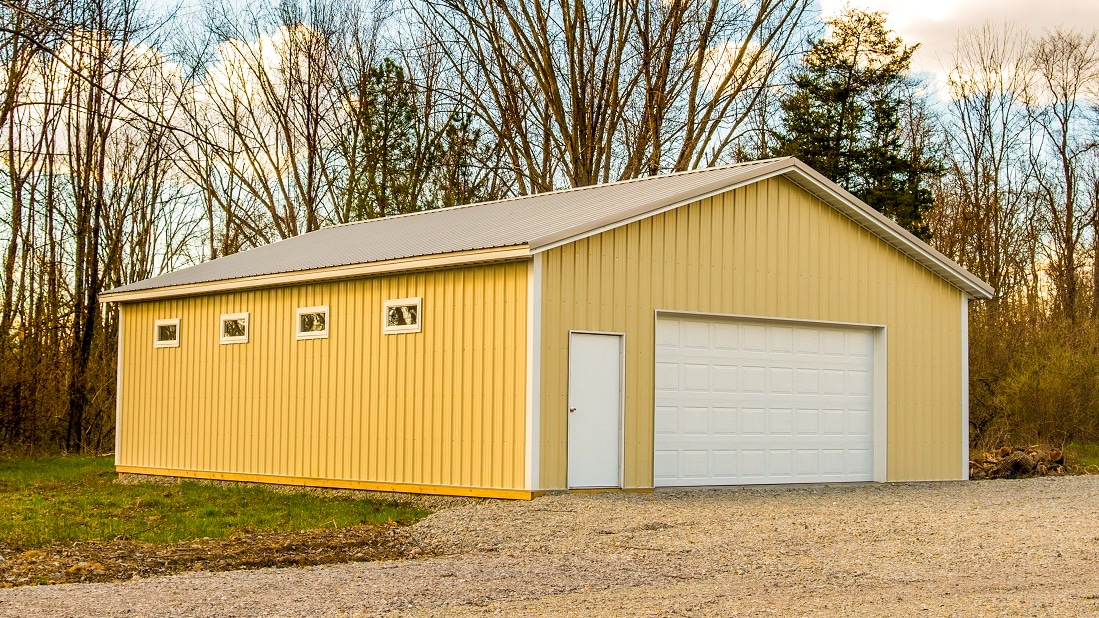
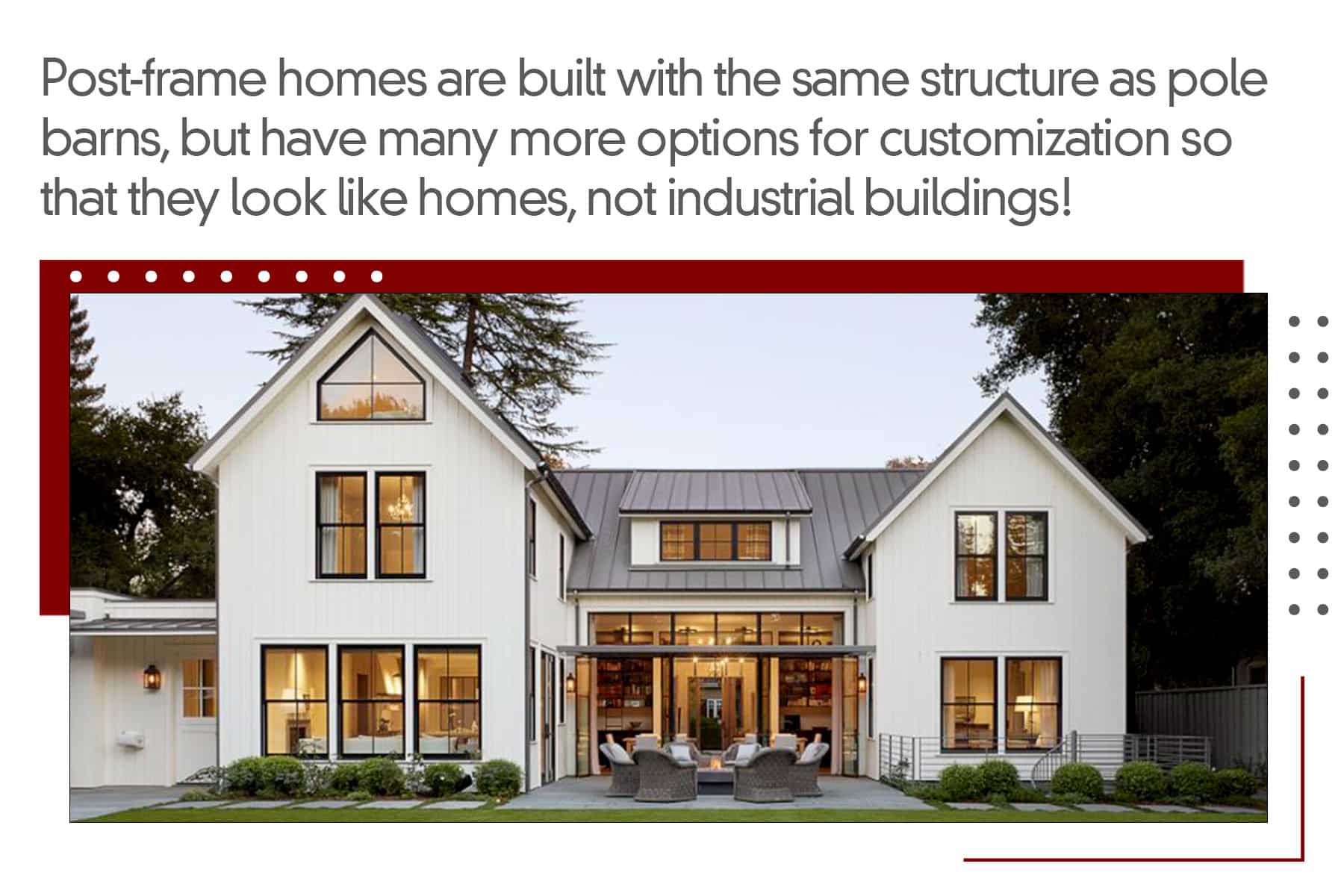
A few years back, there was an effort to ban post frame (also known as timber frame) housing in Plymouth. A similar ban has been floated a few times in Culver and resurfaced at the August Plan Commission meeting. In both cases, the rational has been that the style doesn’t fit the community. As near as I can discern, (and I could be missing something) it doesn’t have much to do with the post frame construction, but more about the look of vertical metal siding, since these homes can be indiscernible from homes built using standard framing.
Post frame construction is most often associated with the “Shade & Shelter” functionality of Pole Buildings. Where post frame barns are designed to protect farm equipment, post frame homes are generally better insulated, stronger structurally, sealed tightly and have a different aesthetic. It’s just a different framing technique that has recently had a resurgence in popularity.
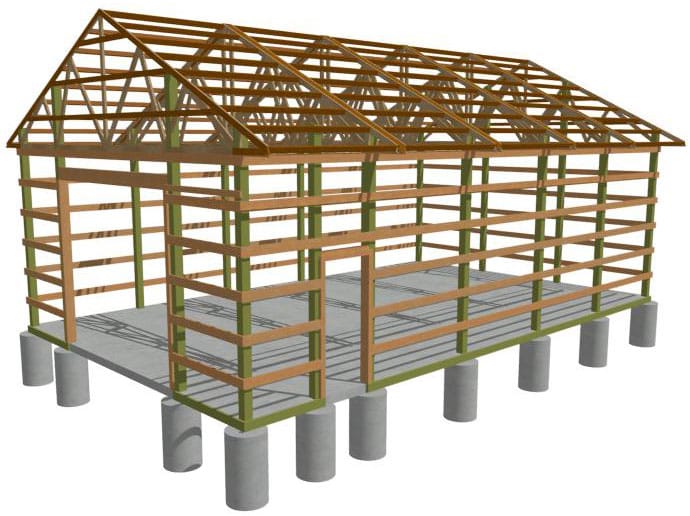
The main difference in this style of construction is the use of posts (poles) to provide the frost protection and uplift protection in lieu of the footings and frost walls used in standard construction. They are nearly always slab-on-grade (SOG) for the first floor. (Many standard construction homes are SOG as well, but standard homes could also have crawl spaces or basements.) Standard construction will use 2×4 or 2×6 studs at 16″ or 24″ on center to form the shell. Post frame buildings have posts spaces as much as 8′ on center with horizontal 2x4s girts to support the siding. Standard construction will have trusses or rafters at 24″ on center, where post frame buildings space out the trusses to bear on the posts and then use 2×4 purlins to support the roofing materials.
For a pole building, the big advantages are the ease and speed of construction. The construction is very forgiving. It is generally a big box to provide the most cubic feet of storage with the minimum of effort. They tend to leak and creak over time, but provide the basic shelter function needed. For a post frame home, there are a lot of enhancements:
- In standard home construction, the frost wall is insulated, in our area, down to 3′ below grade. In post frame home construction, insulation is added under the slab extending 3′ – 6′ from the perimeter to provide a similar thermal break.
- In standard home construction, there is continuous sheathing, generally OSB or plywood spanning the studs and providing the exterior diaphragm framing stiffness. In post frame home construction, this is provided by the wall girts which also support the vertical metal siding. Sheathing would still need to be added if a horizontal finish such as traditional siding or a brick veneer is used.
- In standard home construction, interior wall finishes such as drywall or wood paneling can be applied directly to the studs. In post frame home construction, it will be necessary to add interior girts to provide support for the interior finishes.
- In standard home construction, the wall depth is based on the stud depth, so in general there is a cavity of 5-1/2″, if 2×6 framing is used. Each stud is a thermal transfer point as there is no insulation between the interior and exterior at stud locations. In post frame home construction, the exterior wall thickness is determined by the post thickness (6″ or 8″) plus the 2×4 girt thickness on the interior and exterior, giving a wall cavity of 8-1/2″ or 10-1/2″. Unlike studs that create a thermal transfer from top to bottom, post frame construction reduces the transfer points to just the locations where the girts bypass the posts. This allows for super insulation, more than doubling standard exterior wall R values.
- In standard home construction, the roof framing is generally webbed trusses with OSB or plywood decking to tie things together and provide a substrate for shingles. In post frame home construction, either the trusses need to be moved closer together (generally requiring a collar beam) to allow sheathing on the trusses or the sheathing is installed over the purlins.
- In standard home construction, interior walls are often load-bearing. In post frame home construction, interior walls are non-bearing, allowing doors without headers, allowing standard slab thicknesses and often, greater stud spacing.

While some of these homes embrace the barndominium style, such as the one to the right that even includes a simulation of a silo, they often are hard to distinguish from their neighbors. It’s not the framing that determines the exterior aesthetic, and in many cases you wouldn’t know the framing style if you didn’t see it under construction. Three of the apartment buildings at The Paddocks have a definite barn aesthetic, yet they were stick-built.
Stating that the style doesn’t fit the community seems a particularly curious thing to say about a home in Culver. Culver has a myriad of building styles ranging from traditional to bungalows to A-frames to geodesic domes. Culver has exterior finishes ranging from siding to painted concrete block to limestone to fieldstone. The siding breaks down to various styles including vertical, horizontal and diagonal. We have buildings with vinyl, steel, aluminum and wood siding. Culver is allowing new construction to expand in size to the point that they encourage replatting/combining of small lots to accommodate the larger construction.
Some communities establish aesthetic requirements. Culver doesn’t have these. As it stands, they’re zoning decisions are based mostly on safety. Post frame verses traditional framing is more of an issue for building codes and as of this time it is allowed. Many would object to the use of vibrant colored residential standing seam roofs as not fitting the traditional aesthetic, but nothing has been said about banning those. Personally, I’m fine with the diversity. Culver shouldn’t stoop to the level of a group of Karens. A flock of Karens is known as an HOA. Culver shouldn’t go there. (Neither should Plymouth…)