West High Corner

Whew! There’s a lot going on there! Very little of it good… To orient you, if you’re not local, this is the curve north of Lake Latonka, where S.R. 17 begins to run east towards Plymouth and Sycamore Road continues north towards S.R. 30.

Property at SE Corner of West High Intersection highlighted in cyan.

So I don’t bury the lead, the initial reason for writing this was a John Oliver style, “Why is this Still a thing?” rant. I came around this corner from the East the other morning on the way to work, in the dark, to find a school bus stopped to pick up kids from the house on the inside of the curve on the SE corner of this intersection. It wasn’t very visible to me until I was almost on it and it would have been worse for someone coming from the South. The best case for this is this time of year when it’s dark and the bus’s flashing lights are reflecting off of everything. At twilight, the danger doubles down.

This property just recently changed hands. I know things get grandfathered in. I know it’s cold out and kids don’t want to walk far, so the closest point to the house is the preference. But there is a significant piece of property here with an alternate driveway. Barring getting rid of this dangerous driveway, can’t the school bus pick up at the alternate driveway off the curve?

West High Fireman’s Memorial at Night

This intersection has always been dangerous. The memorial at the northwest corner of the intersection commemorates the 5 fire fighters that gave their lives at that intersection in 1982. The truck they were in took the corner too quickly and went into the swamp on the west side of the road. This was the worst single-event loss of life for a single fire fighting unit prior to the 9/11 terror attack. The permanent stone memorial included lighted flags and was dedicated in 2014 It replaced 5 wooden crosses on a utility pole near the crash site. It is somewhat fitting that this memorial is quite striking, yet somewhat eerie when lit up at night.

West High before it’s 2023 demolition.

It will be interesting to see how long the West High Corner moniker remains in use since the referenced school is gone. The Northeast corner of the intersection was home to the West High School, named for West Township. Many people were sad to see the school go away this past year. I have to agree that it was frustrating that it couldn’t be repurposed, but location is everything and is often the case with structures like that, its highest and best use was as a school. I could not find documentation, but my recollection is that the school corporation sold it at auction for $1,500 in 2005. From there, the buyer stripped most of the things of value from the building. It became a door and trim shop after that. The Covid pandemic ended that. Most recently it was purchased by Jackson Salvage, which made it go away… except for the slabs and foundations. All that remains is a memorial with a bell and well along Sycamore Road to commemorate the school’s previous glory.
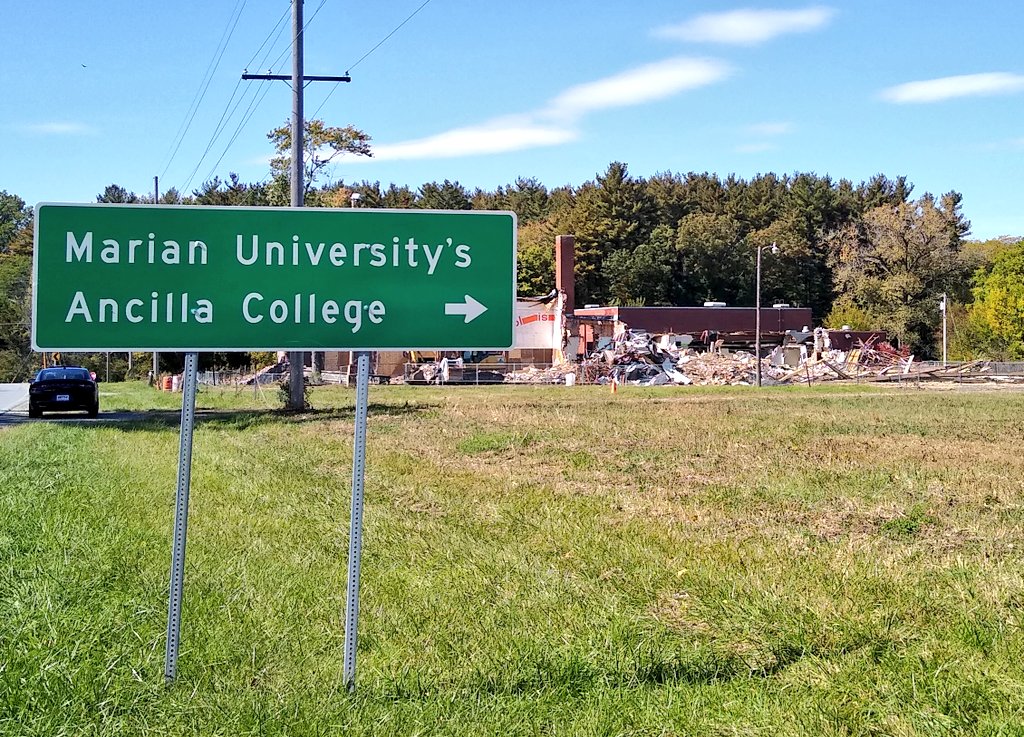
Am I the only one that found the juxtaposition of this crooked MUAC sign pointing at the partially demolished West High building amusing? This sign went up as the building was coming down…
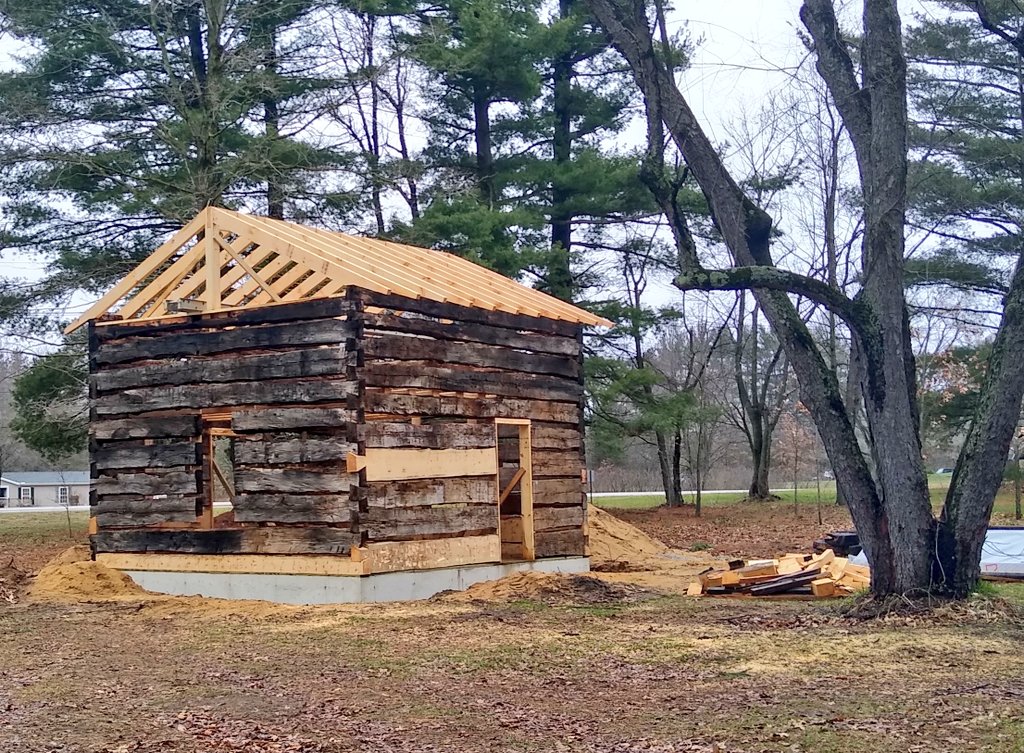
Historic West Township Trustee’s Cabin

The property on the southeast corner referenced at the beginning of this post was the former location of the original West Township Trustee’s home; a log cabin that was just recently relocated south to Memorial Forest. The picture to the right shows the cabin during reconstruction as new roof framing was placed. The recently formed Marshall County Parks and Recreation Department tried to have it relocated onto the West High site, but there weren’t sufficient funds to make the deal possible.

As attested to by the lost fire brigade, the West High Corner is to be respected. The two exits/entrances onto S.R. 17 from Sycamore Road are also treacherous. From experience, the southernmost connection is the most dangerous and least respected as I often see cars exit or come onto S.R. 17 without stopping. West bound cars cannot see that intersection until they’re into the curve, so if they are taking it quickly, there’s often near misses. In icy winter conditions, this is even worse.

Culver Chamber proposal to extend SR 17 north along Sycamore Rd with a gentle curves to align with Rose Rd

In the mid-1990’s, the Culver Chamber of Commerce petitioned the Marshall County Commissioners to improve Sycamore Road to give Culver more direct access to S.R. 30. For a time, this was a collaborative effort between the Town of Culver, Ancilla College (now Marian College), Culver Academies and Swan Lake Resort. One option for this was to attempt a trade-off with INDOT, changing Sycamore Road into the north end of S.R. 17 and the east/west portion from West High to Plymouth would have become a county road again. This would have had many benefits including an intersection fix at West High, an improved route to S.R. 30 from Culver, fewer driveway accesses, and an easy aerial railroad crossing. At the time, Marshall County had already broached INDOT through MACOG about the Pine Road extension. And also at that time, Plymouth didn’t want to give up the benefits of INDOT maintenance on the main street through the City. (Plymouth is having second thoughts now as their Complete Streets Committee wrestles with the pedestrian issues associated with this.) With the completion of the Pine Road extension to S.R. 17, this initiative is unlikely to be considered. Some of the property that was vacant has been developed, further hindering this right-of-way acquisition.

I don’t see a good solution to this intersection in the near future. At a minimum, I would still like to see something done to eliminate the school bus stop in the middle of a State Highway curve. This intersection doesn’t need another memorial…

Crosswalks

At the Culver Town Council meeting this Tuesday, Don Fox made a presentation on Make My Move. It’s an interesting pilot program to encourage full-time remote workers to relocate to Indiana. Culver is a participant in the pilot program and already has someone interested.

Crossing sign on Lake Shore Drive at the Beach Lodge

Later, under public input, Don again spoke. He first commended the Council for their wisdom for installing the crosswalk markers in the middle of Lake Shore Drive at the Beach Lodge, Osborn’s Mini Mart and The Lakehouse Grille. He then requested they consider adding these at State Street, Washington Street and Madison Street.

It was quickly pointed out that the crossing at State Street was included in the original sign placement, but it quickly became apparent that it interfered with the ingress/egress of fire trucks at the fire station. Someone in the audience extrapolated this to be a problem if a sign was installed at the Madison Street crossing due to the narrowing of the street in this area created with the landscape/traffic islands. This also devolved into a conversation about whether this would require a sign ordinance reference or if it was exempt since it was State Law. At that point it was tabled until the next meeting.

Shark Teeth at the Intersection of Harrison Street and Center Street in Plymouth

Culver’s traffic is not unique, but it is often comprised of a mix of locals that know the area and visitors, both motorists and pedestrians, that are not as familiar with the area. One suggestion I would put forward in lieu of the center-of-the-road signs is to use Shark Teeth as an added reminder. (See left) They serve two purposes: 1) Providing a visual cue that there is a crosswalk and 2) Providing a visual cue for where to stop when there is a pedestrian in the intersection.

Nothing is free, so even though it’s just paint, there would be some cost for installation and maintenance. These will not work for snow covered roads, but at that point, you can’t see the crosswalk either! Also, the Town only has the the yellow center-of-the-road signs up Spring through Fall, since they would be destroyed by snow plows in the winter. To the best of my knowledge, Shark Teeth have not been used within the Town of Culver, but they were installed by INDOT on S.R. 10 at the crossings to the Academies sports fields. Unfortunately those are currently an example of what they look like when they aren’t maintained…

The ones in the picture above are from Plymouth, IN and I believe they are on one of their Safe Routes to School. I will say that when I first ran across them, I slowed to try and figure out what they were, but had to look it up later to actually know. I’ve also been behind people in Culver that have seen the little yield sign on the center-of-the-road signs and stopped… even though there were no pedestrians anywhere near the crosswalk… Education is an important component of any plan. But just some slowing and extra attention is the point, isn’t it?

I’m sure there will be other ideas, but this seems to be an economical and efficient solution.

Comprehensive Plan Vision

I am currently serving on committees in Plymouth and Culver working on new Comprehensive Plans (or Com Plans). These documents are governed by State statute, but leave some flexibility to the communities. Sometimes the term “dream” is used with these documents, as in, “What would be your dream use for this area.” or “Dream Big!”. That leans much more towards fantasy for my liking. My preferred term is “Vision”. The heart of the Comp Plan are the land use maps… the “plan” part of the Comp Plan. It’s a visual tool detailing what the community would like to see and where that is.

There are several stumbling blocks for most people in this process. The first is that Comp Plans usually have a life of 5-10 years. (Plymouth’s last Comp Plan was completed in 2013 and Culver’s was completed in 2014.) People can become fixated on that short time horizon. While the Comp Plan should be revisited and updated every 5-10 years, the plan should be for 25-50 years, as theoretically the community continues on in perpetuity. This makes the 5-10 year update more of a tweak, removing things from the previous to-do list that have been completed and to adjust the overall plan for new trends that have developed. The Vision should be longer.

The second hang-up is a struggle to look past what’s there now and who owns that property. Most people look at a parcel of land and say, “I know that landowner and they would never go for that.” But… this is where they need to be thinking farther into the future than the 5-10 year life of the Comp Plan. The municipality will be here 25, 50 & 100 years from now. Will that landowner? Will that building still be viable? Will that street be there? The Vision should be longer.

The third major hang-up is separating the Comp Plan from the Zoning Ordinance. The Comp Plan lays out what the community would like to see. The Zoning Ordinance lays out what is allowed. There can and should be a difference. This is where a zoning hierarchy would be useful. In a discussion in a Culver meeting last week, we discussed the current Comp Plan’s direction for Main Street between Washington Street and Lake Shore Drive to be future Commercial. We discussed extending that to Lake Shore Drive between Main Street and State Street. This brought up discussion of the recent rezoning of a house on Main Street from Commercial to Residential. (Rezoning of 303 North Main Street discussed here.) The rezoning of 415 Lake Shore Drive was discussed as well. I look at these differently. While I have no problem with the reversion of 303 back to a home, there should have been a way to make that accommodation under the commercial zoning, leaving the long term vision in place. I would say the same accommodation should have been made for 415. While the new construction at 415 will theoretically be there longer, the townhouses planned are denser development and a reasonable intermediate step between single family residential and commercial. The strict district designations need to be softened to allow more mixed development. Furthermore, townhouses mixed in with commercial spaces are a reasonable long term plan in a walkable community.

For my Lurkers, this is not the first time I’ve pushed the Vision idea. I really thought Culver missed the boat not redoing their Comp Plan in 2020 and calling it 20/20 Vision. The whole pesky pandemic thing kind of got in the way, not to mention the Town Manager at that time had Stellar Fatigue and despite the Stellar Communities SAP accomplishing much of what was in the 2014 Comp Plan, he didn’t want to create new goals that he would be charged with achieving. Ha!

As with most of these things, there will be more to come. I’m pleased with Culver and Plymouth putting forth the effort and while I was hesitant about them at first, I’m pleased with MACOG‘s administration of the planning. (Thanks Donny!) Everybody work on their Vision. Do your best to envision what’s over the horizon, not just what can be seen today.

Extraterritorial Boundaries

I’m currently sitting on committees forming new comprehensive plans for Plymouth and Culver. I’ve been pushing Culver to do a new Comp Plan since 2020. (See post here) Wouldn’t ‘2020 Vision for Culver’ been a good name!?! But I think they had some Stellar fatigue followed by pandemic malaise…

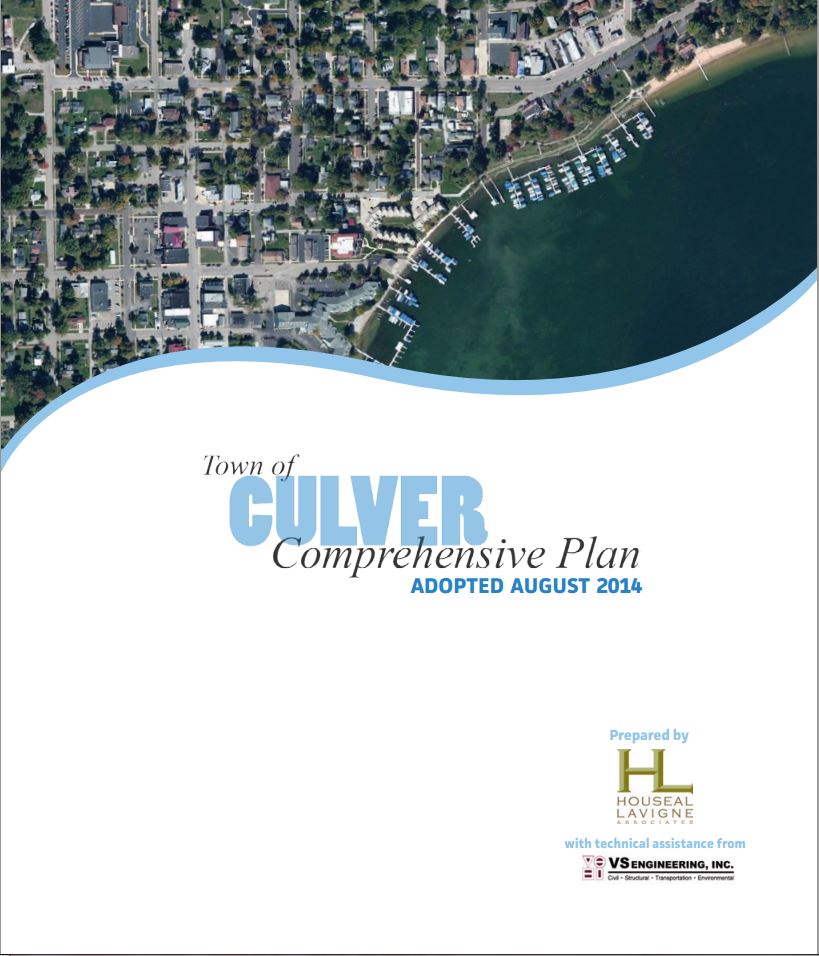
Houseal Lavigne Comp Plan for Culver

This will be the third time I’ve done this for Culver and the second time for Plymouth. MACOG has started offering this as a (paid) service and is leading these meetings for both communities. Ratio Architects did the previous one for Plymouth and an earlier one for Culver. The last one for Culver was completed by Houseal Lavigne.

What have I learned from these experiences? You’re buying a template. They all have strived to “personalize” the product, but lined up on a table without the credits, it would be pretty easy to group them by consultant. The format would give it a way.

But to paraphrase Arlo Guthrie in Alice’s RestaurantBut that’s not what I came to tell you about. I came to talk about… Extraterritorial Boundaries.

If you follow that link, you’ll see that the Indiana legislators are constantly messing with the definition and powers granted to municipalities for their extraterritorial jurisdiction. The core premise is that municipalities are allowed to extend their zoning boundaries to cover areas of potential future municipal expansion. This is done with the consent of the County. It has generally been a 2 mile zone. The distance is increased when there is a lake involved, i.e. in the case of Culver, the south end of Lake Maxinkuckee is more than 2 miles from town, but is included in Culver’s Zoning Jurisdiction. This is not annexation. It doesn’t change tax rates. It doesn’t include water, sewer or road extensions. It just brings those areas under the municipality’s land planning jurisdiction and provides some control over how it is developed. In most cases, any development of significance would need municipal connections and most other developments will feel minimum impact. It’s a good way for the municipality to keep track of what’s happening around them and how it will affect them.

Culver’s Zoning Boundary – 2013
The pink area shows the current extended authority. The loop outside that shows the approximate limits if the Two Mile area was granted.

I have pushed several times for Culver to expand their Extraterritorial Jurisdiction to the limits allowed by the State. This is just good planning practice. I have an extended post about it from February 14, 2013 here. The drawing to the right is from that post. It shows where Culver’s Extraterritorial jurisdiction should have been then. That was before the annexation of The Paddocks PUD on the west side of town, the Beste annexation on the west and north side of town and the upcoming annexation on the south side of the Masonic Cemetery. All of those would extend the potential jurisdiction to the south, west and north. (The main effect would be on the north side since in the drawing we’re already running into to edge of county boundaries and the chances of Starke or Pulaski counties granting Culver jurisdiction are slim.)

Culver Zoning Boundary – 2023

The other change from the map above is that the current boundary became much more jagged after that. Sometime around 8 years ago, Culver chose to partner with the County on permitting, using their system. Unfortunately their system is quite crude and couldn’t handle parcels that had split zoning. This ended up in some negotiations which moved split parcels in and out of Culver’s jurisdiction based on the percentage that was in Culver’s jurisdiction at the time. At that time I argued strenuously that all the partial parcels should be brought under Culver’s jurisdiction since they were all fully within the allowable extraterritorial jurisdiction, but the Marshall County Plan Director and Marshall County Building Inspector pushed back on this, not wanting to give up County control. This was a huge missed opportunity, but it’s water under the bridge now.

Plymouth Zoning Boundary – 2023

I have been told that Plymouth’s Extraterritorial Boundary does take in all of the allowed jurisdiction. Looking at the drawing to the right, this is mostly correct, but not 100%. This is most obviously an issue in the industrial area on the NW side of Plymouth.

The Comprehensive Planning process will not change this, but I would suggest that the new Comp Plans include strong recommendations to expand the boundaries. That is a first step. This is not so much a power grab. It’s not about control. It’s more about knowledge and PLANNING. Both communities should look at Bremen and their struggles, where they’ve allowed their industrial area to become landlocked. This is an easy, local example of why planning outside the immediate boundaries of the community are important.

Marshall County Sewer District Areas of Concern

Currently, there are new things going on which should be part of this extraterritorial planning. One of these, which is of huge significance, is the County’s pursuit of expanded sewer districts. In Culver, it is likely that the town would be asked to take in sewer for Burr Oak and Hibbard. The push for inclusion of lakes means it is likely that Plymouth may be asked to take in all of the chain of lakes all the way to Lake Latonka. If these areas start to become municipal “customers”, then their future development becomes the concern of those municipalities. Look at the trend towards bigger and bigger houses around Lake Maxinkuckee and Pretty Lake. Sewer access will make this likely with the other lakes as well Many of them have lots that are currently unbuildable, but with sewer, that will change.

Marshall County Chain of Lakes

There is also a concern with allocation of resources. The County is struggling to hire and struggling to provide coverage. In the Culver area, a potential solution for both entities would be to expand Culver’s zoning jurisdiction to the County lines to the south and west of Culver. This would eliminate the small fringe area of county zoning around Culver and it would help Culver with planning control.

While Burr Oak and Hibbard aren’t exactly booming communities, sewer access could change this. Again, bringing this under Culver’s zoning control would help the town anticipate and plan for any growth. Sewer access could well spawn growth in Burr Oak. As mentioned in my article, the proximity to major electric service from the Burr Oak substation and access to an significant railroad line could be the catalyst for growth if sewer were available.

I don’t see much in the way of downside to this expansion. I know some in the AG area don’t want this oversight, but in reality, the municipal zoning has been changed so that the AG designation for the municipalities reasonably mimics the AG designation in the County. The municipal plan commissions have a county appointed member so there is representation. This is not to say that the municipalities don’t occasionally over step, as they did with the WECS rules, but even with those, the county eventually came pretty much in line with the same rules.

I will continue to advocate for expanding the Extraterritorial Jurisdiction of Plymouth and Culver as I serve on these committees. I think this is appropriate and necessary planning. It should be positive for all involved.

Audiologist’s Husband Rant

Rebecca L. Berger, AuD (Dr. Becky)
Doctor of Audiology

Just felt like venting a bit on Becky’s behalf. Becky has always loved helping people with their hearing. Her initial degree was in Deaf Education with a minor in Audiology from Ball State University. After several years of teaching, she found that it wasn’t right for her. She loved helping the children, but the administration and bureaucracy was too much. At that point we were living in Georgia. (Did you know that most teachers prepare a lesson plan for their class, while teachers of special needs students, such as deaf students, are required to fill out IEP‘s for each individual student?) We discussed it and she ended up quitting teaching and going to the University of Georgia and getting a Masters Degree in Audiology. Shortly after that we moved back to Indiana and she began practicing Audiology with a group of Doctors. While working with them, she went back to school again, obtaining her Doctorate in Audiology. She studied and understands the theory behind hearing aid technology and the anatomical parts of the ear, how they interact with the brain and how they all are affected by hearing loss.

With all Becky’s education came additional responsibility. As a Doctor of Audiology, she is under different regulations than hearing aid dispensers. She is governed by HIPAA regulations, Medicaid & Medicare regulations and other requirements; things dispensers don’t have to follow.( To be a hearing aid dispenser, there is a test you must pass with the State, but the minimum education is a GED, not a degree, let alone a Doctorate degree.)

The Doctors Becky worked for retired and she decided to go on her own. That was in 2015 when she started Berger Audiology. Less money, but more autonomy and more time to help patients. She invested in the latest technology. She is now the only full time Audiologist in Marshall County. She operates a satellite office in Winamac. But she struggles with the competition. She wrote a 2019 blog post about it here.

Since that time, things have progressively gotten worse. The government has been slowly chipping away at what differentiates an Audiology from a dispenser. On top of that, they are pushing a trend towards Over-The-Counter (OTC) hearing aide sales or even worse, over the internet. You’ve probably seen the ads by Lively which advertise a telephone consultation with an audiologist or worse, My Power Ear, which cites “no need to see an Audiologist” as a positive selling point. She’s seen patients that have bought hearing aids from big box stores, having been sold that they were getting “the latest technology”. In some cases that has turned out to be a generation or two old. Honestly she’s a bit depressed and upset every time one of those ads.

We’re all thrilled with the convenience of the internet and the ability to buy nearly anything you want from Amazon. But is this what we want for healthcare providers? Telemedicine may work for some things like getting a prescription refilled, but does it really replace hands on care? Or in the case of Becky, an Audiologist, how is a phone conversation prescribing a hearing aid equal to her, a trained professional, doing a complete physical examination and doing a hearing test in a calibrated sound booth, using the latest technology? Can they look in your ear an determine that your hearing loss is actually due to wax? Or that the type of hearing loss indicates that you need to see an ENT because there’s the potential for serious issues where hearing loss is just a symptom? Food for thought… or just my rant…