At the last One Marshall County meeting, in the introductions, we were asked to give one “Fun Fact” about ourselves. I generally hate these things and default to the Christian Easterday story. For some reason that didn’t seem appropriate to this group. I had some time to think about it and decided on this:
I was a general contractor until Culver was having trouble finding an affordable housing/workforce housing developer and I stepped up to fulfill that role. So far I have created 120 housing units in Marshall County with another 14 planned for this year… so I guess I’m a developer!
Honestly, I hadn’t thought about that and it sunk in a bit when I said it. I’ve created 120 homes in Marshall County in the last 7 years! Mayor Listenberger said, you might as well embrace it, you’re a developer. So… I guess I am!
Whew! There’s a lot going on there! Very little of it good… To orient you, if you’re not local, this is the curve north of Lake Latonka, where S.R. 17 begins to run east towards Plymouth and Sycamore Road continues north towards S.R. 30.
Property at SE Corner of West High Intersection highlighted in cyan.
So I don’t bury the lead, the initial reason for writing this was a John Oliver style, “Why is this Still a thing?” rant. I came around this corner from the East the other morning on the way to work, in the dark, to find a school bus stopped to pick up kids from the house on the inside of the curve on the SE corner of this intersection. It wasn’t very visible to me until I was almost on it and it would have been worse for someone coming from the South. The best case for this is this time of year when it’s dark and the bus’s flashing lights are reflecting off of everything. At twilight, the danger doubles down.
This property just recently changed hands. I know things get grandfathered in. I know it’s cold out and kids don’t want to walk far, so the closest point to the house is the preference. But there is a significant piece of property here with an alternate driveway. Barring getting rid of this dangerous driveway, can’t the school bus pick up at the alternate driveway off the curve?
West High Fireman’s Memorial at Night
This intersection has always been dangerous. The memorial at the northwest corner of the intersection commemorates the 5 fire fighters that gave their lives at that intersection in 1982. The truck they were in took the corner too quickly and went into the swamp on the west side of the road. This was the worst single-event loss of life for a single fire fighting unit prior to the 9/11 terror attack. The permanent stone memorial included lighted flags and was dedicated in 2014 It replaced 5 wooden crosses on a utility pole near the crash site. It is somewhat fitting that this memorial is quite striking, yet somewhat eerie when lit up at night.
West High before it’s 2023 demolition.
It will be interesting to see how long the West High Corner moniker remains in use since the referenced school is gone. The Northeast corner of the intersection was home to the West High School, named for West Township. Many people were sad to see the school go away this past year. I have to agree that it was frustrating that it couldn’t be repurposed, but location is everything and is often the case with structures like that, its highest and best use was as a school. I could not find documentation, but my recollection is that the school corporation sold it at auction for $1,500 in 2005. From there, the buyer stripped most of the things of value from the building. It became a door and trim shop after that. The Covid pandemic ended that. Most recently it was purchased by Jackson Salvage, which made it go away… except for the slabs and foundations. All that remains is a memorial with a bell and well along Sycamore Road to commemorate the school’s previous glory.
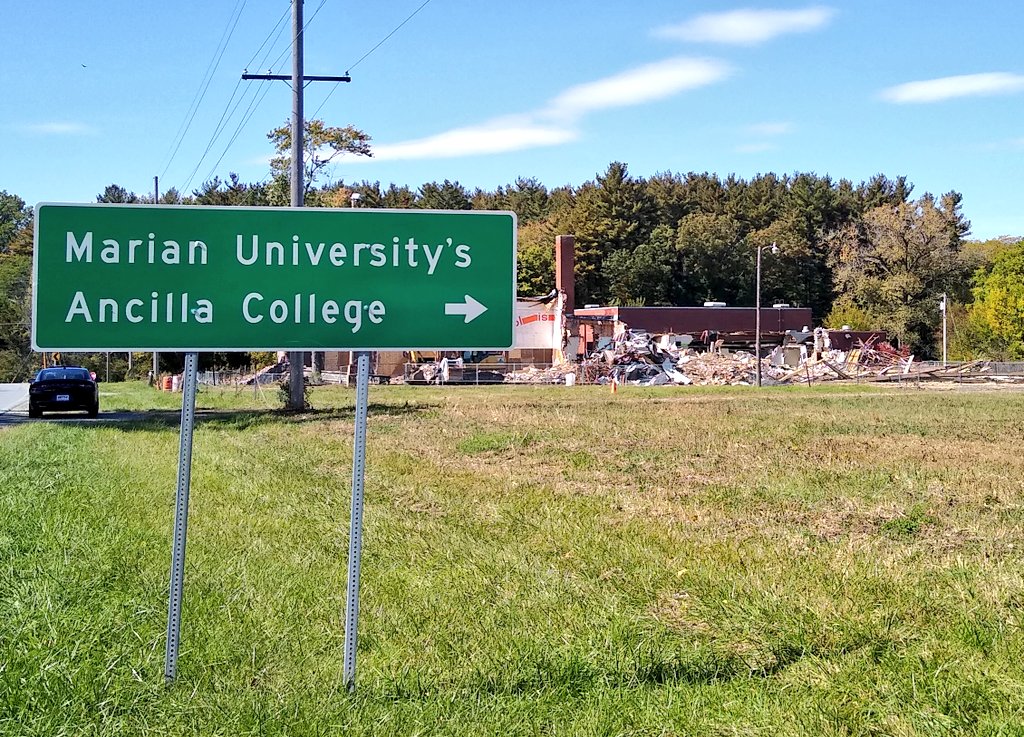
Am I the only one that found the juxtaposition of this crooked MUAC sign pointing at the partially demolished West High building amusing? This sign went up as the building was coming down…
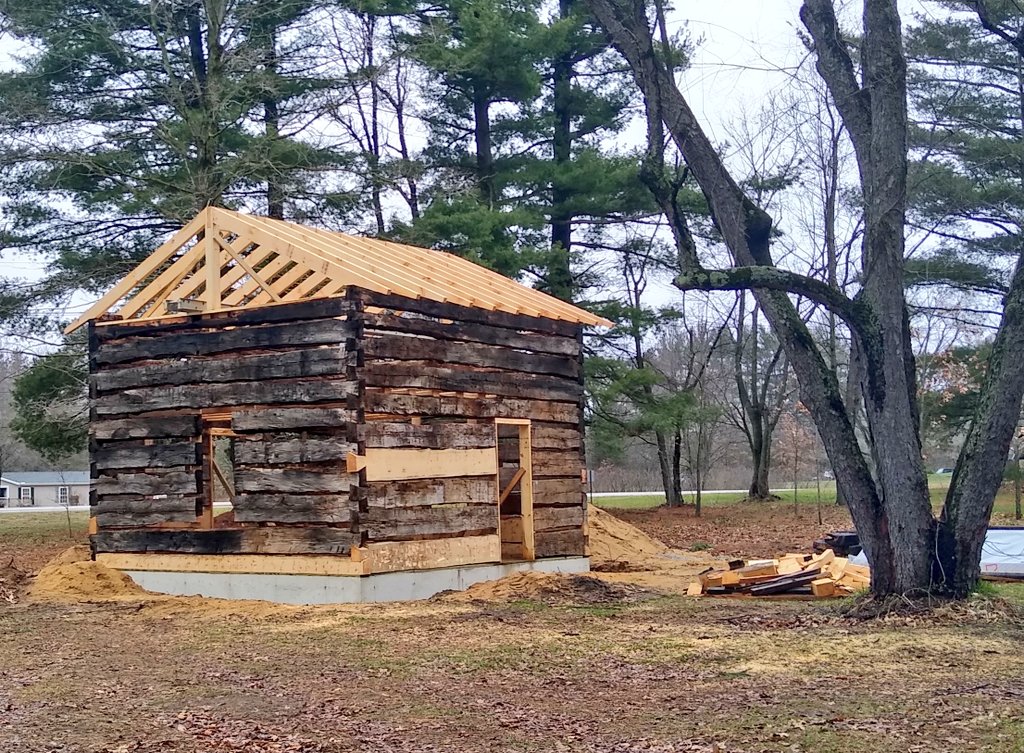
Historic West Township Trustee’s Cabin
The property on the southeast corner referenced at the beginning of this post was the former location of the original West Township Trustee’s home; a log cabin that was just recently relocated south to Memorial Forest. The picture to the right shows the cabin during reconstruction as new roof framing was placed. The recently formed Marshall County ParksandRecreation Department tried to have it relocated onto the West High site, but there weren’t sufficient funds to make the deal possible.
As attested to by the lost fire brigade, the West High Corner is to be respected. The two exits/entrances onto S.R. 17 from Sycamore Road are also treacherous. From experience, the southernmost connection is the most dangerous and least respected as I often see cars exit or come onto S.R. 17 without stopping. West bound cars cannot see that intersection until they’re into the curve, so if they are taking it quickly, there’s often near misses. In icy winter conditions, this is even worse.
Culver Chamber proposal to extend SR 17 north along Sycamore Rd with a gentle curves to align with Rose Rd
In the mid-1990’s, the Culver Chamber of Commerce petitioned the Marshall County Commissioners to improve Sycamore Road to give Culver more direct access to S.R. 30. For a time, this was a collaborative effort between the Town of Culver, Ancilla College (now Marian College), Culver Academies and Swan Lake Resort. One option for this was to attempt a trade-off with INDOT, changing Sycamore Road into the north end of S.R. 17 and the east/west portion from West High to Plymouth would have become a county road again. This would have had many benefits including an intersection fix at West High, an improved route to S.R. 30 from Culver, fewer driveway accesses, and an easy aerial railroad crossing. At the time, Marshall County had already broached INDOT through MACOG about the Pine Road extension. And also at that time, Plymouth didn’t want to give up the benefits of INDOT maintenance on the main street through the City. (Plymouth is having second thoughts now as their Complete Streets Committee wrestles with the pedestrian issues associated with this.) With the completion of the Pine Road extension to S.R. 17, this initiative is unlikely to be considered. Some of the property that was vacant has been developed, further hindering this right-of-way acquisition.
I don’t see a good solution to this intersection in the near future. At a minimum, I would still like to see something done to eliminate the school bus stop in the middle of a State Highway curve. This intersection doesn’t need another memorial…
At the December meeting of the Culver Redevelopment Commission (CRC), Linda Yoder, Executive Director for the Marshall County Community Foundation (MCCF), made a presentation on One Marshall County. One Marshall County is the new umbrella organization that Marshall County Economic Development Corp (MCEDC) has spearheaded. Linda and I serve on the collaborative council discussing this new initiative and Linda had volunteered to make the presentation of the need for One Marshall County before the CRC. This also included a request for funding.
There were a few math errors in the presentation, but one of these jumped out at me was during the discussion of Stellar and the investment that Marshall County Crossroads brought to local communities. The numbers quite clearly did not include the investment from tax credits provided by IHCDA. The Low Income Housing Tax Credits (LIHTC) provided by IHCDA amounted to the biggest single project investment from any of the State agencies involved in Stellar. In all, through the tax credits and loans, Plymouth and LaPaz shared $14 million dollars of investment in their communities with Riverside Commons. That investment didn’t show up in the presentation numbers. This is no shade on Linda! She didn’t prepare the numbers…
The Paddocks in Culver
This isn’t the first time for this. Culver received approximately $10 million in tax credits and loans for The Paddocks, but that number rarely shows up in their Stellar discussions. These would be huge contributors to the ROI discussion, since local investment in these projects was largely limited to in-kind waivers and some inhouse work. (Culver contributed nothing to The Paddocks project. Plymouth gave waivers on improvements to surrounding alleys. LaPaz waived sewer tap fees and secured matching INDOT funding to improve the street serving the project.)
Riverside Commons Plymouth
I think there are a couple of reasons for this lack of acknowledgment: 1) The Stellar Committees don’t really understand the program and 2) Unlike many of the project which were directly municipal projects, i.e. parks, trails, etc., that required more active involvement, the LIHTC portion of Stellar is directly administered by the project developer, so there isn’t a pass-through of dollars. The LIHTC award creates a private project. Where there was some shifting of dollars amongst the other municipal projects within the Stellar awards, that was not an option with LIHTC.
Riverside Commons – LaPaz, d.b.a. LaPaz Commons
Despite the success of The Paddocks in Culver’s Stellar Community program, Marshall County didn’t even include a LIHTC request in their first application for Stellar Region. I had lobbied for its inclusion and felt that the group slighted IHCDA by not accepting their offer. I lobbied a little harder in their second attempt and Riverside Commons was included in that application, which was successful. This was probably not the only reason, but I firmly believe it contributed to the success of the second application.
There have been some complaints about The Paddocks, but The Paddocks has met or exceeded all of the metrics set forth for it. The same can be said for Sand Hill Farm Apartments, the precursor project that made Culver Stellar and The Paddocks possible. It’s too soon to document that for Riverside Commons, which has different goals, but I have no reason to believe the results will be different. As far as community acknowledgement, the LaPaz and Plymouth councils have done a great job of recognizing Riverside Commons. They each have a Stellar agenda item on their council agendas and request updates for each meeting. Culver did not include The Paddocks in their Stellar reports to the council.
I think it’s a missed opportunity when the LIHTC investment is not celebrated and included in the ROI… But then, I’m obviously biased!
I attended the introductory meeting on READI 2.0 presented by South Bend – Elkhart Regional Partnership (SEBERP) at the Rees Theater yesterday. Honestly, attendance was pretty poor, but there was some good information. READI 2.0 is a refined repeat of the original READI (1.0) program which was a refined repeat of the Regional Cities Initiative. In various forms, these programs have been designed to incentivize municipal and private investment in statewide goals. As with the past programs, READI 2.0 offers the carrot of up to 20% project investment matched by 20% local government investment and 60% private investment. Whether the entire 20% is granted depends on the quality of the project, its merit for meeting goals and its ranking among other submissions.
Sand Hill Farm Apartments
Sand Hill Farm Apartments was awarded Regional Cities Initiative (RCI) dollars. Those funds, though only 7% of the project cost, provided some incentive to move the project forward when Culver‘s first Stellar application was unsuccessful. The project was initially to be the LIHTC portion of Culver’s Stellar application. When that wasn’t successful, the RCI funds helped make the project viable as market rate housing. Moving this project forward has been noted as instrumental in Culver’s success with their second Stellar application. Unfortunately, Culver did not follow through on their commitment, so some of those funds never were disbursed by RCI and those that were got redirected to reimbursements in lieu of benefiting the project.
Water Street Townhomes
Culver Sand Hill Farm was awarded READI 1.0 dollars for Water Street Townhomes. This is a mixed use building with 11 two-bedroom townhouses, 2 one-bedroom apartments and a corner commercial space. We are still working with the City of Plymouth to create the structure to put those dollars to work. SEBERP awarded less than the initial request, but Plymouth is following through with their entire match in order to make this project possible.
Culver Sand Hill Farm also submitted a townhouse project for Culver, Spirit Townhomes, which was named in the READI 1.0 Strategic Investment Plan. Unfortunately, after the fact, Culver chose to partner with a different developer on the much larger and more controversial project, The Dunes. (Discussed here.) C’est la vie! Sometimes you reap what you sow.
SBERP will be putting in an application for READI 2.0 funds for our region after the first of the year. Yesterday’s meeting was one of several where they are soliciting input on what goals of the SEBERP region fit within the stated READI 2.0 goals. This will help them refine their application. They feel confident that their track record managing the Regional Cities Initiative and READI 1.0 funds put them in a good position to receive the maximum award from READI 2.0. The handout to the right was provided at the meeting, showing some of the impact these investments have had. $878 Million in project investment through those two programs, which is 9.5 times the investment from the State. (See the backside of the flyer here.)
There is a rural component to READI 2.0, directing that 25% should go to rural areas. Of the three counties in SBERP (St. Joseph, Elkhart and Marshall), only Marshall County is designated at rural. That doesn’t mean that Marshall County doesn’t have to have competitive projects, but it gives a 25% set-aside leg up. L:ast time, READI 1.0 projects were rewarded on population, which put Marshall County at a disadvantage.
One of the interesting changes in the program is the option for receiving a loan in lieu of a grant from the program. The funds could be loaned out at a reduced interest rate, with the funds paid back to SBERP for future reinvestment in the region. While the concept is a good one, the implementation appears to be flawed, from my perspective. As it currently stands, the loan would be capped at the same 20% level as the grants. While both a grant and a loan could be awarded, they cannot total more than 20% of the project. I will need to hear more about this, but my initial impression is that there is not much incentive to take the loan in lieu of the grant, but I may be missing nuances here. It would make some sense to see loan amounts allowed to be larger percentages since the money will be recirculated. Then there would be more incentive to take that option.
Roger Umbaugh
An interesting sidebar – not only did I sit with Linda Yoder, Executive Director of the Marshall County Community Foundation (MCCF), at the READI 2.0 meeting, I also followed that up with an MCCF meeting at her office to hear from MCCF’s financial advisor on impact investing options for the newly formed Roger Umbaugh Local Impact Investing fund. (More on this in a future post.)
Impact Investing seems to be a great way to influence desired outcomes. Great projects that are good for the community often flounder because the investor ROI isn’t there. If Impact Investing can influence that through grants, loans and other creative means, then it benefits everyone.
I don’t yet know if or how Easterday Construction Co., Inc. (ECC) or Culver Sand Hill Farm LLC (SHF) will participate in READI 2.0. The experience with READI 1.0 hasn’t been bad, but there have been a lot of strings attached to it after the award that weren’t factored into the original project. I’ve been approached about several projects that would fit under the READI 2.0 umbrella. I’ll continue to monitor this and continue to be part of the discussion. Whether ECC or SHF participate or not, it seems that it’s another great opportunity for Marshall County and Marshall County communities.
This is a great event for seniors and has been something Dr. Becky has participated in as a community service since she opened Berger Audiology. She’s always hopping when she’s there, so make sure you get signed up early.
She only has the time and equipment to do the screenings there, but if you haven’t met her, it’s a good time to make a connection. She’s the only full time Audiologist in Marshall County and has better equipment at her office and more education and expertise than the hearing aid dealers in Plymouth. Make it a point to stop and see her!