Deposit Dilemma

One of the issues facing entry level workers is the issue of deposits. There is a deposit required for a rental unit. (In the case of a new home buyer, it’s the down payment.) There is a deposit required to get water turned on. There is a deposit required to get the gas turned on. There is a deposit required to get the electric turned on. For someone just starting out, this can be daunting. When someone moves, theoretically they’ll get their deposits back from the previous rental, but not before they have to put them down for the new place.

These have come about due to landlords, municipalities and utilities getting burned by tenants and homeowners skipping out on bills. For that reason, the justification for deposits is there. But… how often is this an issue in the first month when all the deposits are required? I would venture to say that 9 times out of 10, this is an end of occupancy issue, not a starting problem. Theoretically, the landlord renting to the tenant or the bank making the loan on a new purchase have vetted the tenant’s ability to afford their housing choice at least initially.

Riverside Commons Plymouth

The new housing in Plymouth at Riverside Commons is geared towards lower wage earners. People that are good workers with steady income, but not at a level to afford good housing. These units are 100% electric and on city water and sewer, so there are only three deposits required. Unfortunately, Plymouth’s deposit requirement for water is $150. REMC, which provides the electric, has a deposit of $350, plus a $10 membership fee for the co-op. That’s $500+ in deposits without counting the rental deposit. This does not make it easy for a renter to move from substandard housing to the new units. The Paddocks in Culver runs into similar issues qualifying tenants, though I don’t think the start-up costs for water, sewer and electric are quite as high.

So, here’s what I would like to suggest for municipalities:

  1. Municipalities create an account for delinquent and non-payed utilities. To put a number at it, I would suggest $10,000. In lieu of just being a line item, put this into an interest bearing account, so there is some modest growth. (Placing it with Marshall County Community Foundation would be a way to double down on doing good and possibly earn a bit more.)
  2. Set the deposit rate at a number easily divided by 12. For example $120 in lieu of Plymouth’s $150.
  3. Ask for the full deposit at hook-up as done now, with an option for half down and the remainder paid as a surcharge on the first 6 water bills. A convenience fee of a couple dollars could be added if deemed necessary.
    • The Clerk would be better able to answer this, but I would assume that non-payment rarely happens in the first couple of months, but is more likely at the end of service when the tenant or homeowner has moved. By then, the deposit would have been fulfilled.
  4. Put ALL utility deposits in the above interest bearing account.
    • According to this site, there are 3,868 households in Plymouth. So, theoretically, there is an escrow account managed by the Clerk holding $580,200 in water & sewer deposits. If you reduced that to $120, as I suggested, then there’d still be $468,160 at any given time. Ignoring the current interest rate hovering around 5% (MCCF should be better), a 1% return would be $4,642 a year. That could cover quite a few no pays.
    • According to this site, there are 592 households in Culver. (I think that’s pretty low and must be only counting fulltime residents.) Culver only has a $75 deposit, which is only about half again the cost of a minimum water/sewer bill. So, theoretically, there is an escrow account managed by the Clerk holding $44,400 in sewer & water deposits. Under the same conservative 1%, the return would be $444 per year. That’s not going to cover as much, but it would still cover some.
    • I don’t know this, but I assume the current practice is to just mingle this money in the General Fund. That means the initial deposit is tracked for repayment, but any return (interest) on the General Fund account just goes back in the General Fund. If tracked separately, then that interest helps defer any non-payment costs. Obviously less effective in lower population municipalities, but still a factor.
    • I also assume there are older accounts that had smaller deposit requirements, where the deposit has never risen. I’m just using round numbers, so the associated Clerks would probably want to set that straight, but I think the concept is reasonable. While I know that the utilities are supposed to be self-sufficient, every residential unit pays taxes to the municipality and over time, there is some reasonable cost of doing business.
  5. Put all late fees in this account as well. This would act as an additional hedge.

The above isn’t a panacea, but it would help low-income workers with a hand up that shouldn’t hurt the municipality much, if any. If the same principles could be applied to private utilities and maybe even rents, then it would be an equitable way of solving the insurance provided by deposits, while reducing the penalty those deposits put on low income individuals and families. This is just the beginning of a thought on a possible solution… But I think it is something worth consideration and refinement.
Some Things Never Change…

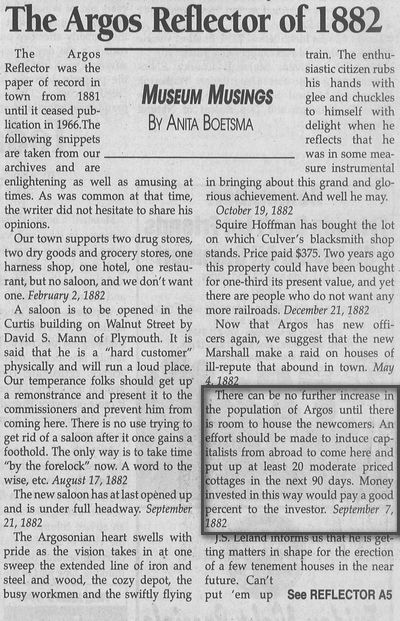
I was amused by a blurb from Anita Boetsma’s article on the Argos Reflector.

I just finished serving on the Comprehensive Plan Steering Committees in Culver and Plymouth right now. This is my 4th and 5th times through this process and housing is always an issue. I know Argos has been struggling with housing issues and according to this article, that struggle has been going on for 140 years!

As is also typical today, the commentator in the Reflector was happy to suggest what others do with their money. “Money invested in this way (housing) would pay a good percent to the investor.” Uh, huh. Other people’s money is easy to spend. I’m sure there would have been further commentary if the writer thought the “good percent” was too good…

I’m reminded of some of the grief I received from the then Culver Town Manager, Street Superintendent and Building Commissioner, who all thought I should be spending more on Sand Hill Farm Apartments and The Paddocks when they were under construction. While their comments were disheartening, it was nice the few times, then Town Council President, Ginny Munroe, publicly reminded them that with all the projects being completed due to Stellar, I was the only one with upfront skin in the game, i.e. making investments and with the potential for losses if things didn’t go well.

Currently, another developer is trying to wind their way through a housing development project in Culver. His project is to be partially funded through a READI grant. As Culver found out when initially looking for a housing developer, there aren’t as many out there as you might think. Culver Sand Hill Farm LLC was created to fill that void. While working on Sand Hill Farm Apartments and The Paddocks, we endured a lot of pushback. Culver’s unofficial motto, “Change is Bad, Even When It’s Change for the Better!” was the theme of many public meetings. The current developer is hearing it all again: The project is too big. The units should be built in a different order. The entrance should be somewhere else. There should be a direct connection to Town. There should NOT be a direct connection to Town. The houses are all going to look the same (stated as bad). The houses should all look the same. There are too many houses and not enough apartments. There are too many apartments and not enough houses. At 300 units, it is a small Town of its own and should provide some services accordingly… and on and on… While the injections of public funds gives the public some say, it still has to be understood that the developer is a for-profit entity and has to make the best decisions for a profitable outcome. Otherwise, why is he doing this? (A question that gets asked at Culver Sand Hill Farm LLC often…)

Housing remains a big issue in both Comprehensive Plans. Plymouth’s was adopted last year. Culver’s is still pending rewrites. In both cases, housing remains front and center, though slightly different approaches have been outlined. Housing is still considered part of the American Dream, but even with that shared vision, everyone has their own ideas about how to achieve that dream and what it looks like.

It’s not too late to make the current developer see the folly of these fights and watch him walk away. Culver Sand Hill Farm LLC sold 12 acres planned for future housing, rather than go through that process again. It’s now going to be a mini-storage facility. Culver Investment Corp. let their PUD expire and have their property for sale. Finding someone else to step up to the Culver’s housing challenge may be hard to do.

Container Homes

A lurker asked me about shipping container homes and the PUD Container Home project planned by Voodoo Dream Work LLC at 3919 North Michigan Road between Plymouth and LaPaz. I don’t generally comment on other developer’s projects, but I cannot imagine that this isn’t an improvement on what’s existing. I wish Mr. Landgrebe and Voodoo the best and hope their project is successful.

Former Community Garden Site

My lurker asked what I thought of the shipping container home concept. I actually looked into this before and was given some drawings by Brent Martin, SRKM Architecture, to consider. I hadn’t considered container homes for a whole subdivision as Mr. Landgrebe is proposing, but I thought they would be interesting to consider for infill lots. There are many small lots that were platted when standards were looser, that would be difficult to develop now due to setbacks and other restrictions.

Corner of Clymax & Jefferson

There are several lots in Culver that are virtually undevelopable due to their size and setback restrictions. The former Community Garden parcel owned by the Wesley United Methodist Church at the NE corner of Slate Street and Lewis Street comes to mind. Another is the parcel at the SE corner of Clymax Street and Jefferson Street. Not only does the second one have streets on two sides, but it has issues with utility poles and an alley.

An interesting side note: Culver’s current Building Commissioner has a different interpretation of setbacks for corner lots than was enforced in the past. In the past, a lot that fronted two streets was considered to have two front yards and consequently two rear yards. The current interpretation is that the front yard is the side with the street address making the rear yard the opposite from that. This will help some of these difficult small lots.

Sand Hill Farm Apartment 2 Bedroom Rendering from SRKM Architecture

The biggest positive for shipping container construction is that modular construction can be highly efficient. Parts and pieces that can be manufactured in a controlled, factory setting can speed up construction in the field. Sand Hill Farm Apartments were based on modular construction, with each apartment based on a standardized two bedroom layout. The three bedroom units are the same two bedroom unit layout with stairs to a third bedroom above. The one bedroom units are the same two bedroom unit layout with the second bedroom truncated to allow space for the office in one case and a maintenance room in the other. I spent a lot of time working with Hi Tech Housing, Inc. out of Bristol, hoping to use them and their version of modular construction. In the end, that just didn’t work out.

The main problem I found when I looked into shipping containers was their rigidity; ironically, one of the positives their proponents tout. 1) The module that they create is limiting. To make them into a home, they need to be framed out to allow space for insulation and space for infrastructure like plumbing and electrical to run throughout the space. This reduces the living space. 2) Their steel frames mean that any modifications require a cutting torch. 3) Any attempts to combine them are made difficult by the deep corrugations, which are designed to give them strength, but create additional space issues. 4) Cuts made for doors, windows and larger openings between them take away some of the strength inherent to the modular unit. 5) The Building Inspectors I’ve talked to are uncomfortable inspecting them with the modifications, and would require an Architect or Engineer to sign off on them. This creates a problem in finding an Architect or Engineer comfortable in doing this.

Shipping Container Home from the www.wewilltransportit.com site

The shipping container home shown in the picture to the right is what I envisioned for some of the above infill sites in Culver, but if would have had Building Inspector issues and would still have required local variances as it would have been below Culver’s required square footage standards. Check out the site for the home to the right here. They have some other interesting pictures, but most of them are single container homes, making the square footage requirement harder to meet. But picture how much floor space stairs between floors would require and how that would subtract from your usable space when you add a second floor.

I don’t feel like shipping containers as homes follow the axiom of “everything to its highest & best use”. The best use for a shipping container is for shipping material. (Much as I said about the best use of West High School would have been its original designed use as a school.) Architect Belinda Carr does a great job of breaking it down in the video below:

I’m not sure I’m ready to say they’re a scam, but they just didn’t make sense to me. To each their own. I just don’t see them as a panacea to the housing crisis.

Modular construction does make a lot of sense. Sand Hill Farm Apartments, The Paddocks and Riverside Commons were all framed using factory produced wall panels. They’re delivered en masse and then carpenters stand them up on site. We did this with most of the Garden Court projects we built as well. It just makes sense when there are repetitive room shapes and sizes. A big difference is that we can work towards other modular sizes when we build this way. Drywall comes in lengths and widths in multiples of 4′. This makes rooms with dimensions based on 2′ increments more efficient. Carpet comes in 12′ widths. We design for that efficiency. Wood studs have easily determined bearing capacities based on 16″ and 24″ centers… which works out with the 4′ drywall increments. Those same 4′ increments work out for OSB and plywood which is used for exterior wall sheathing and roof decking. Studs come in standard length, which can help determine the most efficient ceiling heights. Considerations of these increments helps reduce waste.

I’ll be watching Mr. Landgrebe’s project with interest. It should be interesting visually and his vacation voucher rental model is novel. I wish him the best and who knows; he may cause me to rethink my views on container housing…

West High Corner

Whew! There’s a lot going on there! Very little of it good… To orient you, if you’re not local, this is the curve north of Lake Latonka, where S.R. 17 begins to run east towards Plymouth and Sycamore Road continues north towards S.R. 30.

Property at SE Corner of West High Intersection highlighted in cyan.

So I don’t bury the lead, the initial reason for writing this was a John Oliver style, “Why is this Still a thing?” rant. I came around this corner from the East the other morning on the way to work, in the dark, to find a school bus stopped to pick up kids from the house on the inside of the curve on the SE corner of this intersection. It wasn’t very visible to me until I was almost on it and it would have been worse for someone coming from the South. The best case for this is this time of year when it’s dark and the bus’s flashing lights are reflecting off of everything. At twilight, the danger doubles down.

This property just recently changed hands. I know things get grandfathered in. I know it’s cold out and kids don’t want to walk far, so the closest point to the house is the preference. But there is a significant piece of property here with an alternate driveway. Barring getting rid of this dangerous driveway, can’t the school bus pick up at the alternate driveway off the curve?

West High Fireman’s Memorial at Night

This intersection has always been dangerous. The memorial at the northwest corner of the intersection commemorates the 5 fire fighters that gave their lives at that intersection in 1982. The truck they were in took the corner too quickly and went into the swamp on the west side of the road. This was the worst single-event loss of life for a single fire fighting unit prior to the 9/11 terror attack. The permanent stone memorial included lighted flags and was dedicated in 2014 It replaced 5 wooden crosses on a utility pole near the crash site. It is somewhat fitting that this memorial is quite striking, yet somewhat eerie when lit up at night.

West High before it’s 2023 demolition.

It will be interesting to see how long the West High Corner moniker remains in use since the referenced school is gone. The Northeast corner of the intersection was home to the West High School, named for West Township. Many people were sad to see the school go away this past year. I have to agree that it was frustrating that it couldn’t be repurposed, but location is everything and is often the case with structures like that, its highest and best use was as a school. I could not find documentation, but my recollection is that the school corporation sold it at auction for $1,500 in 2005. From there, the buyer stripped most of the things of value from the building. It became a door and trim shop after that. The Covid pandemic ended that. Most recently it was purchased by Jackson Salvage, which made it go away… except for the slabs and foundations. All that remains is a memorial with a bell and well along Sycamore Road to commemorate the school’s previous glory.

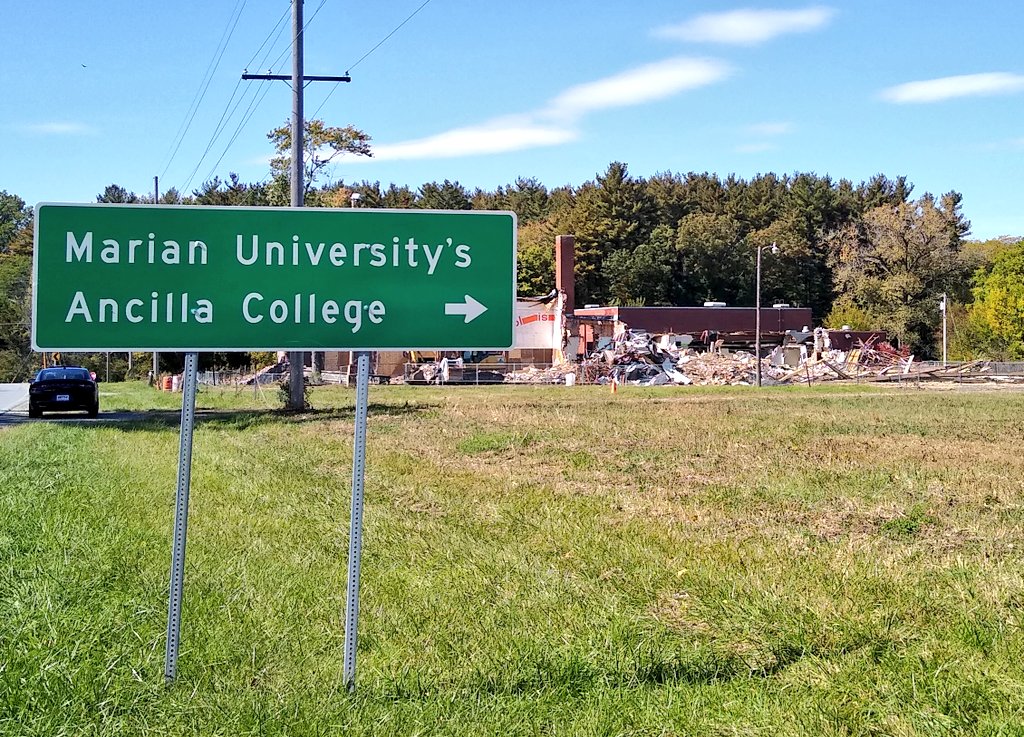
Am I the only one that found the juxtaposition of this crooked MUAC sign pointing at the partially demolished West High building amusing? This sign went up as the building was coming down…
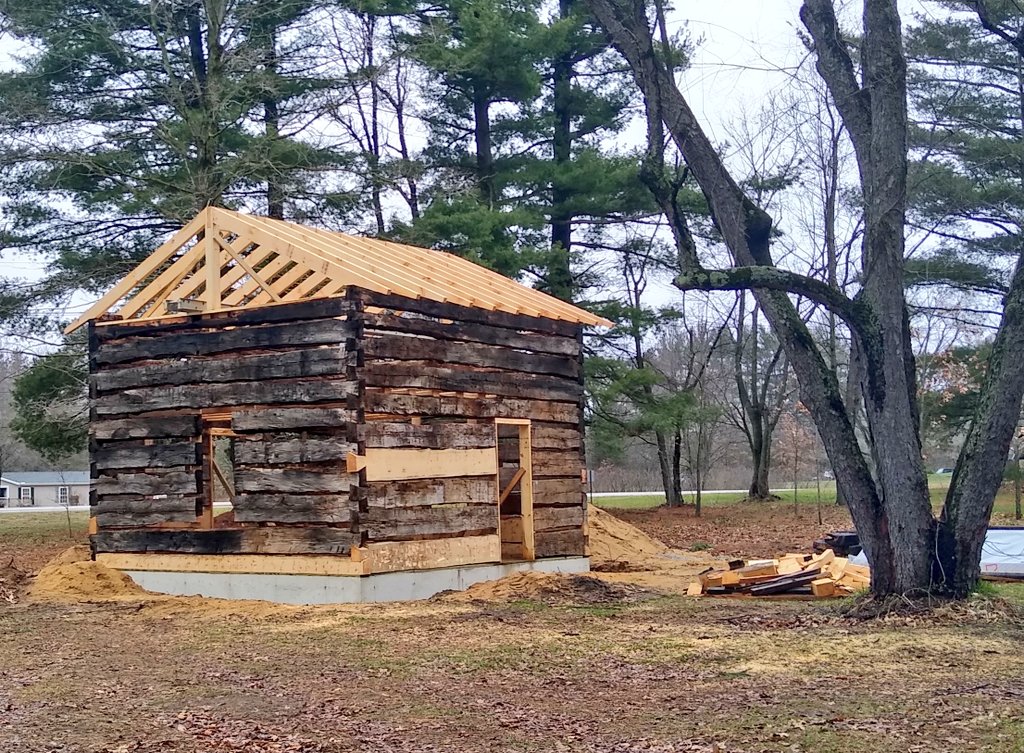
Historic West Township Trustee’s Cabin

The property on the southeast corner referenced at the beginning of this post was the former location of the original West Township Trustee’s home; a log cabin that was just recently relocated south to Memorial Forest. The picture to the right shows the cabin during reconstruction as new roof framing was placed. The recently formed Marshall County Parks and Recreation Department tried to have it relocated onto the West High site, but there weren’t sufficient funds to make the deal possible.

As attested to by the lost fire brigade, the West High Corner is to be respected. The two exits/entrances onto S.R. 17 from Sycamore Road are also treacherous. From experience, the southernmost connection is the most dangerous and least respected as I often see cars exit or come onto S.R. 17 without stopping. West bound cars cannot see that intersection until they’re into the curve, so if they are taking it quickly, there’s often near misses. In icy winter conditions, this is even worse.

Culver Chamber proposal to extend SR 17 north along Sycamore Rd with a gentle curves to align with Rose Rd

In the mid-1990’s, the Culver Chamber of Commerce petitioned the Marshall County Commissioners to improve Sycamore Road to give Culver more direct access to S.R. 30. For a time, this was a collaborative effort between the Town of Culver, Ancilla College (now Marian College), Culver Academies and Swan Lake Resort. One option for this was to attempt a trade-off with INDOT, changing Sycamore Road into the north end of S.R. 17 and the east/west portion from West High to Plymouth would have become a county road again. This would have had many benefits including an intersection fix at West High, an improved route to S.R. 30 from Culver, fewer driveway accesses, and an easy aerial railroad crossing. At the time, Marshall County had already broached INDOT through MACOG about the Pine Road extension. And also at that time, Plymouth didn’t want to give up the benefits of INDOT maintenance on the main street through the City. (Plymouth is having second thoughts now as their Complete Streets Committee wrestles with the pedestrian issues associated with this.) With the completion of the Pine Road extension to S.R. 17, this initiative is unlikely to be considered. Some of the property that was vacant has been developed, further hindering this right-of-way acquisition.

I don’t see a good solution to this intersection in the near future. At a minimum, I would still like to see something done to eliminate the school bus stop in the middle of a State Highway curve. This intersection doesn’t need another memorial…

LIHTC & Stellar

Linda Yoder

At the December meeting of the Culver Redevelopment Commission (CRC), Linda Yoder, Executive Director for the Marshall County Community Foundation (MCCF), made a presentation on One Marshall County. One Marshall County is the new umbrella organization that Marshall County Economic Development Corp (MCEDC) has spearheaded. Linda and I serve on the collaborative council discussing this new initiative and Linda had volunteered to make the presentation of the need for One Marshall County before the CRC. This also included a request for funding.

There were a few math errors in the presentation, but one of these jumped out at me was during the discussion of Stellar and the investment that Marshall County Crossroads brought to local communities. The numbers quite clearly did not include the investment from tax credits provided by IHCDA. The Low Income Housing Tax Credits (LIHTC) provided by IHCDA amounted to the biggest single project investment from any of the State agencies involved in Stellar. In all, through the tax credits and loans, Plymouth and LaPaz shared $14 million dollars of investment in their communities with Riverside Commons. That investment didn’t show up in the presentation numbers. This is no shade on Linda! She didn’t prepare the numbers…

The Paddocks in Culver

This isn’t the first time for this. Culver received approximately $10 million in tax credits and loans for The Paddocks, but that number rarely shows up in their Stellar discussions. These would be huge contributors to the ROI discussion, since local investment in these projects was largely limited to in-kind waivers and some inhouse work. (Culver contributed nothing to The Paddocks project. Plymouth gave waivers on improvements to surrounding alleys. LaPaz waived sewer tap fees and secured matching INDOT funding to improve the street serving the project.)

Riverside Commons Plymouth

I think there are a couple of reasons for this lack of acknowledgment: 1) The Stellar Committees don’t really understand the program and 2) Unlike many of the project which were directly municipal projects, i.e. parks, trails, etc., that required more active involvement, the LIHTC portion of Stellar is directly administered by the project developer, so there isn’t a pass-through of dollars. The LIHTC award creates a private project. Where there was some shifting of dollars amongst the other municipal projects within the Stellar awards, that was not an option with LIHTC.

Riverside Commons – LaPaz, d.b.a. LaPaz Commons

Despite the success of The Paddocks in Culver’s Stellar Community program, Marshall County didn’t even include a LIHTC request in their first application for Stellar Region. I had lobbied for its inclusion and felt that the group slighted IHCDA by not accepting their offer. I lobbied a little harder in their second attempt and Riverside Commons was included in that application, which was successful. This was probably not the only reason, but I firmly believe it contributed to the success of the second application.

There have been some complaints about The Paddocks, but The Paddocks has met or exceeded all of the metrics set forth for it. The same can be said for Sand Hill Farm Apartments, the precursor project that made Culver Stellar and The Paddocks possible. It’s too soon to document that for Riverside Commons, which has different goals, but I have no reason to believe the results will be different. As far as community acknowledgement, the LaPaz and Plymouth councils have done a great job of recognizing Riverside Commons. They each have a Stellar agenda item on their council agendas and request updates for each meeting. Culver did not include The Paddocks in their Stellar reports to the council.

I think it’s a missed opportunity when the LIHTC investment is not celebrated and included in the ROI… But then, I’m obviously biased!