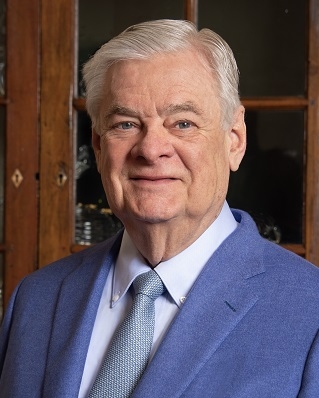
It was heartwarming to see the elementary kids out helping plant trees at the High School this morning. Kudos to Karen Shuman, School Superintendent, and Kevin Danti, Town Manager, for leading the effort with shovels in hand. Jud Dillon would be proud!
The property has a history with my family, as it was formerly part of my Great Grandpa Russell Easterday’s farm. When I was 7 or 8, I remember riding my bike to the end of Slate Street to give treats of carrots to the members of Grandpa Easterday’s herd of white-faced Hereford cattle that were brave enough to come see me at the fence. At one time, the Easterday farm extended all of the way down to Easterday Construction. Before the office building was built in the 50’s, there were cattle barns and the red barn on the property was known as the pony barn where grandpa kept horses. Russell and Wanda Easterday lived in the brick house on the west side of the north end of Ohio Street.
Arthur Judson “Jud” Dillon and Grandpa Easterday were friends. Like my grandfather, Jud was a farmer that moved on from farming to better support is family. In both cases they became teachers. Grandpa moved on to construction while Jud moved from teacher to guidance counselor to High School Principal. Jud’s farm surrounded the intersection of 10 & 17 at the entrance to Culver from the north. If you look up old deeds in that area, you’ll see that the town lots in that area are part of the Dillon Addition.
When the high school was built, there were few, if any, trees in the pasture. All of the older trees you see around the high school were planted by Jud. Since the high school was built in 1969, and the first Earth Day was in 1970, it’s hard to say if those trees were tied to Earth Day or not. As Jud’s son, Gary, relates it (Stories and Stones ’25, 17 min mark), Jud had an affinity for trees and was responsible for planting them all around Culver while Gary was responsible for watering them.
It’s nice to see the legacy continue. The school property definitely needs a few more trees!
This is mostly a historic reference piece from my memory. I can’t find much in the way of documentation. Forgive me if I misremember and as always, I’ll update it if better documentation comes along. Out of curiosity, I checked Judy’s history page and there wasn’t even a mention of the Second Century Committee, but I know her focus is on older things.
I served on the Culver Chamber of Commerce board of directors from 1990 to 2002, holding every office except chairman. John Thompson worked at the Culver Academies and served on the board and as board chair for several years in the mid 90’s. Jim Dicke II‘s purchase of properties around Culver had not gone unnoticed by the Chamber. He had purchased, demolished, and cleaned up multiple properties around town, but there hadn’t been any movement towards development. (To this day, there are several vacant properties that he still owns.)
Through his connections at Culver Academies, John arranged a meeting with Jim in New Bremen, Ohio. A delegation from the CCC went, including John Thompson, Erik Freeman, Pam Fisher and myself. Jim was a gracious host, giving us a tour of his company, Crown Equipment Corporation, their offices in downtown New Bremen and a general tour of the Town. Over a lunch at a New Bremen restaurant, Jim shared what he had done with New Bremen.
The Village of New Bremen is very much a Crown Equipment Corporation Company Town. Crown Equipment is the main employer in the area and it was in Crown’s best interest for New Bremen to thrive. But as a small town with only one large employer, this was difficult. This was made more challenging by their rural location without direct connections to any major highways. Jim made the decision to invest in the community. Houses were purchased and renovated as Bed & Breakfasts for use by Crown Equipment visiting guests and consultants. A downtown block was purchased, preserving the facades to maintain the local charm, but completely rebuilding everything in the back half to serve as corporate offices, bringing Crown employees and visitors into the downtown. An older car dealership in the downtown was purchased and moved to the edge of town, to allow for more appropriate use of the downtown streetscape. The restaurant we were meeting in was upgraded and kept viable through subsidies in order to be there when Crown Equipment needed a place to take guests.
It was during this meeting that Jim made what I considered an iconic statement, which I have repeated for decades now: “Towns are either growing or dying. They can’t stay the same.” I don’t know if this was an original statement, but I’ve not seen it anywhere else. (There is a version of it from Lou Holtz about individuals that I found, but I’ve always attributed the town version to Jim.)
Jim said his vision of Culver was to see Culver Academies become more integrated into the community as Crown Equipment had done with New Bremen. He said he wanted to see the town of Culver thrive, as he thought it was important to the Culver Academies. You can see his fingerprints on this through the move of some Culver Academies administrative offices to the former Mr. T’s Drug Store at 820 Academy Road and to the former Culver Community School’s administration building at 222 North Ohio Street.
John asked the big question, “What would it take for you to invest in Culver like you’ve invested in New Bremen?” Jim responded that obviously he already had, through some of his property purchases and clean-up, but there wasn’t a clear path for Crown Equipment to have a Culver location. He did say he was happy to continue his efforts to involve Culver Academies in the Town of Culver and would support efforts to bring more industry to Culver. But he added the caveat: the town needs to show they are organized, have a plan and are ready for changes.
Our group was pensive on the return trip to Culver. While we felt we had made progress with the things the Chamber of Commerce was doing, Jim had pointed out some community shortfalls, the most obvious being a lack of collaboration. From this discussion, the Culver Second Century Committee was born. Culver Academies was going through their 1994 centennial celebration. The Town of Culver was previously named Marmont and changed its name to Culver in 1885 to honor Henry Harrison Culver, founder of the school. It seemed fitting that our new group reflect change as the Town of Culver entered its second century.
The Culver Second Century Committee (SCC) was created as an offshoot of the Culver Chamber of Commerce (CCC). This allowed SCC to exist under CCC’s 501c(3) status. This also gave the CCC some oversight and responsibility for the group, but allowed other groups to participate without direct CCC membership. There were no membership dues or other impediments to participation. We actively recruited participation from the town government and other civic groups such as the Lions, Kiwanis, Tri Kappa and others. The goal was to start a dialogue and create some synergy between the groups and to have some common projects in lieu of each group raising funds for similar efforts.
The group formed a steering committee consisting of four members. It intentionally recruited a mix of Chamber members and non-Chamber members for the steering committee to reinforce the collaborative goal. I did not serve on the initial steering committee, but did serve for a time after the initial member’s terms expired. The group began having quarterly lunch meetings which resulted in a true collaborative spirit. Town government representatives were involved as well, so we had a wide spectrum.
The first major thing tackled by the group was the Community Needs Assessment and Recommendations conducted by Mary Means & Associates, Inc. out of Alexandria, Virginia. (I believe the Town of Culver has copies of the original document, but I couldn’t find it online to provide a link. I do have a copy if anyone would like me to share it.) The Community Needs Assessment was completed in October of 1997. This was not a deep diving document, but it did gather public input and act as a catalyst for next steps. Even back then housing was an issue mentioned. There was also a recommendation for updates to the Comprehensive Plan and the Zoning Ordinance.
SCC continued to meet and push for changes. The next piece to come out of the Needs Assessment was the Culver Community Charrette lead by Ratio Architects. This resulted in the Culver Community Charrette Handbook presented in November of 1998. Ratio Architects built on and expanded the ideas in the Needs Assessment, defining some of the themes of Culver to expand upon. An example of this was the use of fieldstone throughout Culver, which lead to the Chamber sponsoring the new sign with fieldstone columns at the 10 & 17 entrance to town and the covering of the Lakeshore Drive wall across from the Root Beer Stand with fieldstone. Sand Hill Farm used this theme with the entrance sign on Sand Hill Boulevard. The Paddocks used this theme with the fieldstone facades on the townhomes in their development.
Welcome to Culver Sign at intersection of 10 & 17
After the charrette, Ratio Architects was hired to update the Culver Comprehensive Plan. That version of the plan incorporated many of the themes from the Needs Assessment and the Community Charrette. While this was a Culver Plan Commission project, the Second Century Committee remained involved. But unfortunately, as the ownership of the project transitioned to the town, some of the collaboration and commitment to SCC waned.
Over time, the SCC steering committee became less of a guiding group and started becoming more of an action group. I was no longer part on the steering committee, but still attended the meetings. Unfortunately, in this time frame, the meetings with the larger group ceased and the underlying groups had less stake in SCC. Culver Chamber was going through some transitions as well, so SCC was mostly on its own.
For a while the SCC steering committee was taking on different projects. For example, Dick Brantingham was on the steering committee for years and shepherded the sidewalk program, working to pair residents and/or businesses on the same block with the town’s replacement assistance program in order to maximize the impact. There were other projects like that as well.
In 2011, the SCC made another change in direction as it became part of Indiana Main Street and got rolled into the Visitors Center and/or one of the other organizations. To the best of my knowledge, the Second Century Committee didn’t make it through the first quarter of Culver’s new century and if there are remnants, it no longer functions as intended.
Somewhat a Blast from the Past last week was the discovery of a display of artifacts from The Remnant Trust at the Columbia Club in Indianapolis. Their mission to preserve historic documents promoting individual liberty and human dignity led them to possess original copies of the Declaration of Independence and others even older, written by the likes of Isaac Newton and Aristotle.
The Remnant Trust Winona Lake Exterior
In 2010, we met with the founder of The Remnant Trust, Brian Bex, to discuss an OrthoWorx project to house some of their documents in the former Billy Sunday Museum in Winona Lake. (Billy Sunday was a professional baseball player from the Warsaw area, turned evangelist.) OrthoWorx considered this project part of their effort to address the “trailing spouse” issue they had when attracting employees for the Warsaw Orthopedics industry. Executives being recruited to work in Warsaw reported pushback from their spouses who would rather live in a more urban environment with the associated amenities.
Billy Sunday Memorabilia
The existing building had a lot of rustic shiplap pine woodwork and didn’t have the feel they wanted for a scholarly museum. Office space was limited and the HVAC was inadequate. It also still had much of the Billy Sunday memorabilia in place. Despite all of this, the price was right and we were hired to implement the renovation. The plans for this renovation were completed by Scearce Rudisel Architects (now SRKM Architecture), under the direction of Mary Ellen Rudisel.
New lighting, office space and flooring were part of the overall renovation giving the space a more updated feel. Some of the woodwork was salvaged and relocated to keep the theme consistent. But the main focus was the vault.
The Remnant Trust Vault
The vault would be where the documents would be stored. Most of these would be stored on shelving in standard library manner, while others were placed in their own cases. It was designed to look unassuming, but that belied the underlying construction. Special effort was made to seal the space so that it was protected from the elements. Walls were steel stud construction with double layers of abuse resistant drywall. The door was designed to look like a standard door, but serve as a high security vault door with environmental seals. Special lighting was installed to assure that no detrimental affects to the documents would be caused. The space was also environmentally controlled by a redundant, high-end HVAC system with temperature control that would keep the vault within 1 degree of temperature set point and within 1 percent of humidity set point whether the vault was empty or occupied. Occupancy varied, since it was vacant the majority of the time, but also allowed for visiting scholars as well as school classes and the occasional Remnant Trust party of 30 or more.
One of the interesting tenets of The Remnant Trust is that these works, while revered, should be accessible. Visiting scholars could be seen wearing gloves and turning pages with microspatulas while visitors from the public are allowed to touch these documents, some many hundreds of years old.
Unfortunately, after a few years at this location, The Remnant Trust found a university benefactor and moved the collection to another location. Warsaw did not prove out to be the best location for visiting scholars and for sharing their collection. It’s a loss to our area. But seeing the smaller display in the Columbia Club reminded me of their work. You can make an appointment to for a private tour here, though it’s open to guests and members to walk through anytime.
The Heritage Park Pergola Dedication was in the Culver Citizen last week. The project was built by Easterday Construction Co., Inc. in the 90’s. It was commissioned by Richard Ford. I’ve discussed it here, here and here in the past.
One of the cool things about working in construction is the ability to drive around our area and see the projects that become history over time. Great Grandpa Easterday wasn’t the best about recording the early history of Easterday Construction… He was too busy running a business! But for those of us that remember, we see reminders of our beginnings as we look around Culver and throughout our region.
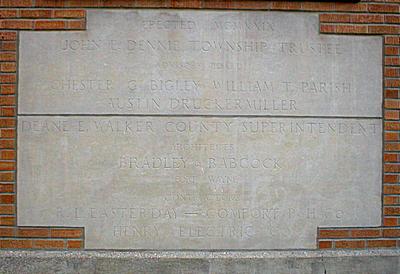
The Pony Barn remains adjacent to the Easterday Construction Co., Inc. office as a reminder of when the site was the Easterday beef farm at the edge of town. (Before the high school was built, neighborhood kids would ride their bikes to the north end of Slate Street and feed treats to the Grandpa Easterday’s Hereford Cattle in the field there.) The dedication marker on the elementary school gym is a reminder of a depression era project we completed, when we had a three digit phone number and our offices were in on the top floor of the State Exchange Bank Building (Now First Farmers Bank & Trust). Those that remember that history are disappearing. Only the 3rd and 4th generations of the Easterday Construction family remain and some of them have passed on. Those of us that are left still remain proud of the mark we have left in the history of Culver and surrounding communities.
At Tuesday night’s Culver Town Council Meeting, Town Manager, Ginny Munroe reported on the annexation progress for the “Tamarack Road project”. This is the storage facility project proposed by Beachview Properties LLC at 18710 Tamarack Road.
I get why it is referred to by the Tamarack Road moniker since that is the property address, but it has me thinking about the future. While this is truly none of my business, I would anticipate the future business on that site will want a West Shore Drive address. That would be more recognizable than Tamarack. But will it or should it remain Tamarack Road after the annexation?
Currently South Main Street becomes Tamarack Road at the town limits. I’d need to consult our local historians, Jeff Kinney or Kurt Garner, but I assume South Main Street was Tamarack Road until some point in the past. This seems likely since on the north side of Culver, School Street becomes Tamarack Road again at the town limits.
I assume the street/road will need to be addressed by the Town and County as part of the annexation processes. Situations like this, where one side of the road is annexed, but not the other side aren’t particularly clean. The County is generally more than happy to transfer the road and it’s associated maintenance to the Town. The Town generally wants to negotiate some kind of split where costs are shared until such time as the other side is annexed. This leads to fun questions like does each entity only plow their half during snow events?
Beachview Properties Tamarack Rd Site
Assuming the Town and County work out some amicable agreement, what happens to the name? Does it remain Tamarack Road or does it become the next section of South Main Street? Circling back to the address question, would the future business see more benefit to addressing themselves as being on Main Street?
In all reality, is South Main Street really the appropriate name for even the existing portion of this street? Generally “Main Street” designates the main business district of a community. (Often communities move on and Main Street becomes relegated to a side street.) In my limited knowledge, there were only one business on that section of street in the past. There was a florist shop on the east side of the street just north of the Masonic Cemetery. That business has been gone for decades. Currently South Main Street is solely residential and assuming the Comp Plan is followed, not to mention the current plans for The Dunes, this area will be totally residential for the foreseeable future. Given that and the fact that it doesn’t even line up with Main Street proper, makes the naming question more interesting.
I don’t really have strong feelings on any of this. Just musing about the possible future and it’s ties to the past…
***********
After writing Tamarack multiple times in this post, I took a drive down this road and didn’t spot a single Tamarack tree, thus I’m assuming the name is due to Marshall County’s peculiar choice to name north-south roads after trees in a mostly alphabetical order.