
This is mostly a historic reference piece from my memory. I can’t find much in the way of documentation. Forgive me if I misremember and as always, I’ll update it if better documentation comes along. Out of curiosity, I checked Judy’s history page and there wasn’t even a mention of the Second Century Committee, but I know her focus is on older things.
I served on the Culver Chamber of Commerce board of directors from 1990 to 2002, holding every office except chairman. John Thompson worked at the Culver Academies and served on the board and as board chair for several years in the mid 90’s. Jim Dicke II‘s purchase of properties around Culver had not gone unnoticed by the Chamber. He had purchased, demolished, and cleaned up multiple properties around town, but there hadn’t been any movement towards development. (To this day, there are several vacant properties that he still owns.)

Through his connections at Culver Academies, John arranged a meeting with Jim in New Bremen, Ohio. A delegation from the CCC went, including John Thompson, Erik Freeman, Pam Fisher and myself. Jim was a gracious host, giving us a tour of his company, Crown Equipment Corporation, their offices in downtown New Bremen and a general tour of the Town. Over a lunch at a New Bremen restaurant, Jim shared what he had done with New Bremen.
The Village of New Bremen is very much a Crown Equipment Corporation Company Town. Crown Equipment is the main employer in the area and it was in Crown’s best interest for New Bremen to thrive. But as a small town with only one large employer, this was difficult. This was made more challenging by their rural location without direct connections to any major highways. Jim made the decision to invest in the community. Houses were purchased and renovated as Bed & Breakfasts for use by Crown Equipment visiting guests and consultants. A downtown block was purchased, preserving the facades to maintain the local charm, but completely rebuilding everything in the back half to serve as corporate offices, bringing Crown employees and visitors into the downtown. An older car dealership in the downtown was purchased and moved to the edge of town, to allow for more appropriate use of the downtown streetscape. The restaurant we were meeting in was upgraded and kept viable through subsidies in order to be there when Crown Equipment needed a place to take guests.
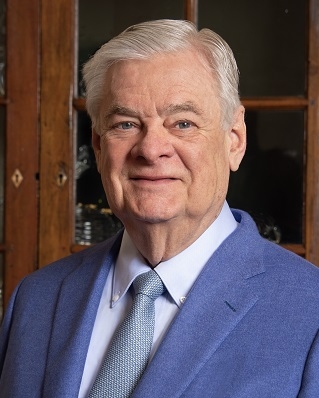
It was during this meeting that Jim made what I considered an iconic statement, which I have repeated for decades now: “Towns are either growing or dying. They can’t stay the same.” I don’t know if this was an original statement, but I’ve not seen it anywhere else. (There is a version of it from Lou Holtz about individuals that I found, but I’ve always attributed the town version to Jim.)
Jim said his vision of Culver was to see Culver Academies become more integrated into the community as Crown Equipment had done with New Bremen. He said he wanted to see the town of Culver thrive, as he thought it was important to the Culver Academies. You can see his fingerprints on this through the move of some Culver Academies administrative offices to the former Mr. T’s Drug Store at 820 Academy Road and to the former Culver Community School’s administration building at 222 North Ohio Street.
John asked the big question, “What would it take for you to invest in Culver like you’ve invested in New Bremen?” Jim responded that obviously he already had, through some of his property purchases and clean-up, but there wasn’t a clear path for Crown Equipment to have a Culver location. He did say he was happy to continue his efforts to involve Culver Academies in the Town of Culver and would support efforts to bring more industry to Culver. But he added the caveat: the town needs to show they are organized, have a plan and are ready for changes.
Our group was pensive on the return trip to Culver. While we felt we had made progress with the things the Chamber of Commerce was doing, Jim had pointed out some community shortfalls, the most obvious being a lack of collaboration. From this discussion, the Culver Second Century Committee was born. Culver Academies was going through their 1994 centennial celebration. The Town of Culver was previously named Marmont and changed its name to Culver in 1885 to honor Henry Harrison Culver, founder of the school. It seemed fitting that our new group reflect change as the Town of Culver entered its second century.
The Culver Second Century Committee (SCC) was created as an offshoot of the Culver Chamber of Commerce (CCC). This allowed SCC to exist under CCC’s 501c(3) status. This also gave the CCC some oversight and responsibility for the group, but allowed other groups to participate without direct CCC membership. There were no membership dues or other impediments to participation. We actively recruited participation from the town government and other civic groups such as the Lions, Kiwanis, Tri Kappa and others. The goal was to start a dialogue and create some synergy between the groups and to have some common projects in lieu of each group raising funds for similar efforts.
The group formed a steering committee consisting of four members. It intentionally recruited a mix of Chamber members and non-Chamber members for the steering committee to reinforce the collaborative goal. I did not serve on the initial steering committee, but did serve for a time after the initial member’s terms expired. The group began having quarterly lunch meetings which resulted in a true collaborative spirit. Town government representatives were involved as well, so we had a wide spectrum.
The first major thing tackled by the group was the Community Needs Assessment and Recommendations conducted by Mary Means & Associates, Inc. out of Alexandria, Virginia. (I believe the Town of Culver has copies of the original document, but I couldn’t find it online to provide a link. I do have a copy if anyone would like me to share it.) The Community Needs Assessment was completed in October of 1997. This was not a deep diving document, but it did gather public input and act as a catalyst for next steps. Even back then housing was an issue mentioned. There was also a recommendation for updates to the Comprehensive Plan and the Zoning Ordinance.

SCC continued to meet and push for changes. The next piece to come out of the Needs Assessment was the Culver Community Charrette lead by Ratio Architects. This resulted in the Culver Community Charrette Handbook presented in November of 1998. Ratio Architects built on and expanded the ideas in the Needs Assessment, defining some of the themes of Culver to expand upon. An example of this was the use of fieldstone throughout Culver, which lead to the Chamber sponsoring the new sign with fieldstone columns at the 10 & 17 entrance to town and the covering of the Lakeshore Drive wall across from the Root Beer Stand with fieldstone. Sand Hill Farm used this theme with the entrance sign on Sand Hill Boulevard. The Paddocks used this theme with the fieldstone facades on the townhomes in their development.

After the charrette, Ratio Architects was hired to update the Culver Comprehensive Plan. That version of the plan incorporated many of the themes from the Needs Assessment and the Community Charrette. While this was a Culver Plan Commission project, the Second Century Committee remained involved. But unfortunately, as the ownership of the project transitioned to the town, some of the collaboration and commitment to SCC waned.
Over time, the SCC steering committee became less of a guiding group and started becoming more of an action group. I was no longer part on the steering committee, but still attended the meetings. Unfortunately, in this time frame, the meetings with the larger group ceased and the underlying groups had less stake in SCC. Culver Chamber was going through some transitions as well, so SCC was mostly on its own.
For a while the SCC steering committee was taking on different projects. For example, Dick Brantingham was on the steering committee for years and shepherded the sidewalk program, working to pair residents and/or businesses on the same block with the town’s replacement assistance program in order to maximize the impact. There were other projects like that as well.
In 2011, the SCC made another change in direction as it became part of Indiana Main Street and got rolled into the Visitors Center and/or one of the other organizations. To the best of my knowledge, the Second Century Committee didn’t make it through the first quarter of Culver’s new century and if there are remnants, it no longer functions as intended.