
Indiana used to be as smart as Arizona, but Mitch Daniels dumbed us down. Or as those of us in Marshall County remember, put us on Heim Time…
government
Accessory Dwelling Units

At the September meeting of the Culver Plan Commission there was a rezoning request for the parcel at 451 North State Street. The request was for a rezoning from R-1 to R-2. The property was originally two lots. Due to one of the Culver Zoning Ordinance restrictions (a lot must have a primary structure before an accessory structure can be built) the lots were combined so that the house on the north lot could have a garage on the south lot. The current owner wanted to add an apartment over the garage for when they had family there. The comments from the board, as well as comments from the neighbors, indicated the use desired wasn’t the problem, but the spot zoning to R-2 and the implications of what could be allowed in the future was at issue. R-2 would allow much denser development including many forms of multi-family residential. Unfortunately for the owner, this was the recommendation from the Building Commissioner and they weren’t given much encouragement to seek a variance as there wasn’t a hardship. Subdividing back to the original two lots would be an option, but there was a concern about the two existing buildings meeting setback requirements. The spot zoning was less of an issue since the Plan Commission spot zoned three different homes that contained 2-3 units to R-2 so they met zoning requirements earlier this year. (See previous post here.)

There was considerable discussion about the issue and it was noted that the current Comprehensive Plan added language that Accessory Dwelling Units should be considered. A work session of the Plan Commission was scheduled and held October 8th to address this issue.
At the work session, the Building Commissioner put forth a proposal to create a new zoning district, R-1.5, to add areas that could have have accessory dwelling units. The counter proposal was, that these should be allowed throughout R-1. What follows are some of the discussion points and my thoughts on them:
- Addressing the Comprehensive Plan directive – The Comp Plan makes recommendations from the consensus of public meetings. It is passed by the Plan Commission and the Town Council. In this case, the latest Comp Plan passed both groups unanimously, so the question is more about how to address the issue rather than whether to address the issue. The Comp Plan isn’t binding, but it does give direction. This is just one of many suggestions in the latest plan that contemplates the Plan Commission reexamining the Zoning Ordinance to reflect the Comp Plan recommendations.
- New District vs Subdistrict vs allowable with restrictions – Both the New District and Subdistrict options suggest that the Plan Commission would have to go through some kind of rezoning process to either recategorize an area of R-1 District to the new standards or effectively spot zone each request as it came up. This would be burdensome for the Plan Commission and property owners and create a spot zoning situation every time it came up. The allowable restrictions should be definable and something the Building Commissioner could handle.
- Need for separate water and sewer – This was suggested by the Street Superintendent in case of future lot subdivision. This really should be a moot point though, since this is an accessory use, not a new primary use and most of the lots these would go on would be too small to subdivide. The Comp Plan contemplated this as a way to achieve additional workforce housing on existing infrastructure. This would go against that purpose. (Though I could see requiring a covenant against future subdivision of the lot if an accessory dwelling structure is allowed.)
- Garage Renovations – There was quite a bit of discussion regarding renovating a garage to be an Accessory Dwelling Unit. There were concerns about garages that were too close to property lines and whether a second floor for a dwelling unit would increase non-conformity. While some garages could be renovated this way, the building code overrides zoning, so many older garages would not meet those requirements and those too close to a property line could not be converted and meet the building code setbacks which override zoning setbacks for some conditions. Aside from those building code violations, most of the other concerns could be address through the allowable restrictions. There is also a separate garage height restriction that would have to be addressed.
- Some R-1 Lots are too small – There were concerns about shoe-horning these in on smaller lots. This could easily be handled with a lot size restriction and actually makes the case for making them allowable throughout R-1, but with restrictions. Lots like 451 North State Street would meet the size requirements, but the adjacent lot to the south wouldn’t. Also, this would not eliminate the impervious surface requirements. The need for off-street parking would have to be discussed too.
There were a myriad of other things that were not discussed or were just briefly touched on. Most of these could be handled with a matrix or a Chinese Menu approach. Square Footage of the building could have a minimum and then an increase based on lot size, but still controlled by the base impervious surface requirements. Additional parking requirements could be determined by the number of bedrooms, but still controlled by impervious surface requirements. There could be a requirement that it be smaller than the primary structure. There could be a lesser height allowable than the 35 foot currently allowed in R-1 or even required to be a certain percentage shorter than the primary structure. All of these and others could be check-off items determined by the Building Commissioner rather than having each one appear before the Plan Commission.
A few additional things that should be address:
- Can these be three season dwellings that are shut down and winterized at the end of the season or must they be available for year-round occupancy?
- Can a mobile home or a motor home fit the criteria?
- Must it have a kitchen/cooking facilities or just bathroom facilities?
- Must it be detached?
- The discussion centered around detached units, but that wouldn’t address the R-2 spot zoning discussed previously.
- It would also preclude uses like mother-in-law suites which are currently a gray area.
- It would also preclude larger homes subdivided into apartments, i.e. multi-family use of existing single family structures.
- Is an Accessory Dwelling Unit different from other, possibly existing, accessory structures, i.e. if there is a house and a detached garage, does that mean the detached garage has to be eliminated in favor of the Accessory Dwelling Unit? I don’t think that’s in the spirit of the Comp Plan goal, but it should be defined one way or another. It is another item that might be determined by lot size in the matrix.
There was a lot of concern about spot zoning or even using the idea of allowing it within R-1 with restrictions, because of these things happen without neighbor input. This is one of those things where the Plan Commission will have to be open to thinking outside the box a bit. The Comp Plan goal for this was to provide additional workforce housing by making the best use of existing infrastructure. Based on this, they need to work on making this easy and inexpensive rather than hard and costly. Some will no doubt be full blown vacation spaces like contemplated in the State Street rezoning. But others will be studio and one bedroom spaces suitable for wait staff, teachers and other workers just starting out. Those are the ones we need to encourage as those spaces are in demand and those workers are in demand.
I’m glad to see the Plan Commission taking this up. If you want to follow along, the Building Commissioner has committed to posting updates and additional information here. I know this was pushed by a rezoning request, but it is just one of many Comp Plan recommendations they should be considering. As per a previous post, they are way behind where they were after the 2014 Comp Plan was created. Fingers crossed they build momentum from this start.
Blue Dot

It appears there is a nascent Blue Dot campaign in Culver. Don’t worry if you don’t know what that it is. I had to research it as well. Nebraska and Maine are the only two states that don’t award all of their electoral college votes to one candidate. In those states, two electoral college votes go with the state majority and the others are awarded by district. As with many states, the rural areas go red and the larger cities tend blue. With Nebraska being a deep red state, the blue dot campaign in Omaha is attempting to get at least one Nebraska electoral college vote for Kamala Harris.

This has me curious what statement is being made with the blue dot in Culver… If it’s a “made you look” thing, then I guess it was successful at least once. It caused me to hit the internet for an explanation. I guess it could be a statement of solidarity, since much like Nebraska, Indiana (and Culver and Marshall County) is pretty red. Culver often struggles to find Democrats to fill positions on boards that require political balance. Maybe they’re a Nebraska transplant and don’t understand the different differences in state election laws. Or they’re just a Cornhusker and this is another way to show college loyalty.

I’m not a fan of single ticket voting. Since there are no names or information with this campaign, I assume that’s what’s being suggested. The local (county) Republican party is also pushing a straight ticket campaign in some of their ads, and I feel the same way about that… particularly on lower ballet candidates. I am likewise not a fan of general get-out-the-vote drives when they are political party driven. There needs to be more done to promote voting as a privilege and that becoming an educated voter is important.
I am curious about the implications of Nebraska’s (since 1992) and Maine’s (since 1972) take on the winner-take-all electoral college system used by other states. I am definitely not in the camp that wants to eliminate the electoral college. Much like the Senate having two Senators per state, regardless of size and population, it is a means of protecting states’ rights and assuring that there is representation across the board for minority states. It is why we were formed as a Republic and not a true Democracy. (Though we are a Democratic Republic.) I would be interested in what an analysis of expanding the Nebraska scenario to other states would look like, but I couldn’t find it.
I’ll be watching for other blue dots in Culver. It’s an interesting development and if nothing else, another curiosity of small town Culver life.
County Development for the Future

There was a County Development for the Future meeting last week and after my post on collaboration, I was pleased to see that it went back to its roots this month. MCEDC president, Greg Hildebrand, gave an update on some of MCEDC’s activities in the past quarter. He then allowed Marshall County Plan Director, Ty Adley, to speak about an upcoming initiative to update the County Comprehensive Plan. From there it transitions to reports from the communities on their projects. A few of these were Stellar Region wrap-ups and READI 1 projects, but there were many discussing their submissions for READI 2.0.
The meeting was pretty positive, with everyone supporting each others’ initiatives and inviting each other to come see the results of their work. There was none of the negative competitive complaints that have been aired earlier this year. This could partially be due to many of those voices being absent, but if they had attended, I don’t think they would have had reason to express negativity. It was all good.

The idea of doing a new Comprehensive Plan for the county should be an opportunity for more collaboration and was my main take-away. It’s all about how it is created, accepted and used though. In the last couple of years, I have served on two comprehensive plan committees. The differing results have been somewhat stark.
Plymouth’s plan was embraced by the Plymouth Plan Commission and and the Plymouth Common Council and Administration. I think this had a lot to do with their participation on the process. Within a month of adoption, implementation meetings were started and subcommittees where formed. A zoning review committee was formed and some zoning ordinances changes suggested by the comp plan have already been passed. A marketing committee was formed and a new logo is already out there with buttons being passed out and new banners being placed on light poles. There is a sense of urgency and the need to continue the progress.

Culver has been making false starts. After Culver’s Stellar projects were finished and their projects from Marshall County Stellar were finished, Culver began an initiative they called Culver Crossroads, patterned after Marshall County Crossroads. (Marshall County Crossroads was the group that spearheaded and achieved Stellar Region designation for Marshall County.) Subcommittees were established and meeting were held. From those meetings it became clear that Culver’s Comprehensive Plan needed updating. Most of the easily achievable goals from the 2014 plan had been made through the Stellar designations. Culver Crossroads became the Comprehensive Plan committee. Culver started this project around the same time as Plymouth or a little earlier. Culver’s plan took longer to complete. There was much more community participation in Culver, but despite that, there was much more community rancor regarding the plan. The plan went through several additional community meetings and rewrites. But the biggest difference is that the Culver plan was completed last Spring and there has yet to be an implementation committee established. The Culver Plan Commission cancelled a meeting this summer because they didn’t have anything to do! Really? After the 2014 plan, the Culver council immediately created a strategic action plan and started working it. That lead to Culver’s Stellar designation. That same push isn’t happening this time. Not only that, the Culver Crossroads committee never officially disbanded, but effectively just evaporated and lost all momentum.
So here’s a short list Ty and the county plan commission can consider to make the post planning process successful:
- Keep the energy flowing. While there is generally some sense of relief that the planning process is done, there needs to be a conscious effort made push pass that and focus on the excitement of a new plan and the potential it represents.
- Encourage implementation by keeping the plan front and center. Plymouth has made it agenda item at council meetings and plan commission meetings much as both Plymouth and Culver did with Stellar. This means putting it on the commissioners’ meeting agenda and the plan commission agenda so it’s seen at every meeting and advances can be celebrated and any lost momentum is questioned.
- After their 2014 plan completion, the Culver town council created a Strategic Action Plan (SAP) pulling out the top items to pursue and identifying a budget to make this happen. Culver’s 2014 plan identified housing as a prime issue, created a housing subcommittee and that subcommittee’s research resulted in Culver’s pursuit of Stellar Community designation. This should be a function of the county commissioners, since they set the county direction and prepare budgets.
- As Plymouth has done this year, use the comprehensive plan committee to seed an implementation committee and new subcommittees to address specific issues. In some cases, new leaders have emerged where they had specific interests, but may not have had the same energy for the plan as a whole.
There are other things, but those are the top ones that I’ve seen be successful and move the plan forward. Good Luck Ty! This will be a big undertaking!
And good job Greg! MCEDC needs to keep “bringing the communities together” high on their priority list.
Sunny Thoughts on Solar Panels
I’ve been watching/reading about all the Solar Farm controversy in Marshall County with a mixture of amusement and disappointment. While I don’t advocate unlimited rights to a property owner, I would advocate tipping the scale in favor of the owner’s decisions about use of their property. My main thought is how the more things change, the more they stay the same. This is a repeat of what happened when there was the discussion about wind farms in Marshall County a few years back. (Wind Farm Posts here and here.)
In both cases, spurious arguments are put forth, when I believe the real reason for disliking either of them is aesthetics. Those against them don’t like looking at them. As with wind farms, I can understand that and feel it is a valid argument. To each, there own… But it was a much more understandable argument regarding wind farms than solar panels.
The setbacks of 300′, 500′ or more being requested seem ridiculous. Marshall County isn’t a table top, but it is pretty darned flat. The high point in Marshall County is 895 MSL and the low point is 775 MSL with an average of 810 MSL per the Joint Highway Research Project by Purdue University. That’s not a whole lot of topographic relief and I’m suspicious that the low number is actually under water! That tells you that there aren’t many areas where a grove of 20′ to 30′ evergreens or mixed plantings wouldn’t hide what’s in the field from anyone on the ground; even from a distance. This would solve the concern some have expressed about the sun reflecting off the panels too. Large setbacks are usually used to protect against noise or odors, not visual issues that can be hidden by a vegetative buffer. These setbacks requested are meant to make property unbuildable unless it’s an excessively large tract of land. Admittedly, I’m pretty indifferent on the aesthetic issue, but I don’t know that a picked cornfield with an inactive sprinkler system sitting vacant from Fall until Spring is a particularly bucolic landscape view either. It is just one of those things that we live with and allow to the property owner.

There is the argument about chemicals from solar panels leaching into the soil. For the most part, new solar panels are solid state devices composed of silicon and glass, with trace amounts of gold, silver, copper and other valuable materials which people in the industry will be glad to retrieve and recycle. There is also the issue that most farmers are leasing land that is marginally productive as farmland, which requires large chemical applications to make them productive. Some of these properties were potato farms in the past, which required hundreds of pounds of fertilizer per acre. As part of this argument, I’ve heard, “Why not put solar panels up to cover parking lots and buildings first, before threatening farmland!?” If there was any merit to the chemical leaching argument, I would much rather have any bad things filtered through soil, rather than running directly into storm drains and thus, our rivers and streams. There’s enough of that coming off cars and trucks in parking lots and on streets. Not that I don’t see merit in solar panels for covered parking. But I assume it’s the same reason they don’t graze cows in solar farm fields. They would need to greatly beef up (pun intended) the support structures for cows rubbing against them and thus, even more so for cars.
There are those that express concern about the loss of farmland which currently produces food products. I would prefer to see some soil analysis and see solar farms placed only on marginally productive land, but much of the placement is based on access to the electric grid. To some extent this is self regulating with property owners making the economic decision themselves. I am sure, if the payout for farming was greater, the land would remain in crops. At it’s greatest proposed coverage, the proposed solar farms would only cover single digit percentages of the total Marshall County farmland available. Is this any different than allowing subdivisions to be built and lots to be sold for housing or industry? Plus, check out some of the interesting things Purdue University is suggesting for agrivoltaics. There are options to keep farms productive as food sources as well as for harvesting solar. They’re just two different ways of harvesting sunshine.
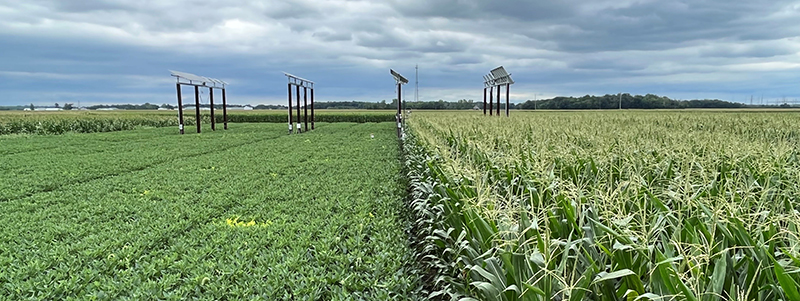
There are those that say solar is a boondoggle and wouldn’t make it without subsidies. Possibly, but farmers know how subsidies work as they are sometimes paid not to plant, told what to plant and subsidized for planting specific crops. They are well versed in how to play that game and how to achieve the best economic benefit from it. Are solar panels the solution to global warming? Hardly. Nor has much of what’s out there touted to change the weather ever resulted in the the reputed outcome. But let landowners take advantage of the rare opportunity to benefit from this one.
One thing that has come out in this that particularly scares me is the bonding or other means of providing for decommissioning of these installations at the end of their life. If we start down that path, where does it end? Drive around Marshall County and you will see abandoned silos, farm windmills, railroad beds on abandoned rail lines, railroad depots, grain elevators, former school buildings, houses, collapsing barns and unusable commercial buildings. That same argument could be used to say we should prevent any of those things happening again, but can you imagine the cost of construction if you had to plan/pay for end of life removal of EVERYTHING? Most construction puts significant funds at risk when the investment in these these things is made. The increased cost due to this increased risk would undoubtedly stop some expansions and new endeavors from happening. In the case of solar farms, you’re asking the companies involved to plan for the cost of removal 30 years from now. What does that look like and how would labor inflation costs balloon that? Building’s generally have lifespans of 2 to 4 times that. How does that even work!?
Again, I believe all of this amounts to spurious concerns, past the aesthetic issues. I’m not thrilled with the aesthetics of high voltage powerlines crisscrossing Marshall County, Those power lines are largely what makes Marshall County attractive to solar farms. But these things benefit my life. Stopping them means hurting other property owners and limiting their livelihoods. If we collectively care enough about stopping these things, then we should put our money where our mouth is and pool funds to purchase and control the property ourselves. Otherwise, be quiet and let progress move on…