Starter Home Barriers

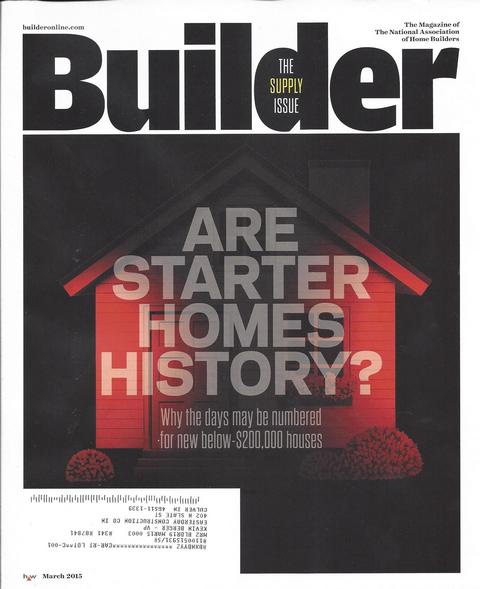
Builder Magazine Cover - March '15As a way to track my thoughts and findings on Affordable Housing, I plan to continue posts here under the tags of “Affordable Housing” and “Sand Hill Farm“.  This will include my thoughts and recollections from Culver’s Affordable Housing Task Force meetings.  That way anyone interested in my take can follow along.

In that vein, I just read an article in Builder magazine titled:  “Are New Starter Homes History?”  I found some interesting take-aways from the article.  Two of the biggest are that they consider a home under $200,000 a starter home and that the general rule for starter homes is 2.5 time median household income, which according to our last Affordable Housing Task Force meeting puts a starter home in Culver at $113,000.  That’s not happening by any stretch of the imagination without serious subsidizing.  Here are some other take-aways from the article:

  1. Making a $200,000 home work is Junior-high-level math.  Solving for 20% profit – Land and building direct costs cannot exceed $160,000.
  2. The lowest build cost is around $50 a foot. To be competitive with existing stock, you need a 2000 sf home which gives you $100,000 for bricks and sticks and $60,000 for the lot.  (That is a price for a developed lot with all the infrastructure, e.g., water, sewer, storm, streets, sidewalks, street lights, etc.)
  3. Metrostudy guidelines say estimated price per bulk lots has gone up from around $50,000 in the recession to over $80.000.
  4. Even if land can be secured at a reasonable cost, cash-thirsty localities heap fees upon fees that weigh more and more heavily on the final home price.
  5. Residential material costs have risen 45% in the last decade.
  6. One way to reduce per lot land costs is to increase density.
  7. Value engineering can bring down costs at the expense of amenities, i.e. build a no frills box.
  8. One question is does today’s starter-home buyer – a millennial adult more often than not  –  want to move into a boxy, no-frills home with Formica and vinyl after living in high-tech student housing and ritzy apartments.  The expectation of what a customer thinks an entry level house is can be crazy.  They want granite countertops, tile backsplash and stainless steel appliances.
  9. There are political ramifications to introducing lower-income citizens into established communities.  Entry-level buyers new to the neighborhood take the not-in-my-backyard hit.

A lot of these are tainted by location.  The commentary about millennials as the target may not be the same here, but when we target starting teachers, we may run into that mindset.  Some of the expectations for the subsidized housing that Culver Academies provides gives credence to this mindset.

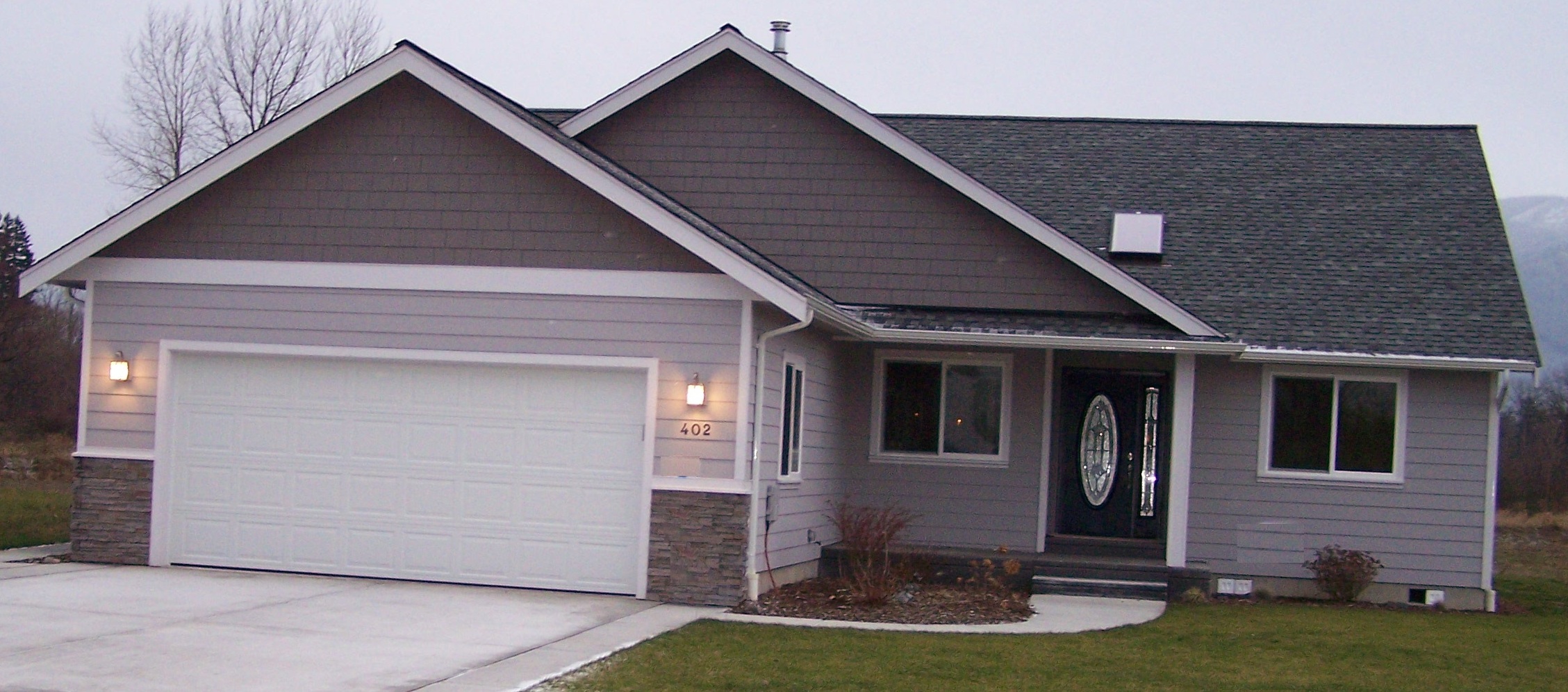
Home Image Source:  Duane Sala Construction

Affordable Housing Update

Culver took a step forward with their Affordable Housing Task Force on Wednesday March 11th.  Representatives from the Town Council, Redevelopment Commission, Plan Commission, Public Schools, Culver Academies and MCEDC met at the library to discuss the issues and goals regarding affordable housing.  With the exception of two with staff positions, all were volunteers from the community stepping up to try and make things better.

Read more

Pocket Neighborhoods

I had written a blog post a couple of years ago about Pocket Towns.  Recently Brent Martin of SRKM Architects sent me a link discussing Pocket Neighborhoods by a different architectural firm with a similar concept.  Brent alluded to this as a possible Affordable Housing solution for Culver.  As with my previous blog post, I can see this having potential in Culver and for Sand Hill Farm.  Currently there is a similar concept, though not an attempt at Affordable Housing, winding its way through a PUD approval at the Culver Plan Commission.  It is a development under consideration on the north side of town that I’m watching with interest.  The PUD framework would allow for the necessary zoning adaptations, but does require a commercial element.  I think the PUD under current consideration is stretching that concept, but technically meets it.  I think it can be done more effectively though.

I continue to think the pocket neighborhood idea is intriguing and while I do not see this working for a large development, I do see how it can be a part of a larger development and could be adapted to an Affordable Housing model.  Below is a sketch from the Pocket Neighborhood website that shows the concept.  Very interesting.


Picture sources:  Pocket Neighborhoods

Sand Hill Farm 2014

Sand Hill Farm

I haven’t written anything about the Sand Hill Farm property in a while, but there have been some things happening there.

Last year the Town of Culver negotiated a new storm water easement through the property.  There was an existing easement that ran diagonally through the property and exited through the Culcom property on Jefferson Street.  The old easement wasn’t a problem when it was planned to be just farm land, but the new easement follows the property lines putting the majority of it within the setbacks.  This frees up additional land for development.  It also provides several access points for future storm water control within the property.  I basically negotiated this as a no cost swap with the Town.  They removed the old easement which was actually a county easement in exchange for the new easement.  It worked out as a win-win for both parties.  The easements allow access and road construction over them, etc.

Read more

Interesting Streetlights

Image borrowed from webecoist.com

In doing the previous post on alternate WECS’s (Wind Energy Conversion Systems) I ran across some interesting options for street lights that are powered by wind, solar or a combination of the two.  Some are more decorative than functional, but I thought they would be interesting to consider for the Sand Hill Farm project.  I’ve collected a list of interesting links below showing some of the innovations that are out there.  I’ve also included some pictures gleaned from the net.

E-Turbine image borrowed from alternativeenergyecogreen.blogspot.com

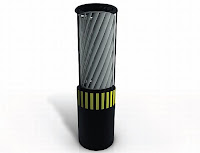
I also was impressed with the idea of the E-Turbine.  This bollard size WECS is designed to be installed along roads and take advantage of the constant rush of air caused by passing vehicles.  I would imagine these would be extremely efficient in underpasses and tunnels where that energy can be directed to the turbines and then employed to light the surrounding areas.  Each Turbine has a built in battery to store the energy produced.  This is similar to the idea previously posted here regarding paving tiles that steal the energy created by foot traffic.

With the currently proposed ordinance these may well be banned too.  0.5 Kilowatts (low end of proposed ordinance WECS definition)  is 500 Watts.   Street lights use bulbs averaging from 35 to 250 watts per hypertextbook.com  That means for a fixture using bulbs at the upper end of this scale, each bulb would require its own turbine to stay under the mandated wattage.


The Flow fixture by Igen Design.  Link:  http://www.coroflot.com/vasquez/Flow-public-lighting-for-the-Third-World

UGE Wind-Solar Hybrid Street Light

UGE’s whimsical  Wind-Solar Hybrid Street Light.    http://www.urbangreenenergy.com/solutions/wind-solar-hybrid-streetlights/how-it-works

Wind Tulip by Tuvia

Wind Tulip by Tuvie:    http://www.tuvie.com/windtulip-wind-powered-street-light-that-looks-like-a-tulip-flower/

Beach Lamp by Zengzhu Deng


Beach Lamp by Zengzhu Deng.    http://www.ecochunk.com/3777/2012/11/14/sea-and-land-breeze-power-the-eco-friendly-beach-lamp-concept/

Loopwing Korea’s WECS

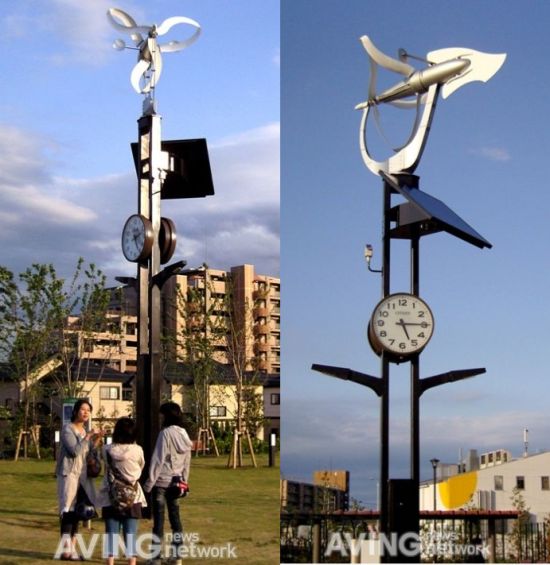
Loopwing Korea powers clocks as well as street lights.    http://www.greendiary.com/loopwing-korea-unveils-self-powered-streetlight-wind-power-generator.html

Of these, I think I like the  UGE version with the banner option and wind/solar combination power.  Some of the links above talk about 400 watt bulbs, but assuming there is a battery to charge too, the wattage may well exceed the 0.5 Kilowatt limitation being proposed.  The wattage restriction would also limit the option of one turbine powering several lights.

The kind of creative thinking that creates these things won’t be stifled by Culver banning WECS’s.  The ban just stops the use of the new technology that’s out there. This is what I tried to suggest at the Plan Commission with limited success.


Read more