Complete Streets II

In the previous entry on Complete Streets, I was discussing development in Culver.  Marshall County is in the process of constructing Pioneer Drive (Pine Road Extension, VanVactor Parkway or Holm Highway depending on what you hear) on the west side of Plymouth.  Theo and I took a walk along it from Lincoln Highway to State Road 17 and back the other evening before the weather turned and before the asphalt was placed.  It was a pretty night for it, though the buzzing, cracking and popping from the high voltage towers was a little disconcerting… 

It appears that Marshall County may have missed several opportunities on this project for implementing some Complete Street ideas.  (Disclaimer:  I have not reviewed the final plans and I’m only going by my observations of the construction as it stands.)  Since this road comes out in the middle of several subdivisions on the southwest side of Plymouth, there could have been better provisions made for cyclists and pedestrians.  Instead it appears that the road has standard shoulders with large deep ditches on either side.  I initially thought that it was probably too far out to really have too much pedestrian traffic, but when I actually walked it the other night, I was surprised to find that I wasn’t the only one out there walking.  Since this road leads to the Lifeplex it would seem only natural that it should include some recreational/physical fitness provisions.  While I doubt sidewalks would have been cost effective for the potential foot traffic, adding a wider shoulder on one side with bike/pedestrian accommodations could have made sense.

The intersection with State Road 17 appears to have some sight distance issues that will make it difficult for both motor vehicles and especially cyclists.  Not to defend their flagrant disregard for road rules and etiquette; it’s pretty common to see bicycles ignore stop signs and lights at intersections.  They seem to do this regardless of the safety hazards involved.

I was disappointed in the implementation of erosion control on this project.  In many of the areas silt fence has been installed merely as window dressing running parallel to the slope rather than perpendicular to the slope where it would be effective.   There were areas where silt fence was installed at the top of the slope rather than at the bottom and was/is having no effect at all on erosion control.  Rip rap was missing from spillways and detention pond structures were left unprotected.

The deep ditches all along the road are disappointing on several levels.  They limit the opportunities for landscaping and the option of making this road into a tree-lined parkway.  They do little to slow stormwater runoff and the detention ponds appeared inadequate to account for the new impervious surface created by this road.  Development expenses will be high since if the ditch dimensions are appropriate then equivalently large culverts will be needed at any driveway accesses.  The ditches will also make it difficult to add lanes in the future if this road should need to be expanded to four lanes (as Oak Road was.).  And finally, since this road is to act as a bypass, then any new drive connections should include accel/decel lanes, which will be difficult and expensive to construct – another thing that is not conducive to development.

Sycamore Road/Rose Road Bypass

There’s no doubt that I was a little jaded on this project from the beginning.  I was involved with the Culver Chamber’s effort to spearhead a true Plymouth by-pass, from where S.R. 17 turns at West High, north to S.R. 30.  My personal feeling is that this would have served as a more effective by-pass and would have furthered the interests of Culver and Ancilla College in the process.  It would have allowed for an aerial railroad crossing due to the natural terrain; something lacking on Pioneer Drive.  (Water under the bridge, since additional residential development has occurred making this bypass route more difficult than it would have been 10 years ago.)  Pioneer Drive does not seem particularly effective as a by-pass or as a means of opening new land for development.  It seems to have missed a lot of its potential.

Community Conversation Follow-up

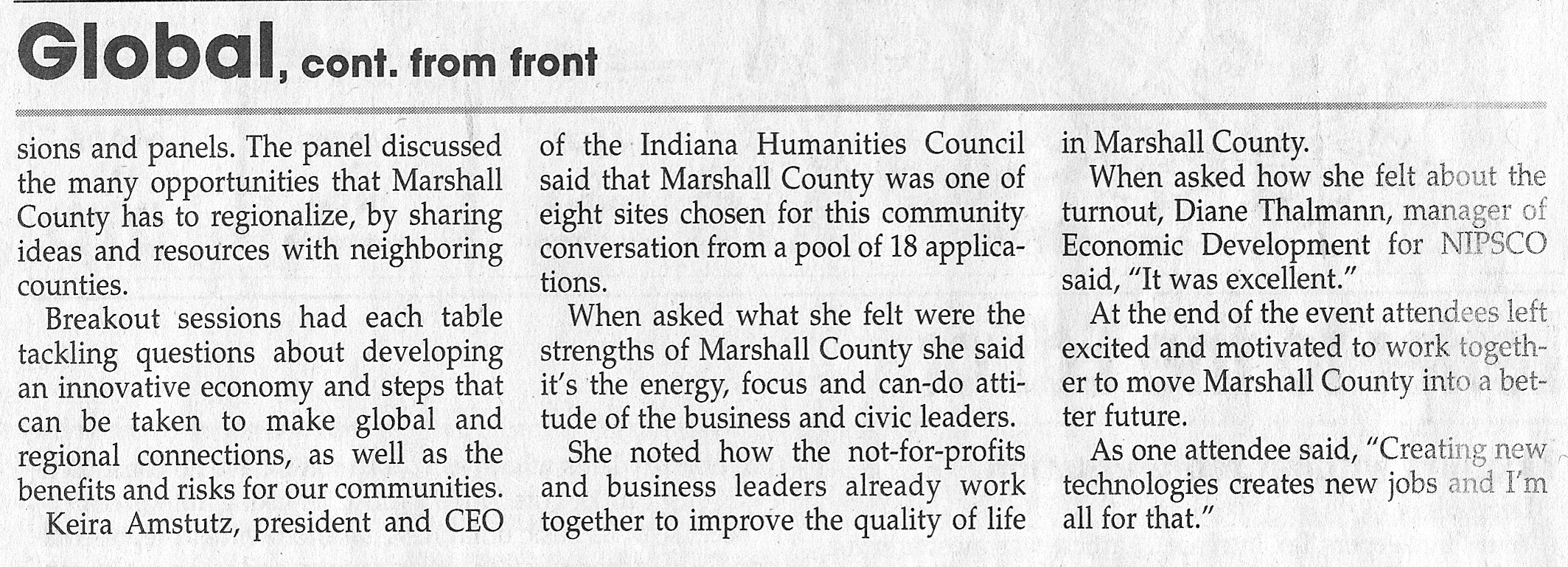
Recap of Community Conversation in the Pilot News, November 18, 2010

I was pleased to see a diverse representation of our County at the Community Conversation last Wednesday.  Unfortunately I had a prior commitment and was unable to participate in the entire program, but I was able to hear the keynote speaker, Richard Longworth, as he spoke about the challenges Marshall County faces.  He also took questions from the audience, which were insightful as well as indicative of where those in attendance thought we were headed.

Second Page of Pilot News Article

I hope this is the first of many such “conversations” about Marshall County’s direction for the future.  Plymouth has just completed a Wheels of Progress survey.  Culver’s Second Century Committee is in the process of reexamining their goals.  I’m sure the other communities in Marshall County have their own steering committees to plan for the future.  If I took anything out of the conversation Wednesday, it was that we all need to shake off the boundaries imposed by towns, counties and states.  We should allow ourselves to think regionally and market ourselves in the same manner.  Otherwise we will continue to  be left behind.  Mr. Longworth indicated that the Midwest didn’t just enter a recession two years ago, but is 30-40 years into a recession that could last a century if we’re not careful.  Something for all of us to think about!

Anirban Basu Quote

“One of the reasons to be skeptical about the prospects for above average GDP growth next year is the knowledge that state and local government spending will continue to fall, at least in real terms.”

—ABC Chief Economist Anirban Basu.

Complete Streets

H.B. 1182, legislation defining Complete Streets for Indiana streets and highways, passed the Indiana House but didn’t make it through the Senate earlier this year.  This Bill followed a national trend to look at streets in a more holistic fashion, taking into account pedestrians, bicycles and public transportation, rather than just the minimalist approach of expediting the transit of cars from point A to point B.  The Complete Streets ideal also looks at issues concerning stormwater control and optimizaton of pavement.

Culver recently received a grant for renovations to Main Street as it runs through the downtown business district.  My understanding is that plans are underway to facilitate these improvements.  I spoke to Town Manager, Michael Doss, and he did not believe that the Complete Streets standards would apply.  (That was shortly after the grant was obtained and now his remarks appear sage-like as the legislation failed to move forward.)  Some of the proposed standards may be of value though and hopefully will be considered by the designer.  Improvements that make the downtown business district more pedestrian and cyclist friendly should be helpful.  We also have a continuing stormwater issue in Culver that could be improved by changes to impervious surfaces in the downtown.  Corrections to the existing stormwater system as well as other infrastructure should be considered as part of this project.  It would be prudent to make sure that we’re not tearing up the new street in a couple of years to correct underlying problems.

Culver does not have a lot of new road construction planned, so opportunities to employ this type of design is limited.  Now that the review of the the Culver Zoning Ordinance is coming to a close, it might be time to revisit the Subdivision Ordinance.  That document has not been updated in decades.  The Culver Comprehensive Plan is also past due for a review.  Some of the new research and trends should be considered for implementation in our planning documents.  Even without updates to these planning documents, there is the potential for doing this type of design through PUD’s under the current ordinance –  something I would hope to accomplish with Sand Hill Farm.

Green That Saves Green 101: T-Wall Intersections

Figure 1 - T-Wall Traditional Framing

Following up on our previous entry on corner connections which dealt mainly with exterior corners, we can look at intersections between interior and exterior walls, often referred to as T-Walls.  These connections create some of the same issues.  There is a need for support at the corner structurally and as a connection point for interior finish material.  Traditional framing accomplishes this using two additional studs in the cross wall to provide nailing corners for interior finishes.  (Figure 1)  When the cross wall is an exterior wall, the same issues of maximizing insulation in the exterior wall applies.  The additional studs can create an insulation void as well as unnecessary use of additional wood studs.

Figure 2 - T-Wall with Bypass Drywall

In a room with drywall finishes, one of the most economical and efficient methods of solving these issues is to install drywall continuously on the cross wall prior to installing the T-Wall studs.  (Figure 2)  This can be accomplished before the cross wall is built or the connecting stud can be left out or loose until after the drywall on the cross wall is installed.  This is a technique that is often used in steel stud framing.

Figure 3 - T-Wall with 2 x 6 Back-up

When it is not practical to install the cross wall drywall first, blocking can be used to provide finish support at corners.  When the T-Wall is 2 x 4 construction, a 2 x 6 installed within the cross wall can accomplish this.  (Figure 3)  As this is only there to create a nailing strip, scrap salvaged from roof sheathing, floor decking or other areas can be substituted for the 2 x 6.  Also, since the 2 x 6 is not there as structural support, it does not have to be continuous as long as it provides nailing points at least every 24″ o/c.

Figure 4 - T-Wall Ladder Connection

Further efficiency can be achieved using scrap lumber, 2 x 4 cutoffs, scrap roof and floor sheathing, etc. to create a ladder effect to provide nailing points.  (Figure 4)  Drywall clips are also a solution, as previously discussed.

These things require planning, but are easily accomplished.

Easterday Construction Co., Inc. will be making every effort to use these more efficient corners for T-Walls on projects as we go forward.  Preferably the bypass method, but using salvaged lumber when this isn’t possible.  This is Green that saves Green!

Summary

  1. Reduction in materials required for the job.  Two less studs and associated fasteners at each corner.
  2. Reduction in labor necessary for material installation.
  3. Reduction in waste material sent to the landfill when cutoffs are substituted for new studs.
  4. Increase in energy efficiency by increasing the accessible wall cavity and eliminating the heat transfer through the additional studs when this situation occurs with an outside wall.