Water Street Townhomes – Firemen, EMS & Fire Sprinklers

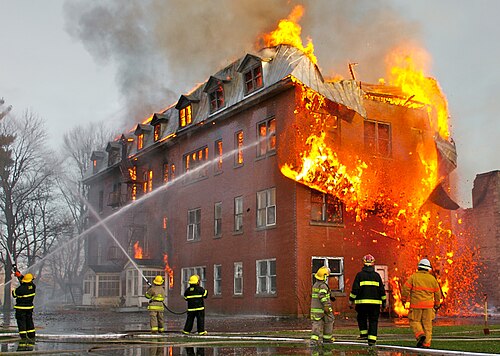
Plymouth Fire & EMS at Water Street Townhomes for a framing tour

Last Month, Chief Holm, allowed us to host the Plymouth Fire Department for a tour of Water Street Townhomes in Plymouth. This was done over three days to cover all three fire department shifts.

We have done this in the past at Sand Hill Farm Apartments and The Paddocks in Culver. We also did this at LaPaz Commons in LaPaz. We generally try and do this at least once during the framing stage so the fire fighters get the opportunity to observe how the framing goes together in case the worst happens and they are fighting a fire in the building or rescuing someone. We generally try and invite EMS as well since it’s a good opportunity to see how to access the building.

In the case of Water Street Townhomes, we showed them where the electric service entrances are with the associate disconnects, where the electrical panels are, where the Knox Box will be and other pertinent information. For emergency access we showed why entrance from the rear might be a better choice due to tight access with a 90 degree turn at the front door.

The buildings are wood framed using modern framing techniques such as engineered wood products. They react differently in a fire than dimensional lumber. We also have 2-hour rated, double 2 x 4 stud, insulated fire walls between the units. These walls have minimal penetrations and have two layers of Type X, fire rated drywall on each side.

In the commercial space on the end, we were required to install sprinklers on the second-floor apartments because those units were over commercial space. While showing this to the firemen, one of the firemen asked why the entire building wasn’t sprinkled? Ah! A teaching moment!

As discussed in this post last week, municipalities charge a fee for buildings to have a sprinkler system. This is a somewhat random fee, for no actual service. Plymouth Water Department Utility Superintendent, Donnie Davidson, said this when asked what the fee covers: “What service is provided is providing water and pressure to the system, the city does nothing else. Everything from the property line is private.”

I took the opportunity to suggest the fireman advocate for the removal of this fee. Municipalities should be doing things to encourage fire sprinkler systems, not discourage them. In the case of Water Street Townhomes, the cost to sprinkle the two 1-bedroom units is $15,800. This is just the installation fee, then there is the $1,500 tap fee and the $537 annual inspection fee. Now on top of all of that, Plymouth charges $54 in its annual Fire Sprinkler Fee. The fee goes up by line size, so this is low as a 1-1/2″ line. Culver would charge their current flat fee of $1,200 + tax (or the new proposed fee of $2,199 + tax) for these two apartments, just as they would for 8, 24, 100 units, etc.)

There is a cost to install the fire walls between the units too, but it is a one-time cost which is less than the cost of installing a fire sprinkler system. (It also does double-duty by providing sound dampening between units.) I won’t leak or require maintenance or inspections. It is one and done. Is the protection as good as what you get with a fire sprinkler system? Probably yes as far as unit to unit spread, but probably not for saving the unit that catches fire. Plus, much more water is used in fighting a fire from the exterior of a building than that used to when a fire sprinkler system douses the fire at the source when it first starts. But as demonstrated with the two flats at Water Street Townhomes, this is only a solution when there is a horizontal division of units, not a vertical division.

I hope the fire fighters I spoke to speak up to City officials and suggest that this fee be removed. The huge and unjustified increase being contemplated in Culver is why these types of fees are scary to developers and building owners. The fact that they are a regressive fee on renters and discourage additional protection for fire-fighters just adds to the negatives.

Regressive Fees

We generally talk about taxes being regressive or progressive. The income tax in the U.S. is generally considered a progressive tax system, i.e. the percentage of tax paid on income progressively increases the more you earn. The Top 10% of taxpayers in the U.S. paid 75% of the total income tax paid, while the bottom 50% of taxpayers pay 2.3% of total income tax paid, per the the Tax Foundation. This is opposed to sales tax, that is applied evenly across the board, but takes a larger percentage of a person’s total income, the lower they are on the income scale. While this is debated incessantly (“Billionaires don’t pay their fair share!”), the various governmental fees are rarely factored in.

I discussed this in a post (Deposit Dilemma) last year, when we first opened Riverside Commons Apartments in Plymouth. At that time, Plymouth required a $150 deposit to start water and REMC required a $350 deposit to start electric, for a total of $500. This for an apartment where some residents were paying less than $400 for rent due to their reduced income level. A similar problem has been brought to light in Culver as the Culver Town Council struggles to meet their water service obligations.

There was a Public Hearing for a new water rate ordinance at the Culver Town Council meeting last week. For various reasons, Covid being one of them, Culver has not raised rates in nearly 15 years. Kicking the can down the road has led to somewhat dire straights and they need to do something. Even those opposing specifics of the rate change, me included, acknowledge that some form of rate increase is needed. Because water service is a service, there is no methodology to do progressive billing. Fairness prevails and the rate goes up across the board with no favoritism. Where this falls apart is in the fire protection fees, specifically fees for fire sprinklers.

The State of Indiana requires new apartment buildings to have fire sprinkler systems if they have more than two units. Somewhere in the past, municipalities were advised to charge fees for these. In reality, it is a tax, as a fee would imply there is some service provided. No service is provided beyond providing water at the street, which they would do anyway. Because it’s termed a fee, there is sales tax attached to this, despite no product or service being provided. We can talk about the life safety benefits of a fire sprinkler system to residents and fire fighters another time, but this cost appears to be without merit.

There is no inspection or scheduled inspections, no maintenance, and no record-keeping. The only justification is the cost of bringing water to the site, which the municipality would do anyway. Reasonably, water usage for a fire in a building with sprinkler system would be significantly less than that used to fight a fire using traditional methods, since fire sprinklers generally put out the interior source before the building is engulfed.

The existing fire sprinkler fee is $1,200. The new ordinance proposed a fee increase of 83% to $2,199. Several points on this:

  • The fee is per system, with no adjustment for line size, square footage covered, commercial vs. residential. On a reducing scale of coverage, CabinetWorks pays the same fee as The Cove, which pays the same fee as Sand Hill Farm Apartments, which pays the same fee as one 8 unit building at The Paddocks. Because there are three separate apartment buildings with fire sprinklers at The Paddocks, they pay this fee three times.
  • This fee had little justification before, but the increase is not tied to any increase in service or increase in cost other than the overall cost of the water system. Whether a structure has a fire sprinkler system or not, does not affect that cost.
  • When this fee is applied to residential units, this results in a double hit, since the resident will experience the increased water bill for their water usage and then a second hit for the fire sprinkler fee. This may come as a rent increase for apartments or a HOA assessment for condos.
  • Because this is labeled a fee, Sales Tax gets layered onto this, further increasing the burden.
  • This unintentionally targets the most vulnerable. Renters often fall on the lower end of the income spectrum, so this fee is extremely regressive, hitting those least able to pay.

The Town Council did listen and delayed a vote on this. (Much Appreciated!) The Town Manager said he would do more research into this. I will be interested to hear the background on how this fee was set and whether there is an option for more fair and equitable sharing of costs.

Happy Little Trees…

It’s too bad that maintaining urban trees isn’t as easy as Bob Ross painting them… They take a lot of work and planning. There are occasional “Happy Little Accidents”, but they don’t always workout so well over time…

I took advantage of Emerson Wells’ office hours a couple of weeks ago and met with her to talk about Culver’s trees. Ms. Wells attends Indiana University and is part of the McKinney Climate Fellows program. It was an interesting discussion. I learned a bit about why Culver is working with her and hopefully contributed a little history and insight from another perspective.

One of Culver’s best aesthetic features is its abundance of mature street trees. Unfortunately, a limited budget has made if difficult to start replacement trees for when the existing trees age out. Then there’s the issue of the indiscriminate butchering of existing trees by utility companies. Ms. Wells is working with the Culver Tree Commission to do some tree canopy analysis, some targeting of tree needs and a maintenance plan to help make sure new planting thrive and older trees are preserved. It was interesting to hear that she was allowed to expand the program, working with the Lake Maxinkuckee Environmental Council, to provide insight on lake shore trees outside town limits too.

After that meeting, I heard from Kevin Danti, Culver Town Manager, that there was some consideration to planting some of this year’s trees on the two Culver Sand Hill Farm properties, Sand Hill Farm Apartments and The Paddocks. I let him know I would be interested in participating. For that reason, I also attended the July meeting of the Culver Tree Commission to hear a little more about their plans.

Culver Tree Commission with Ms Emerson Wells

Despite being a serial meeting attendee, this was only the second or third time I’ve attended a Tree Commission meeting. (It’s been a while as the group is nearly all new members since my last visit!) It was interesting to hear some of their plans and their approaches to things. The Commission is a working group that not only makes the decisions at meetings, but also shoulders some of the installation and maintenance involved with municipal trees. There is some hope that a working subcommittee might be formed to help them. Ms. Wells suggested that she could bring in some people to help with training. I was also pleased to hear that they are going to do the paperwork to re-establish Culver as a Tree City USA community. Apparently, Culver meets all the standards and just neglected to do the paperwork to maintain that status sometime in the past.

The main suggestion I gave Ms. Wells was to consider plantings on the town’s property at the NE corner of Davis and Ohio Streets. This is the new well location and adding some environmental protection there would be good. Plus there are some storm water drainage problems in that area that would benefit from removing some of the impervious surface on that site. Since I couldn’t talk the town into improving the South Main Street/Davis Street intersection with a traffic circle, making it more aesthetically pleasing would be a fall back position. It won’t provide the same safety improvements, but such is life…

Fingers-crossed that Ms. and the Tree Commission are able to do all they hope to do. I think the plans will be a benefit to Culver. Having a plan for the future and not just this year is a big step in the right direction.

Institutional Memory

At the last Culver Town Council meeting, Greg Hildebrand, President of the Marshall County Economic Development Corporation (MCEDC), made a presentation on 2024’s accomplishments and some overall accomplishments through the last several years. Culver’s representative to the MCEDC board turned in his resignation that night as well. Greg told the board he was researching their question about public officials as MCEDC representatives.

As Culver’s first MCEDC representative and as such, a founding member of the MCEDC Board, I found the question surprising. But then I checked the MCEDC website and there is only one board member still there from the early days. Greg is the 6th person in the staff leadership role, so he has no knowledge of the start-up.

Every institution, whether public or private, must evolve. Unfortunately though, when institutional memory is lost, that evolution can involve back-tracking, repetitive spending, and potential repeating mistakes. In the case of MCEDC, the original representatives met for nearly a year before actually forming the corporation and hiring staff. We met with multiple existing Local Economic Development Organizations (LEDOs), which were set up with various structures in order to try and determine what was best. These ranged from local government departments to quasi-government /private partnerships to independent private corporations. We met with site selectors to determine with which form they preferred to work. We met with the State economic development arm, to get their take on what was most effective. Once we determined that the private corporation structure was most flexible and preferable, we researched various corporate forms before deciding on becoming a 501c(6) corporation. Then we hired Ice Miller, one of Indiana’s leading law firms in the area of economic development to help craft our by-laws. Three key take-aways from this:

  • Many site selectors and companies considering a move do not want it public until a decision is made. If the LEDO is a government department or has government representatives on the board, there is a concern about required disclosures that make the potential new business squeamish. For this reason, MCEDC prohibited public officials from holding board positions.
  • A public funded LEDO has more strings attached due to direct tax payments covering costs. MCEDC was set up with service contracts to the various government bodies, so that the services are provided on a consulting basis. This has allowed funding by local Redevelopment Commissions. (It has also caused a few problems regarding flexibility due to government bodies specifying deliverables… not something included in the original contracts.)
  • 501c(6) status makes the corporation a tax exempt entity, but with different abilities and restrictions. This allows contributions from private corporations and individuals to be tax deductible. One other key benefit is a 501c(6) is allowed to lobby government representatives.

The decisions made and the reasons for making them were lost with the retirement of the original board members.

The loss of Institutional Memory has been demonstrated to me in the past from other boards on which I have served too. A new board member has a “new idea” or one they’ve used elsewhere. Institutional Memory could demonstrate how something similar was tried in the past with the associated success or failure. That doesn’t mean the idea may not be worthy of implementation or in the case of past failure, trying again, but maybe it can be improved by past experience or there may be unique reasons why it didn’t work in the past. It could even have left a bad taste in the mouth of donors/supporters and that alone is a reason to avoid it. Board turnover may prevent that experience from moving forward. Sometimes with strong-willed, long-serving staff leadership, the Board gets overshadowed, deferring to staff leadership when staff leadership’s tenure exceeds that of any board member. The Staff becomes the Institutional Memory for better or worse…

I don’t have a great solution for this. Board minutes would be the first line of defense, but there is a wide variety in the way organizations keep minutes, ranging from the bare minimum required by Robert’s Rules, to copious detail on every side conversation. Each has its uses and there are differing schools of thought on which is appropriate for different organizations. Minutes rarely catch everything though.

So here are a few suggestions from my experience on multiple boards:

  1. Minutes should be digitized and searchable. They should be easily available to current board members as a reference. They should be searchable by dates, names and key words. (When I was Secretary of the MCEDC Board, I kept a running to-do list of board decisions that I included at the bottom of the minutes and updated it monthly with new things directed by the board and removing things that were completed in the last month. The Executive Director hated that, but it was useful for accountability.)
  2. Along with board minutes, institutional history should be kept. This can be in a narrative form, added to monthly and included in total, attached to the first meeting of the year’s minutes covering the previous year. This should include successes and failures, in enough detail for a new board member to easily understand what happened. This should also be easily available to current board members in a searchable form.
  3. Board members should be encouraged to provide a summary of their time on the board with the associated highlights and missed opportunities. What stands out when looking backwards can often provide insights and direction for what comes next. This should also be easily available to current board members in a searchable form.
  4. Paid staff should be encouraged to provide their input since they are the day-to-day face of the board and have invaluable insight into what is happening. That said, they should be reminded when necessary that they are not board members, do not have a vote, and are charged with carrying out the board’s directives. (Most of those I have worked with understand this and use their influence judiciously, but I have worked with some that abuse this or balk at taking direction from the board when it doesn’t go their way. They and the board must understand that if this happens too much, it is time for a parting of the ways…)
  5. The searchable sources under 1 through 3, should be consulted anytime there is a new project, staffing change, board reorganization or other activity that could be positively influenced by what came before… This should be a staff function, but should also be considered by anyone suggesting something new or a change in direction. Learning from the past is invaluable.

I believe strongly in refreshing boards and the regular influx of new blood. I think term limits are a reasonable approach to allowing board members a way out as well as a way to encourage new blood, even though this is at the expense of Institutional Memory. But that doesn’t change the fact that the loss of Institutional Memory causes mistakes to be repeated, costs to be repeated and some people to be re-offended. There is a balance for which we should strive, else like MCEDC above, we lose the benefit of the work done in the past.

“Those who cannot remember the past are condemned to repeat it.” – George Santayana, The Life of Reason, 1905

The Cost of NIMBYism to the NIMBY Advocates

Data Center

Marshall County is five months into a two year moratorium on construction of Solar Farms, Battery Storage Facilities, Carbon Capture and Data Centers. This has been due to a small, but vocal group of NIMBYs. This has trickled down to restrictions in Culver and consideration of these issues in other Marshall County communities. As per a previous post here, I maintain that communities are either growing or dying. Setting that aside, there may be additional costs to our leadership’s decision to limit or stop development.

The recent actions of the state legislature and new governor has reimagined our tax structure. This means that local governing bodies have to figure out how to do more with less tax income. Turning away new development, with the associated additional tax income, is not a proactive way to address this.

All of the development associated with the construction under the moratorium has minimal long-term impact on county resources. As with any construction, there will be short-term impacts on roads, but those can be mitigated or negotiated as part of the development package. These are not projects that will employ hundreds of people (though the few they do require will be highly-skilled and well-paid), so they will not require acres of parking lots, they will not increase traffic counts on our roads post-construction, they will not cause any increase to our current housing shortage… What these developments will do is pay a lot in taxes, donate to local charities and provide resources for other development where we can look to additional high wage jobs.

Of the four moratorium targets, Data Centers in Indiana have specifically been touted by President Trump and our State government. Turning our backs on any of these initiatives makes us look provincial. That’s not the way I want our county to be perceived.

I am not saying that these should be given free rein and there should be no restrictions on their construction. I don’t know that a short (very short) moratorium isn’t appropriate while research is done, but a two year moratorium likely means that nothing happens for 18 months or more. We don’t have to reinvent the wheel here. Other communities have these and would happily share what they have learned. To my knowledge, there has been little time spent working on new regulations by Marshall County, let alone trying to reduce the length of the moratorium… of which 5 months have passed already… The recent changes to tax laws should make this a priority, not to mention the possibility that we are missing opportunities while other communities take advantage. Those opportunities could be gone if the needs are filled elsewhere.

The tax cost is just one effect on the NIMBYs (and the rest of us). A Department of Energy (DOE) report from December of last year found, “…data centers consumed about 4.4% of total U.S. electricity in 2023 and are expected to consume approximately 6.7 to 12% of total U.S. electricity by 2028. The report indicates that total data center electricity usage climbed from 58 TWh in 2014 to 176 TWh in 2023 and estimates an increase between 325 to 580 TWh by 2028.” As Data Centers consume more power, there will be costs to all of us as power production is ramped up (more costs), and competition for power drives the price up. Our moratorium stops two of the ancillary developments, solar and battery storage, that could help mitigate this too.

Allowing these facilities won’t reduce our electric bills. They could keep us from getting a double hit from higher taxes and higher electric bills and if done right, maybe lower taxes to help mitigate those higher electric bills.

One more time, for those in the back of the room… Communities are either growing or dying! This doesn’t mean we shouldn’t assure that it is smart growth, but extending an open hand in friendship is probably better than showing a closed fist. Our vocal NIMBYs may well cost us all in the end…