Implementing Culver’s Comprehensive Plan

Culver 2024 Comprehensive Plan

I’ve mentioned several times in previous posts that I am concerned about Culver’s lack of movement on the new Comprehensive Plan. (Here and here if you want to see a few past comments.) At the December Plan Commission meeting, they set up a work session to discuss accessory dwelling units (ADUs).

During Citizen Input, I commended them for tackling the ADUs, but reminded them that was only one of a myriad of changes suggested by the Comprehensive Plan. After the 2014 Comprehensive Plan, then Council President, Ginny Munroe, immediately formed a committee that created a Strategic Action Plan (SAP) and a Capital Improvement Plan (CIP) to implement key points in the plan. This fostered the creation of an entry-level housing committee that ultimately resulted in Culver achieving Stellar Community Designation. A few of the results included, 72 new housing units in the Sand Hill Farm development, the new Damore Amphitheater in the Park by the lake, the new Cavalier Park by the school and another trail extension.

Looking from the outside, the current town council has not done much to implement the new plan. The Culver Redevelopment Commission (CRC) is making some moves toward implementation, but it really needs to start with the Plan Commission and the Town Council. Many of the recommendations will require changes to the Zoning Ordinance and that is a function of the Plan Commission.

Section 5 of the 2024 Comprehensive Plan talks about implementation and includes a Priority Action Plan. While many of the recommendations require action by the Town Council, even those should be pushed by the Plan Commission as technically, the Comprehensive Plan is a Plan Commission document, adopted by them prior to adoption by the Town Council. For the ones specific to the Plan Commission, here is a short list:

  • Page 73, review the Zoning Ordinance to see where it affects plan goals negatively and what changes should be made to foster achievement of goals. Specifically, “The Zoning Ordinance can be used with the Future Development Character Map to set a vision for how land is used at the parcel level.” The Zoning Ordinance is currently being reviewed by the Town Attorney for technical problems. This appears to be putting the cart in front of the horse, as a review of proposed outcomes should have been done first as some of the things currently under review will likely change and other things will be added.
  • Page 74, “A goal of the Priority Action Plan is to update the Culver Zoning Ordinance to enable some of the goals and strategies of the Action Priority Plan (sic) to be accomplished.” Some of the Comp Plan’s proposed use changes don’t fit neatly under the existing Zoning Ordinance. This might require changes to existing districts or even the creation of a new district. This should be done in a thoughtful process and not on a whim, with a lets-see-what-happens attitude. While the Plan Commission is not responsible for creating the CIP, their deliberation on Comp Plan goals will help set priorities for the CIP. For example, the Comp Plan talks about future development in unimproved areas. The Plan Commission will need to make Zoning Ordinance changes if they want to foster that development and from that, the Town Council will need to budget (CIP) for infrastructure improvements necessary to make that development possible.
  • Page 75, Land Exaction Tools. “An impact fee is a land exaction tool the town can use to implement public infrastructure and facility (sic) projects.” Impact Fees could be part of the Zoning Ordinance. Culver is not a booming economy where development is clamoring to happen, thus impact fees are unlikely to foster what we want to see happen, nor will they solve the problem of infrastructure costs. Conversely though, they can be a tool that impedes less desirable development, and can be waived to promote desirable development. The consideration of waiving fees can be a negotiation tactic that helps mold development to Comp Plan goals. Care should be taken to not drive away development that sees the fees and doesn’t understand the system. Care should also be taken to tread lightly and not give grounds for complaints of unequal treatment.
  • Page 76, Tax Increment Financing (TIF). While this is a function of the Redevelopment Commission (CRC), the Plan Commission should be aware of where TIF districts are set up and work with the CRC to take advantage of them. I would strongly recommend that this be part of the Building Commissioners checklist and whenever new development is considered, that the CRC be notified so they can assess how it will affect existing TIF districts and if not in a TIF district, whether expansion of the TIF to include the new development is warranted. As the Building Commissioner works most closely under the Plan Commission, the Plan Commission could request this be included in his reporting to them.
  • Page 83, A, Appendix – Action Program. While the Comp Plan pulled some specific priority goals for the Plan Commission, as listed in the first three bullet points above, it also includes ALL of the goals. This was done with the recognition that Comp Plans are meant to have a life of 5-10 years and the hope is that the priority items get completed quickly. Then the Plan Commission can pick from the remaining goals to continue improvements. That said, there are already different plan commissioners from when the plan was adopted. The Plan is a living document that needs to be flexible and if the new group of plan commissioners want to tackle different thing, there is a whole list available with documented citizen support.
Future Development Character Map from Culver 2024 Comprehensive Plan

Further emphasizing the need to look at the existing Zoning Ordinance, one of the things highlighted in the Future Development Character Map, Page 58, (right) was the creation of “Entertainment Corridors”. These were designated for Lake Shore Drive, Main Street and Jefferson Street. This was an acknowledgement of Culver’s Tourist and second home resident focus. In the discussion of these corridors, the conversation revolved around walkability, mixed use (commercial/residential) and diversification of our economy for year-round attractions.

Bringing these corridors to fruition, could be handled several ways, through modifications to existing districts, creation of new districts or through some form of overlay district. All will require more in-depth analysis and some rezoning to make them happen. This mixed use focus, could allow changes preventing problems such as were created with the rezoning of 303 Main Street. There is a definition of this district on Page 59 of the Comprehensive Plan, but not to the level of a Zoning District.

The Future Development Character Plan also looks at expansion of the “Employment Center” which would be Commercial/Industrial in the current ordinance and an expansion of the “Regional Commercial” area, which would be C2 under the current ordinance. The Plan Commission should contemplate how they want to foster these community goals.

In any case, there is a lot that should be on the Plan Commissions plate and rather than letting these things languish, they should start to tackle them. If they can break these down and address them in pieces, they’ll make progress. As the old saw goes, “How do you eat an elephant? – One bite at a time…”

End of an Era

Kevin Overmyer

With the retirement of Marshall County Commissioner, Kevin Overmyer, 2024 is the end of an era. Kevin, like is father, Glenn, served multiple terms as Marshall County Commissioner. In total, Marshall County went 46 out of the last 52 years with an Overmyer at the helm. I know there has been some ugliness over the last couple of years, but the positive impact of Kevin and his family has had on the county is undeniable. 

A few years ago, a friend decided to run against Kevin. I was asked to support him in his bid to replace Kevin. My friend told me he thought Kevin’s time was up and that he could do a better job. I had to explain to him that, 1) He might be able to do as good a job… eventually…, but 2) As long as Kevin was willing to serve, his knowledge and connections were invaluable. This was a difficult position for me to take as I generally agree with the idea of term limits, the transfer of power, and the value of new blood. The problem is as long as that’s not a universal concept, the value of connections to politician at the State level are undeniable for a small rural county like ours. His respect in the larger State arena was shown when he was elected President of the Indiana Association of County Commissioners (IACC) Northwest District. 

The above was demonstrated to me during my time serving on the board of MCEDC. A new project in Bourbon drew attention and support from the State. State officials attended the meeting and speeches were made. As was generally the case, Kevin was not one who wanted the spotlight, but it was turned on him by the State officials in their speeches and in the casual conversation at the reception that followed. Stories were told of Kevin’s trips to Indianapolis for meetings as well as kitchen table meetings with these officials in Kevin’s home. Kevin understood the power of these connections and that power was subtly demonstrated that day.

Kevin also understood the value of keeping Marshall County on the map. He made a false start at an economic development entity several years before MCEDC came to be. It failed due to some of the petty bickering that often occurs between municipalities, i.e. what I have referred to in the past as the lasting legacy of old basketball rivalries. Rather than dropping the initiative, he let the idea cool and simmer. Then, learning from his mistakes in the first attempt, he resurrected it in a new form, addressing the stumbling blocks of the previous attempt. This is what became MCEDC (Marshall County Economic Development Corporation), without which our county wouldn’t have made strides to create shell buildings that brought in new businesses, wouldn’t have created the partnership that brought Regional Cities dollars to Marshall County and kept us in that partnership, participating in READI and READI 2.0. When I was Chairman of MCEDC, I recognized the struggle with the municipal rivalries and with Kevin’s (and Roger Umbaugh‘s) help MCEDC created what became the quarterly County Development for the Future meetings. Those meeting broke down barriers, which helped Culver achieve Stellar Community status. That lead to Kevin co-chairing Marshall County’s Stellar aspirations and eventually achieving Stellar Region status.

Kevin also understood the need to work together and move things forward. Bureaucracies are born to grow and create barriers. Even at the County level, this is the case. Kevin had a keen eye for when the red tape was necessary and when it was just an impediment. He was someone you could call to make the right connections, make determinations between what was just policy and what was law, and help make things happen. He was adept at doing this, not only with those under his direct jurisdiction, but down stream in municipalities and upstream at the State. Kevin had a keen nose for BS and who was trying to do the right thing and who was trying to just skirt the rules.

I understand Kevin’s desire to retire and leave the stress behind. He has served Marshall County well, though that isn’t always recognized and no one is perfect. All and all, I feel he’s left a positive legacy. Which is the best any politician can do.

So, I want to end this wishing Jesse Bohannon the best and with the hope that he also can create a positive legacy in his time in office serving as commissioner. It won’t be easy and some of the rancor from the campaign will make this less than a smooth transition. As with my friend I mentioned earlier, I know those relationships can built again, but there is no shortcut for the time that requires. Kevin had a bit of a shortcut through his family name and Glenn’s years of service. Jesse will need to build that all on his own. Good luck Jesse! I hope people remember your time in office fondly 20 years from now too!

More thoughts on Culver Lights

This post tangentially, convolutedly, connects to the recent Hello Darkness post on sign lights. At least it connects for me, the way my mind works…

Welcome to Culver Sign at intersection of 10 & 17

The Culver Charrette that was done in 1998 promoted the idea of continuing themes in Culver. One of them was the use of field stone. The Culver Chamber of Commerce embraced this with the field stone and limestone Welcome to Culver sign at the intersection of 10 & 17 as well as covering the wall at the Lake Shore Drive curve across from The Original Root Beer Stand with field stone. Some development in Culver has embraced this and some hasn’t, but it’s nice when it happens. Sand Hill Farm used this in the entrance sign at Jefferson Street and The Paddocks embraced it as an accent on the townhouses in that project.

Another theme that the Charrette suggested was “Utilize a uniform decorative lighting standard throughout the linkages in Town.” This was done along Lake Shore Drive and Main Street. It was continued part of the way out on Jefferson Street with the trail. It was also recommended as part of the Complete Streets discussion. (I couldn’t find the Complete Streets Ordinance on the Town of Culver website, but Kevin Danti, Town Manager, was kind enough to share a copy with me.)

While the lights were installed to follow the bike and walking trail out Jefferson Street to Sand Hill Blvd, neither the lights or complete streets designs were used in the last street Culver put in, Cavalier Drive. The lights were not used along the trail as it goes south from the downtown area of Main Street out to the Masonic Cemetery. I assume per these standards, Resolution 2018-007, Sec. 3(b), will be applied in The Dunes subdivision, though I am not privy to the negotiations on that project infrastructure. They could well have been waived as they were for Cavalier Drive.

I think the consistent themes suggested by the charrette, add to Culver’s character and contribute to Culver being a memorable destination. The lights are not inexpensive, but their ability to be functional and add charm should not be ignored. As with the lighted signs at the edges of town, it would be good to consider a phased spending plan that adds these fixtures to all the main entrance streets. I would also suggest that they be included along the new trails as they go through town as well, since the trails are part of Culver’s destination marketing. They would make the trails more accessible, safe, and using these lights create a more walkable scale than where there are the taller utility pole mounted fixtures.

The lights contribute to the character of Culver that sets us apart. What we locally take for granted, makes us standout to visitors…

Solar Subdivisions

So this is an idea that came to me last week while sharing a couple beers with a friend associated with the solar industry. I’ll throw it out here and see if it has any legs. With the ridiculously large buffers being requested around the perimeter of solar farms and our dearth of available housing (1,300 units needed right now per the Housing Matters study done by United Way of Marshall County and backed up by the Regional Housing Study being done by MACOG), it would seem like a great idea to subdivide the proposed buffer and building housing around the perimeter of these solar farms. This would change the solar companies lease model, but with the solar companies’ help, this gives the farmers another source of income from the sale or rental of these perimeter properties.

As discussed here before, it seems the main complaint about solar is visual, i.e. the neighbors don’t like looking at them. This would solve this problem as anyone moving into these houses would automatically know what to expect. Many on the “green” side will want to live there seeing it as part of a sustainable future. I can already see the future subdivision names… Green Acres… Solar Farms… Sunshine Place…

Marshall County’s Zoning Ordinance’s A-3, Agricultural Residential District calls for a minimum lot size of 1 acre, which is 43,560 sf. I would like to think this could be negotiated down some, but to some extent these lots need to be larger to accommodate wells and septic fields. (County side sewer could allow some reductions.) Differing buffer setbacks have been requested, ranging from reasonable to absurd, but a mid range 500′ setback, that gives a lot approximately 90′. There could still be a buffer planting on the rear property line of these lots to appease the extreme solar haters, but there won’t be much to see.

This solution provides better use of land. The buffer areas aren’t large enough for much true farming and if they are planted with buffer trees, then they aren’t great for farming anyway. Electricity from the solar field could supplement the housing as a sales incentive, creating solar converts as they go.

Like solar itself, this wouldn’t be the answer in every case. But it might serve double duty in some cases and help find compromise.

Hello Darkness

Welcome to Culver Sign at intersection of 10 & 17

I don’t know about you guys, but I’m so thrilled with the time change and darkness at 5:00. Ha! I saw a meme that inspired this post title that was a play on the Simon & Garfunkel song, “Sound of Silence”. (Though I do kind of like this cover by Disturbed.) The meme went “Hello Darkness my old friend. Soon you’ll start at 5:00 again…” If you read what I post here, you know I’m against the time changes whichever the direction, and I would be fine with it dark at 5:00, if it just gradually happened naturally as it should. Whichever time we’re on, here in northern Indiana, I would be going to work in the dark and returning home in the dark anyway.

Culver Sign
Time Temperature

But one of the things this has brought to light (pun intended) is Culver’s welcome signs have gone “Dark Skies” on us. The lights on the limestone Culver Sign (above) at the east intersection of 10 & 17 are out. The internal light in the relatively new electronic sign at the end of school street (left) has been turned off. And in a “Made You Look” moment, I checked, so you didn’t have to, and the welcome signs at the west end of Jefferson Street and Mill Street were never lit.

I made an enquiry about the two signs that had lights and was told no one else had notice (or said anything) about the limestone sign lights. The light in the top of the electronic sign was turned off because the neighbor complained. Keeping with the song theme, apparently, “She was Blinded by the Light” per Bruce Springsteen. (Though again, I am partial to this cover that was done by Manfred Mann’s Earth Band.)

I’ve discussed the electronic messaging sign here often, and I wondered about the neighbor when it was installed. It doesn’t surprise me that it’s obtrusive. I think the flashing, changing message (often with a white background) is probably actually more of a problem. That could be solved only using messages with a colored background. Most of those are the affirmations, so that should be easy to change. For the upper sign, most of these lights would have the option for dimmers, but if that’s not possible, a screen could be added to the interior of the sign on the east side to reduce the light. There are various screens that reduce opacity that would do the trick.

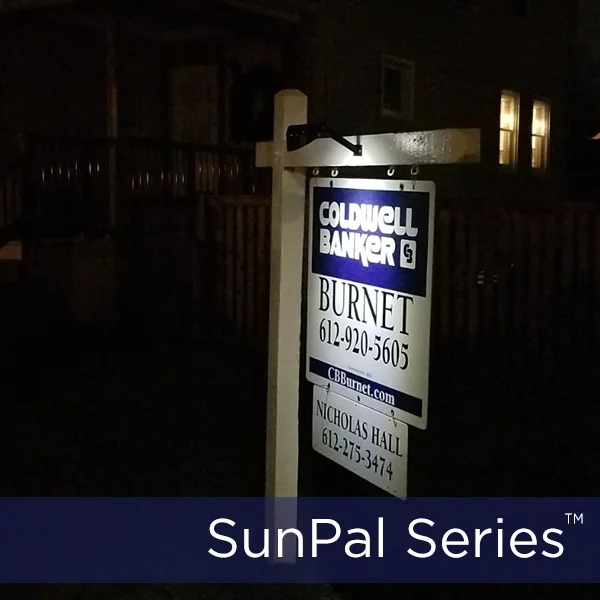
Silicon Solar Real Estate Sign Light

Not much to say about the limestone sign. I assume it needs new bulbs, but we installed those fixtures decades ago and it would probably make more sense to replace the fixtures with new LEDs that use less energy. If I get a vote, something could be done in a soft off-white light that brings out the stone and not a harsh white. As far as the west entrance signs go, it would be relatively inexpensive to install a solar (Oh my goodness! I said that word!) sign lights that would mount to it and light up the faces like the one here for $15.95 (right). Pretty inexpensive even if it has to be replaced often.

Culver doesn’t have much of a highway presence, so all of these signs are important. I doubt they’re going to inspire anyone to make a sudden turn into town. They would help with someone trying to find us though. They also might inspire a stop at a later time, if someone was just passing by. They are already here, we should make the most of them. Light ’em up!