Water Street Townhomes – Lease-up

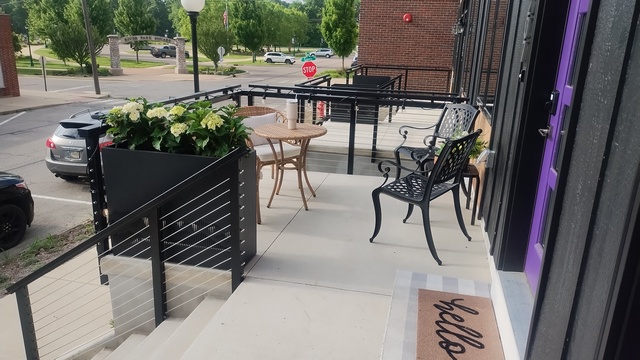
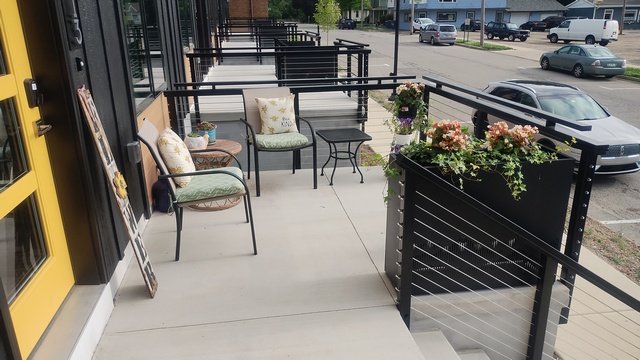
The Water Street Townhomes project is starting to lease up. Two of the new tenants have personalized the front patios with furniture, flowers and in one case, lights. Very nice! I want to go down there some Friday evening and see how they fare with the Mayor’s Summer of Music in River Park Square. The Water Street Townhomes patios should be prime listening spots!

I spent a little time there before a meeting pulling some weeds in the beds. The cooler wet Spring has allowed the landscaping to become established. I’m hoping it didn’t suffer too much through the heat we’ve been having. Things are looking good and I am hopeful that the Creeping Thyme will fill the tree lawns and put on a vibrant display next Spring. What i can’t figure out is how to stop the birds from dive-bombing and pooping on the back wall! What’s up with that!?
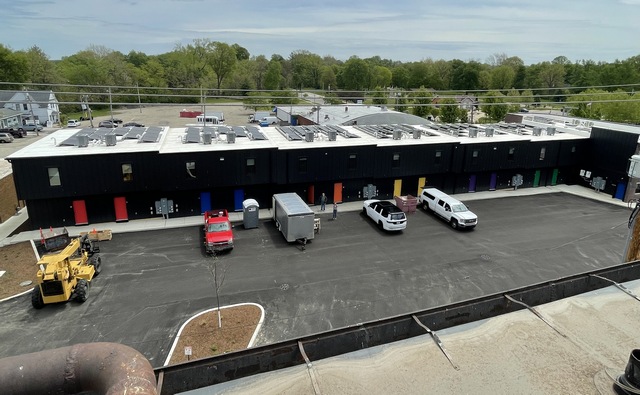
View of Water Street Townhomes from the roof of The Heartland Art Center shows the solar panels on the roof

We haven’t gotten the final software connections made on the solar panels yet, so I’m eagerly waiting to see the effects on the electric bills. Things are set up for tenants to pay the difference. If things work like they were sold, tenants should mostly be without electric costs in the shoulder months… unless they are big bakers… Ha! The units are all electric, so that should be a plus for them. All of the residential units have supplemental solar. The solar panels are mostly invisible from the ground, but Brent Martin from SRKM Architecture took the picture to the right from the roof of The Heartland Arts Center. He is the Architect for that renovation project as well as the Architect for Water Street Townhomes.

There was supposed to be a sister project, Spirit Townhomes in Culver, but the Town Council withdrew support, instead pursuing other projects.

Other than some subcontractor/supplier delays, this was a good project. I’m happy to see some progress towards the project leasing up and supporting itself.
Solar Subdivisions

So this is an idea that came to me last week while sharing a couple beers with a friend associated with the solar industry. I’ll throw it out here and see if it has any legs. With the ridiculously large buffers being requested around the perimeter of solar farms and our dearth of available housing (1,300 units needed right now per the Housing Matters study done by United Way of Marshall County and backed up by the Regional Housing Study being done by MACOG), it would seem like a great idea to subdivide the proposed buffer and building housing around the perimeter of these solar farms. This would change the solar companies lease model, but with the solar companies’ help, this gives the farmers another source of income from the sale or rental of these perimeter properties.

As discussed here before, it seems the main complaint about solar is visual, i.e. the neighbors don’t like looking at them. This would solve this problem as anyone moving into these houses would automatically know what to expect. Many on the “green” side will want to live there seeing it as part of a sustainable future. I can already see the future subdivision names… Green Acres… Solar Farms… Sunshine Place…

Marshall County’s Zoning Ordinance’s A-3, Agricultural Residential District calls for a minimum lot size of 1 acre, which is 43,560 sf. I would like to think this could be negotiated down some, but to some extent these lots need to be larger to accommodate wells and septic fields. (County side sewer could allow some reductions.) Differing buffer setbacks have been requested, ranging from reasonable to absurd, but a mid range 500′ setback, that gives a lot approximately 90′. There could still be a buffer planting on the rear property line of these lots to appease the extreme solar haters, but there won’t be much to see.

This solution provides better use of land. The buffer areas aren’t large enough for much true farming and if they are planted with buffer trees, then they aren’t great for farming anyway. Electricity from the solar field could supplement the housing as a sales incentive, creating solar converts as they go.

Like solar itself, this wouldn’t be the answer in every case. But it might serve double duty in some cases and help find compromise.