A Big Week for Culver Garden Court

Real Estate Management Flyer describing Culver Garden Court Amenities

The week of 8/16/10 was a big week for the planned Culver Garden Court project.  On Tuesday, August 17th, I presented the Minor Subdivision plan for the Wade & Claudia McGee Subdivision to the Culver Plan Commission for approval.  Culver allows Minor Subdivisions  of property consisting of three or less parcels to be completed with a single presentation.  This presentation went smoothly and was accepted by unanimous vote.  All members of the Plan Commission seemed pleased that the project was moving forward.

On Thursday, August 19th, Brent Martin, Project Architect, and I presented the Special Use Permit request to to the Board of Zoning Appeals (BZA).  The BZA had a full schedule and we were fifth of five on the agenda.  Brent had the opportunity, whether he wanted it or not, to observe the Culver BZA in action on several things before we presented. 

The Special Use Permit covered several items:  1)  We applied for the Culver Garden Court project as Apartments which are allowed, but require a Special Use Permit under the existing S-1, Suburban Residential, Zoning District.  2)  The 535 sf units are smaller than is generally allowed under Culver’s multi-family housing requirements.  Since this is a HUD project and the 535 sf size is a HUD maximum square footage under 202 projects, the BZA agreed to this change and allowed the project to move forward.  3)  Culver’s parking space standards require 2 spaces per unit.  We were granted a change from the required 26 spaces to 16 spaces.  This has proven to be an adequate ratio on previous Garden Court projects.

Culver’s Board of Zoning Appeals is operating with one vacant seat.  Fortunately this wasn’t an issue and the Special Use Permit was granted unanimously, 4-0.
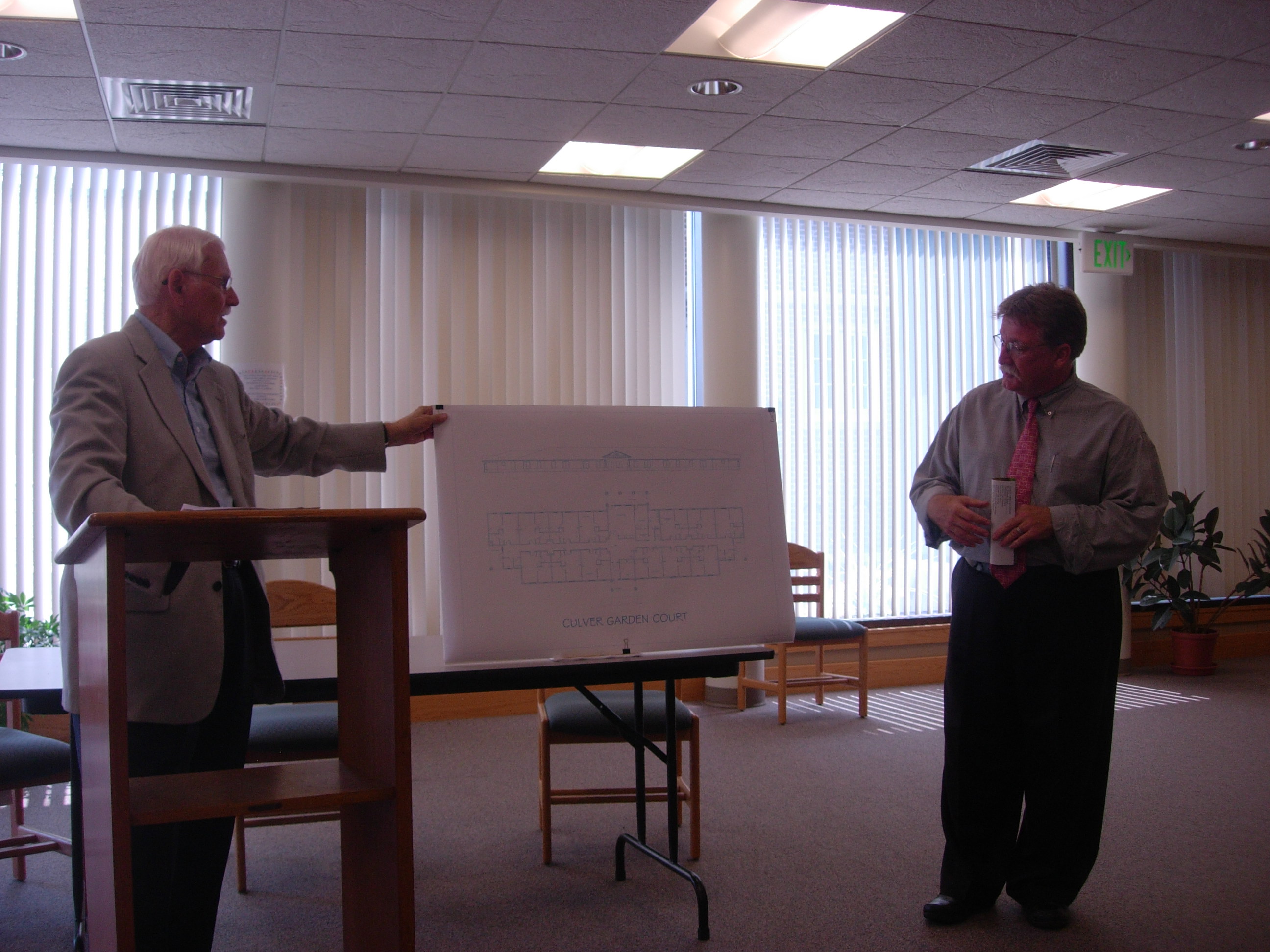
Dr. Ronald Liechty and Brent Martin presenting highlights of the Culver Garden Court Plan

On Friday, August 20th, there was a press conference at the Culver Union Township Public Library officially announcing the planned Culver Garden Court.  Dr. Ronald Liechty, President of Garden Court, Inc., gave a speech congratulating all involved.  Congressman Joe Donnelly spoke as well, giving accolades to Garden Court, Inc. and his assurances that he did all he could to make this project possible and that he knew that it would be a positive addition to the Culver Community.
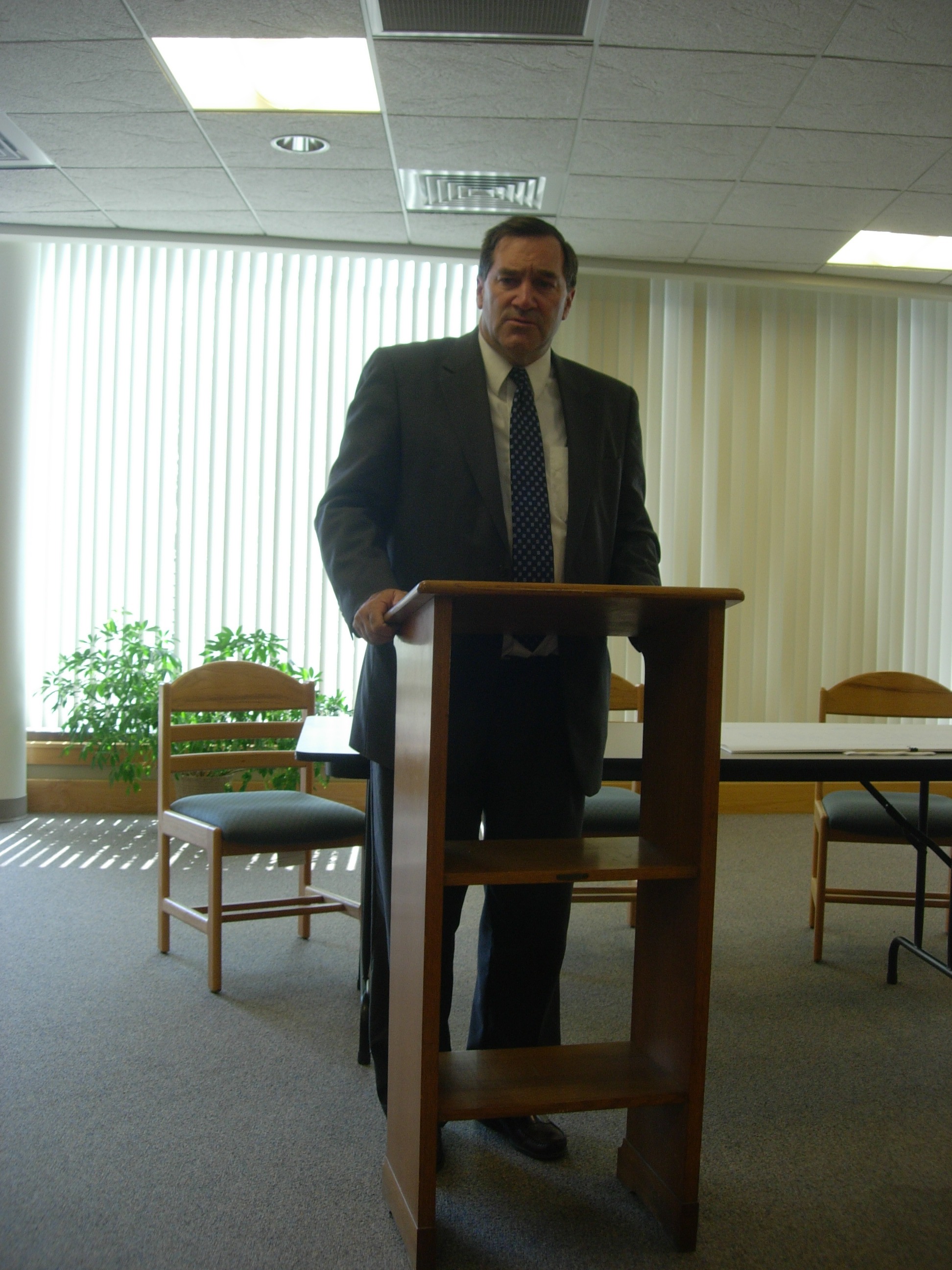
Congressman Joe Donnelly speaking at the Culver Garden Court press conference

There was a fair turnout for the event.  Culver Town Council board members Ed Pinder, Lynn Overmyer and Ralph Winters all attended.  Greg Fassett was there representing both Miller’s Merry Manor and also wearing his hat as Culver Chamber of Commerce President.  Representatives from the Garden Court, Inc. Board were there as well as several representatives from Real Estate Management Corp.  Jeff Kenney, Editor of the Culver Citizen, was there reporting for the Culver Citizen/Pilot News.  We ended up with a front page picture and article in the Pilot News, but it didn’t make the website, so I can’t provide a link.  There were citizens there as well and Dr. Liechty fielded several questions from the audience regarding this project specifically and Garden Court in general.

We are currently waiting on plans from B.A. Martin Archtects, P.C. in order to begin pricing.  We hope to have things together for a closing on this project prior to September 30, 2010 which is HUD’s year end.  Unfortunately, we are also waiting on release of the 501(c)3 designation for this project.  We cannot close without that.  Despite all the talk about efforts to expedite projects, Washington still moves slowly on most of these things…  We will be breaking ground on this project as soon as we can get the release.

Justice Moment

Highway 17 between Plymouth and Culver can be frustrating.  There are a number of hills and curves allowing very few places to pass.  There is also a significant amount of traffic in both directions making it difficult to pass when you do reach the few available passing zones.  Add Burr Oak to that, with its inordinately long reduced speed zone and the bypass train stop across the highway.  There have been more than a few times when I’ve come close to a collision with a frustrated (and possibly psychotic) driver coming from the other direction that has chosen to pass on a double yellow with no visibility.  I’ve also been made late by his counterpart, the driver that choses to putt along at 40-45 mph with a line of 15 cars behind him, oblivious to (or again, possibly they’re psychotic) the waves of hate coming from the motorists behind him.

My wife, Becky, had a Justice Moment coming into town last night.  She was coming into Culver to meet me, running late (my fault, not hers), and got stuck behind one of the slow drivers, driving around 40, maxing out at 45, and oblivious to the line of cars behind him and the choice words coming from my sweet wife in car number 6.

She followed him from our house to Burr Oak, but when he got to Burr Oak, he continued into town at 45mph… through the 35mph zone… and met a nice State Trooper waiting for him.  I can picture Becky’s seat dance and fist pump “Yes!” as she and her fellow friends in line paraded by him.  Sometimes it’s the little things that lift our spirits.

Green That Saves Green 101: T-Wall Intersections

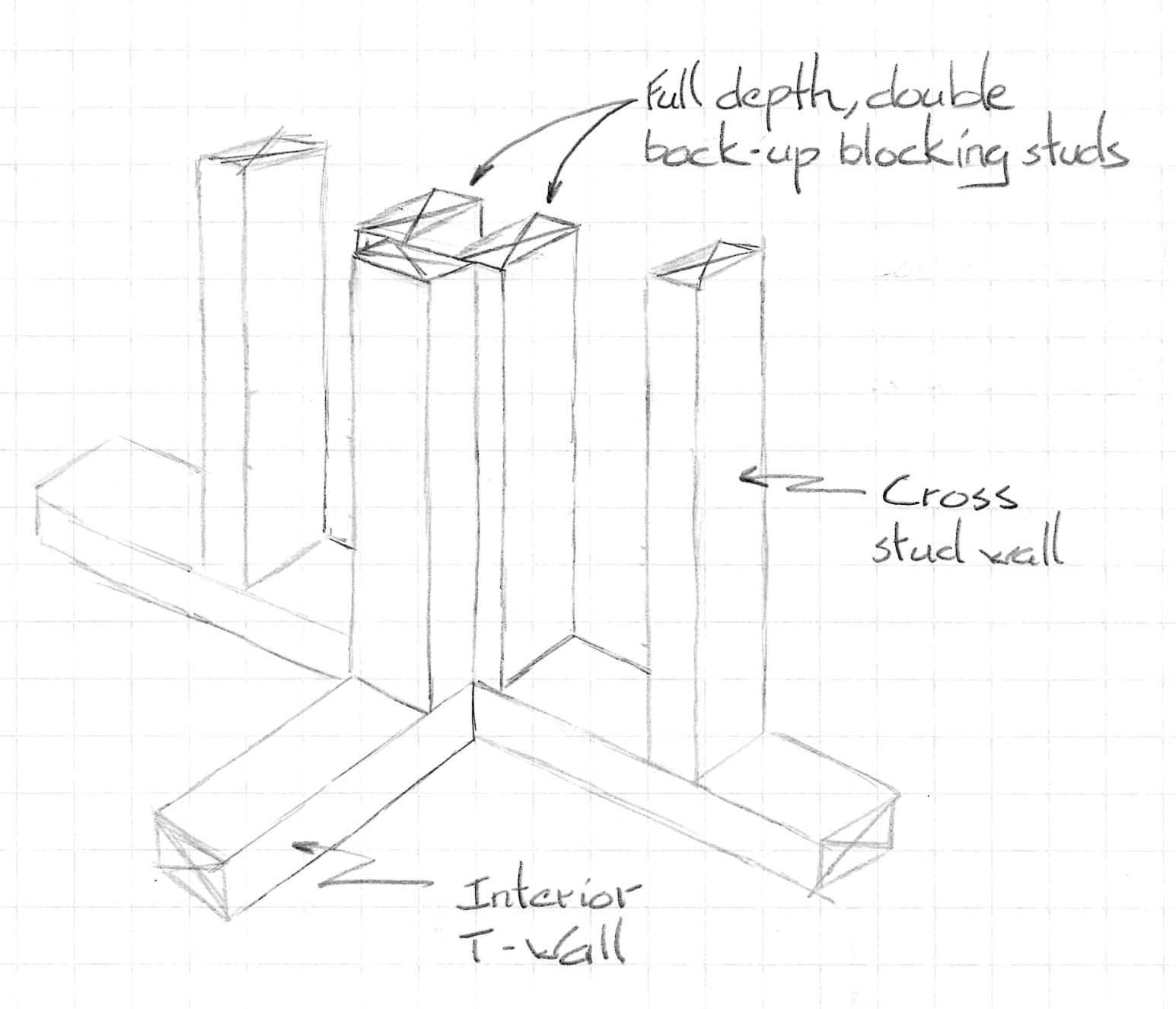
Figure 1 - T-Wall Traditional Framing

Following up on our previous entry on corner connections which dealt mainly with exterior corners, we can look at intersections between interior and exterior walls, often referred to as T-Walls.  These connections create some of the same issues.  There is a need for support at the corner structurally and as a connection point for interior finish material.  Traditional framing accomplishes this using two additional studs in the cross wall to provide nailing corners for interior finishes.  (Figure 1)  When the cross wall is an exterior wall, the same issues of maximizing insulation in the exterior wall applies.  The additional studs can create an insulation void as well as unnecessary use of additional wood studs.

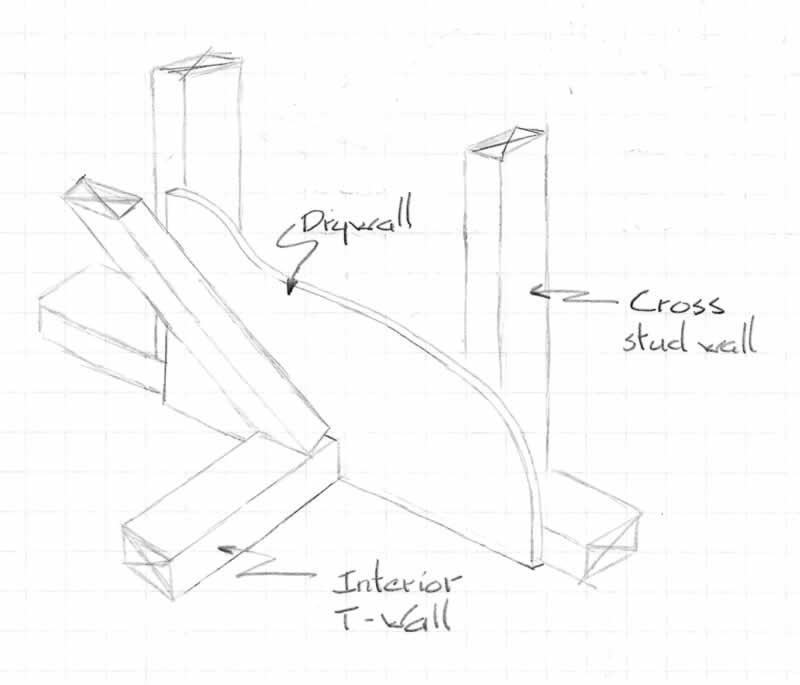
Figure 2 - T-Wall with Bypass Drywall

In a room with drywall finishes, one of the most economical and efficient methods of solving these issues is to install drywall continuously on the cross wall prior to installing the T-Wall studs.  (Figure 2)  This can be accomplished before the cross wall is built or the connecting stud can be left out or loose until after the drywall on the cross wall is installed.  This is a technique that is often used in steel stud framing.

Figure 3 - T-Wall with 2 x 6 Back-up

When it is not practical to install the cross wall drywall first, blocking can be used to provide finish support at corners.  When the T-Wall is 2 x 4 construction, a 2 x 6 installed within the cross wall can accomplish this.  (Figure 3)  As this is only there to create a nailing strip, scrap salvaged from roof sheathing, floor decking or other areas can be substituted for the 2 x 6.  Also, since the 2 x 6 is not there as structural support, it does not have to be continuous as long as it provides nailing points at least every 24″ o/c.

Figure 4 - T-Wall Ladder Connection

Further efficiency can be achieved using scrap lumber, 2 x 4 cutoffs, scrap roof and floor sheathing, etc. to create a ladder effect to provide nailing points.  (Figure 4)  Drywall clips are also a solution, as previously discussed.

These things require planning, but are easily accomplished.

Easterday Construction Co., Inc. will be making every effort to use these more efficient corners for T-Walls on projects as we go forward.  Preferably the bypass method, but using salvaged lumber when this isn’t possible.  This is Green that saves Green!

Summary

  1. Reduction in materials required for the job.  Two less studs and associated fasteners at each corner.
  2. Reduction in labor necessary for material installation.
  3. Reduction in waste material sent to the landfill when cutoffs are substituted for new studs.
  4. Increase in energy efficiency by increasing the accessible wall cavity and eliminating the heat transfer through the additional studs when this situation occurs with an outside wall.

Youcut.com

Congressman Eric Cantor, Republican Whip

Republican Whip, Eric Cantor, has created this exceptional website that is designed to defeat the permissive culture of runaway spending in Congress. It allows you to vote, both online and on your cell phone, on spending cuts that you want to see the House enact. Vote on this page today for your priorities and together we can begin to change Washington’s culture of spending into a culture of savings.

**PLEASE note: Federal PLAs are up for vote THIS WEEK! Vote NOW to prohibit mandated PLAs!**

Click here for the Youcut Website