Dewstop Fan Switch

Excessive condensation is an issue in bathrooms, particularly those with showers.  The Dewstop Fan Switch by GTR Technologies is designed to prevent this problem.  Code requires that all new bathrooms have exhaust fans.  Often the fan does not get turned on when it is needed. Conversely, it may get left on and forgotten.  The old solutions to this problem are motion sensors and timers, but neither of those solutions actually run the fan for the correct amount of time.

The Dewstop switch has a “Condensation Sentry” which detects condensation on nearby surfaces and automatically activates the exhaust fan, airing out the room until it reaches an acceptable humidity level.  The fan then automatically shuts off.  This means that the fan runs the correct amount of time and doesn’t waste energy by running too long and doesn’t risk moisture problems by not running long enough.  That makes this a green solution to the problem.

The fan can be activated manually as well, so it can be run at other times as well.  It is also available in a Fan/Light combination.

What’s missing here is a timer or motion sensor for the light switch.  This would make it truly hands-free device.  That would enhance it as a green device as well.  Possibly that’s something that will be coming down the pike.
Butler Manufacturing Company SunLite Strip

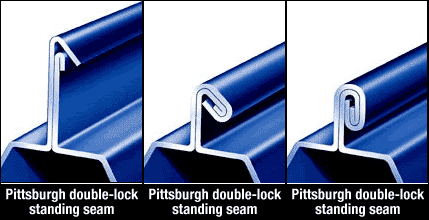
We have always promoted Butler Manufacturing Company’s (BMCMR-24 Roof System for new commercial buildings as well as large reroof projects.  In Culver we have installed this roof on the Edgewater Grille (now Lakehouse Grille), the Culver Ambulance Garage and part of the Culver Street Department Facility.  In Plymouth we have installed this on the Grace Baptist School, the Boys & Girls Club Gym, the Marshall County Highway Department Garage, Pioneer Auto as well as others.  We’ve installed this roof throughout the region with excellent results.  We’ve been pleased with the Pittsburgh double-lock standing seam that is used to make the panels weathertight.  (See GIF at right)  BMC now has a Sunlite Strip Daylighting System for use with MR-24 roofs.  It can be retrofitted to existing roofs as well as included in new construction.

Daylighting has become one of the “Green” initiatives, allowing natural light to be brought into buildings.  The new systems harvest natural light in a much more efficient manner than traditional skylights and the old translucent panels that were often installed on metal buildings.  The raised profile is also safer, since it is visible when walking the roof on a day when the roof is snow covered, or the panels are otherwise obscured by roof debris.

BMC has also created a program called SunLite Calc which allows modeling of different levels of daylight.  The program then generates simple payback calculations to determine if the system is right for your facility.  Let us know if you are interested in discussing these options for your facility.  With the Sunlite Calc we can help you determine if this is “Green that Saves Green“.

Energizing Indiana Seminar

I attended an Energizing Indiana Seminar on Tuesday in South Bend presented by the Indiana Energy Association.  In our area, the partners that we work with are NIPSCO and AEP(Marshall County REMC has programs as well, but opted out of IURC (Indiana Utility Regulatory Commission) due to what they felt were onerous reporting and oversight requirements and the associated costs.)  There are quite a few incentive programs available to businesses and residential customers as well.  Unlike some of the tax incentive programs such as EPAct, these programs provide checks directly from the Utility Companies which means municipalities and other tax exempt entities should be able to take advantage of them as well.

Many of these programs encourage renovations that will pay savings dividends on their own.  (Green That Saves Green!)  The incentives are there to give the extra kick to encourage implementing them now.   I am planning on researching this further and I will include details here, but if you’re interested in pursuing this, please contact us and we can look into your specific situation now!

Culver Garden Court – What a Difference a Day Makes!

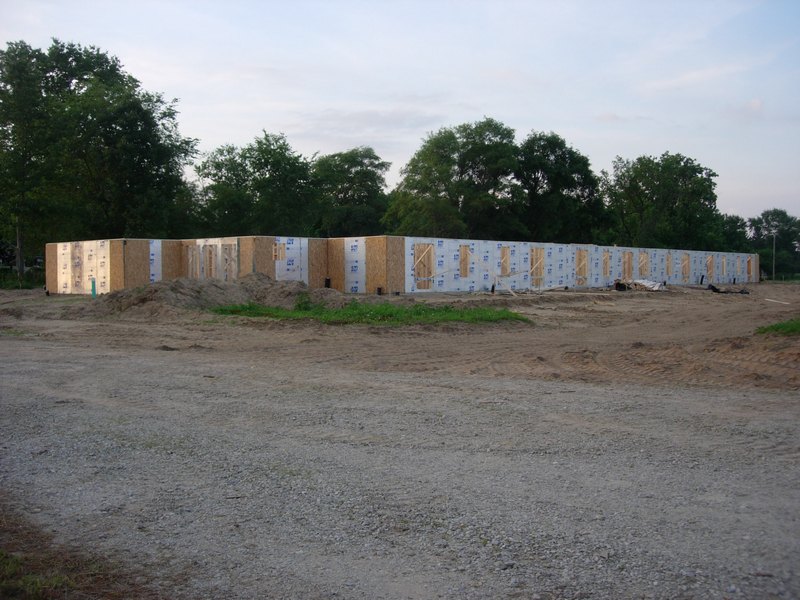
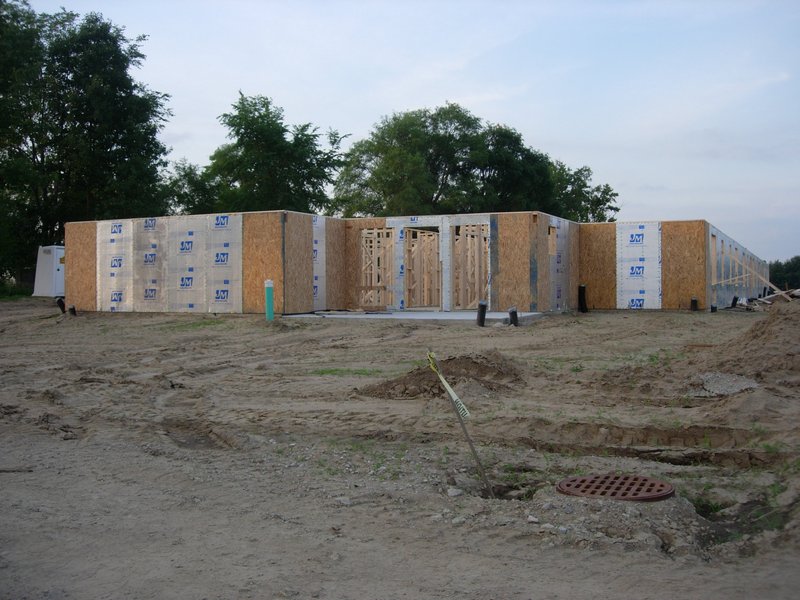
The framers arrived yesterday morning and by the end of the day most of the walls were standing.  (See picture to the right.)  The panels come with the exterior sheathing in place.  You can see a mix on the sheathing where some of it is an insulation board, but OSB sheathing has been substituted at the corners as diaphragm framing.  Often diagonal steel straps are installed at corners in order to avoid breaking the insulation barrier, but in this case there were windows too close to the corners for the strap bracing to work.

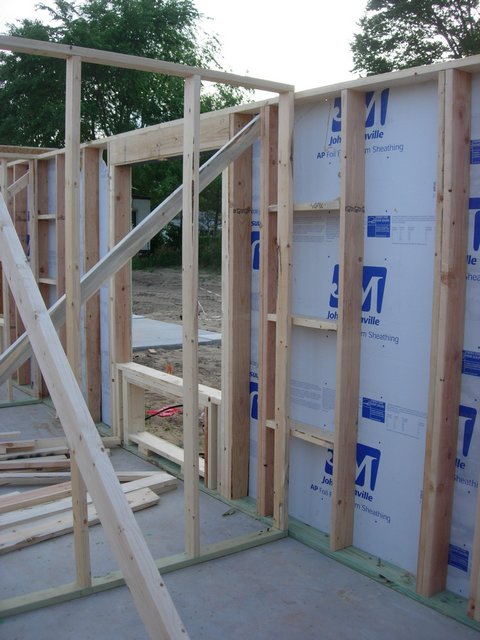
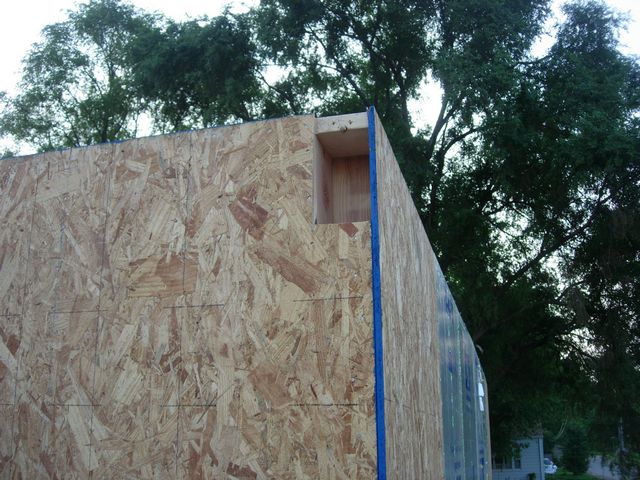
We are constantly trying to improve the framing on these structures to be more efficient, both in the use of lumber and in insulation barriers.  Thus the change to insulated sheathing from 100% OSB sheathing used on previous Garden Court projects, the use of laddered T- wall corner connections at interior walls and the use of California Corners.

These efficiencies are important to us during construction as they reduce material and labor costs.  Since these projects are HUD funded, the budgets are limited.  For the owner, Garden Court, these efficiencies will result in savings on utilities over the life of the project.

Laddered T-Wall intersection allowing more insulation in the exterior wall.
California Corner at an outside corner allowing for more exterior wall insulation

Attic Insulation

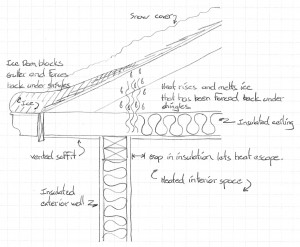
Typical Ice Dam Condition

Becky and I made a trip to South Bend last week and she pointed out the icicles on many of the houses and buildings.  This led to a discussion on ice dams, which I discussed here previously.   There’s another nice picture here.

It was one of those days where it was easy to see which buildings and homes had good attic insulation and which didn’t.   The temperatures were just below freezing and it had been nearly a week since the last snow.  Those structures with poor attic insulation stood out easily amongst the sea of white roofs.

The fact that heat rises makes it fairly easy to understand that the majority of a structure’s heat loss is through the roof.  In most homes, adding attic insulation is a fairly economical way to save energy costs.  When done correctly in conjunction with proper venting, it can prevent or cure ice dam issues as well.  This is green that saves green!

Icicles are pretty, but they may well be the sign of underlying problems and potentially the precursor to water damage.  Take a look at your home the next time you pull into your neighborhood.  If your house has lots of pretty icicles and is the only one without snow on the roof, you may have an insulation deficit.