
 I was asked to write an article for the Culver Citizen explaining a little about Garden Court and the positive reasons for bringing one to Culver as well as the obstacles preventing the project. It was printed in the paper last week along with a sidebar I wrote giving a little description of the umbrella group that is Garden Court. I have copied the article and sidebar below:
Easier Digital Picture Uploads
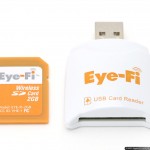
I ran across this item and it’s now on my wish list. The Eye-Fi wireless storage card fits in your camera and can automatically upload your pictures to a photo sharing website. The card fits into your camera just like a regular storage card. It comes with a USB adapter that lets you set it up with a connection to your wireless network. Its range is limited, but that’s not too surprising when you consider that they have crammed the necessary electronics into a standard storage card. The software involved is quite small as well leaving most of the 2 gigs available for picture storage. It runs off your camera battery, but the draw appears to be negligible.

The digital camera has become ubiquitous to our industry. Working on our website and this blog would be much more difficult without a digital camera. Plus we work with enough out-of-town clients and architects that the digital camera has become an indispensable tool. The saying “A picture is worth a thousand words.” remains true. We have even begun including color pictures in our proposals along with sketches and drawings to better illustrate the intentions that accompany the words. I’m currently using a Nikon Coolpix 5200 which is easy and convenient, but I am in the market to upgrade. In some cases I need something that does better in lower light and has a panoramic option.
If you’re interested in purchasing a Eye-Fi storage card, they are available from Amazon for as little as $51: http://www.amazon.com/Eye-Fi-Wireless-Secure-Digital-EYE-FI-2HM/dp/B001AD0TGQ/ref=pd_bbs_sr_2?ie=UTF8&s=electronics&qid=1237668695&sr=8-2
If you are interested in reviews, I’ve included a couple of links below:
PC World reviewed it here: http://www.pcworld.com/reviews/product/30801/review/card.html
Digital Photography Review reviewed it here: http://www.dpreview.com/reviews/eye-fi/7
Crane Day
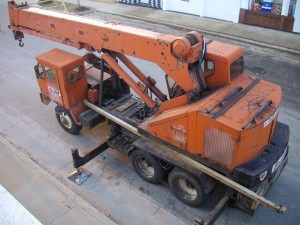
Tuesday was Crane Day in Monterey. We shut down the 6000 block of Main Street for a few hours in the morning as we lifted the roof panels into place for the First National Bank of Monterey(FNBM) Annex project.
The panels are 2′ wide by 40′ +/- in length making them somewhat unwieldy to handle, but minimizing the number of splices required. Fewer splices will mean less maintenance over the life of the roof.
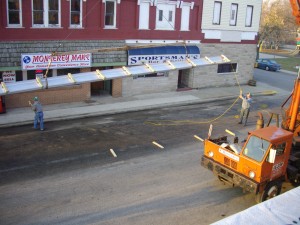
The crane was set up in front of the bank and we closed the street for several hundred feet in both directions. Forklifts were used to maneuver the panels around to where the crane could pick them up. The lengths made the use of a spreader bar and tag lines necessary. We reviewed safety issues with our crew and our Safety Officer, Will Pearson, went down to make sure things were done correctly. We took extra effort to contact all the affected businesses so they were aware of the situation. The Town of Monterey took advantage of the situation and cleaned the street while we had it shut down. It ended up only taking about three hours in the morning so we were done and the streets were open before the noon “rush hour”. It was St. Patrick’s Day after all!

We are installing an BMC MR-24 Roof on this building. FNBM already has this roof on the last addition and has appreciated its weathertightness and low maintenance. The conditions we have on this building allow us to install the panels with limited splices and only two roof penetrations. This should be an exceptionally tight roof as well.
MR-24 qualifies as an economical and environmentally sound solution due to the use of recyclable material and its design allowing minimal heat transfer. We installed two layers of insulation for a total rating of R-38 in the roof.
We are also installing MR-24 over an existing area of flat roof on the existing bank building. this should solve some leak problems they have experienced as well as providing some additional insulation. The MR-24 has a somewhat reflective finish which will help reduce heat gain in the summer.
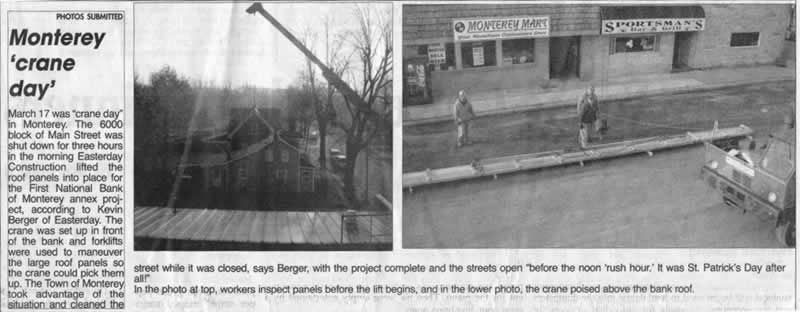
Update 4-2-09: Jeff Kenney at the Culver Citizen picked up this post and reprinted it. Hey, we’re almost famous!
Congratulations to Price Nurseries
Congratulations to Tom McGee and Jody Overmyer at Price Nurseries for their Green Excellence Award from the Indiana Nursery and Landscape Association! They received this award for their design and implementation of the landscaping for the Tri-Way Mini-Golf Course in Plymouth. <Pilot News Article> (Note: The Pilot article has an incorrect address for Indiana Nursery and Landscape and the Price Nursery award has not been posted yet. You can see past award winners here.)
Easterday Construction Co., Inc. and Price Nurseries have enjoyed a excellent working relationship for many years with Price Nurseries acting as a subcontractor for us on many projects and the reverse, ECC doing subcontract work for Price Nurseries on occasion. These projects include Lake Maxinkuckee residences as well as commercial projects such as Fairfield Garden Court in Plymouth.
We are proud of our association with Price Nurseries and look forward to a long and rewarding relationship with them into the future. It is wonderful that their excellent work has been recognized by their peers. Great job guys!!!
Sand Hill Farm – Pocket Towns
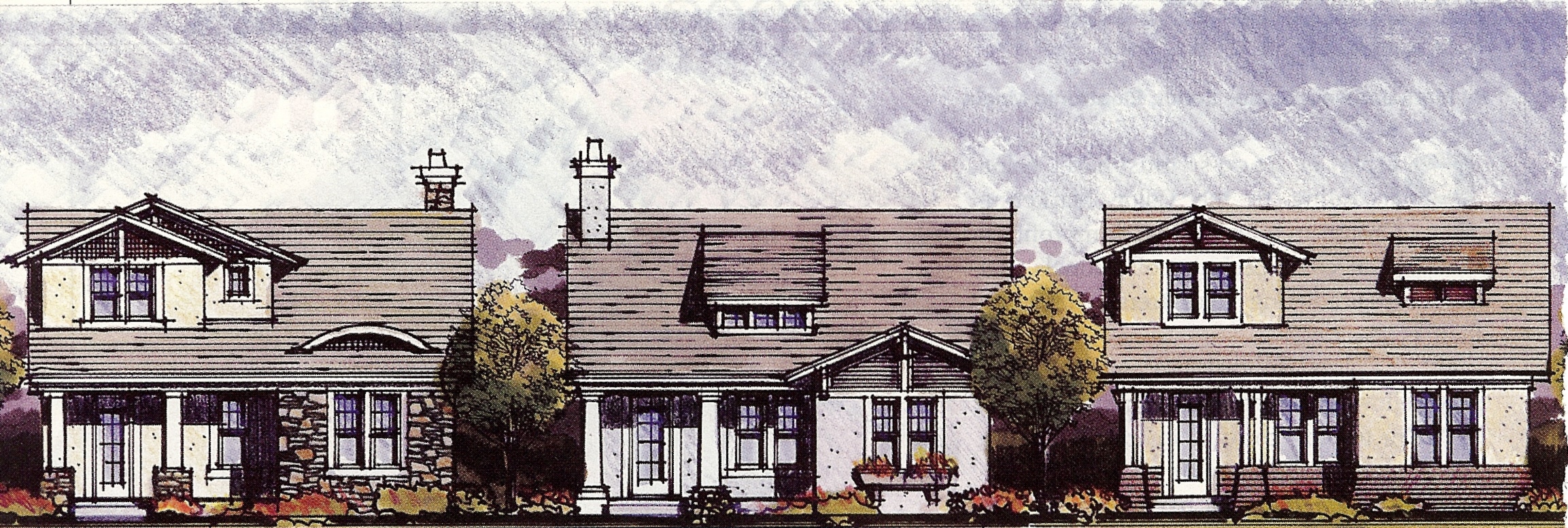
Pocket Towns (copyrighted) are a concept I ran across in an article in the January 2009 issue of Professional Builder Magazine. (Read Article Here.) They are high density housing on smaller lots (less than 3000 sf). The homes are pushed to the front and have as little as 5′ side setbacks. Living space varies from 950 sf to 2400 sf with a mix of one and two story homes. Read more about them on BSB’s website here.
Becky and I were in Tampa a couple of weeks ago. Becky had a conference and I tagged along. I didn’t see the new pocket town neighborhood discussed in the article, but I saw some of the old Tampa neighborhoods that it was modeled after. Somewhat narrow brick streets with granite curbs.
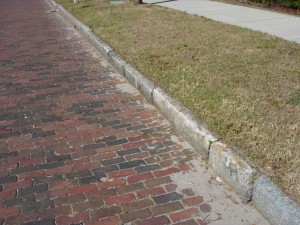
(I’m still trying to figure out how granite curbs were affordable in central Florida at the turn of the century when there wouldn’t be a quarry within hundreds, if not a thousand miles.) At the end of the block was a library and a service station. Across that intersection were small shops and a neighborhood grocery store.
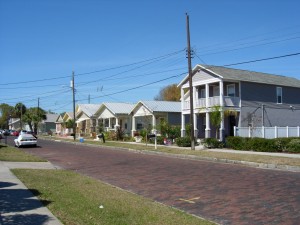
These homes were built on an alley system with no garages or off street parking on the front. Parking was allowed on one or both sides of the street, but the streets were pretty narrow when there were cars parked on both sides. Having an alley also allows for utilities to be moved to the back side of the property. Optimally they would all be buried, but that is usually cost prohibitive and rarely seen in older neighborhoods. Some of the homes had parking in the rear or even a garage accessed from the alley.
Part of the Green initiative is a move towards smaller homes and more efficient use of the landscape. The USGBC gives points toward LEED certification for efficient use of land. Notice the return of the front porch which I discussed here previously.
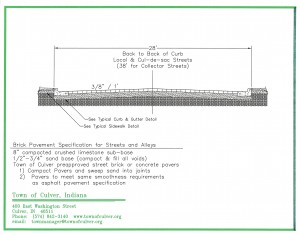
The streets themselves were interesting too. In our area, the recommended construction for brick streets have the streets crowned towards a concrete curb and gutter. This allows storm water to run on the concrete gutter in lieu of across the brick where the brick surface would be eroded and the sand between the brick would be washed away. Florida is so flat and sandy that very little of the water runs off anyway, so the gutter line isn’t as important. The brick streets act as a solid driving surface yet a somewhat pervious surface to absorb storm runoff.