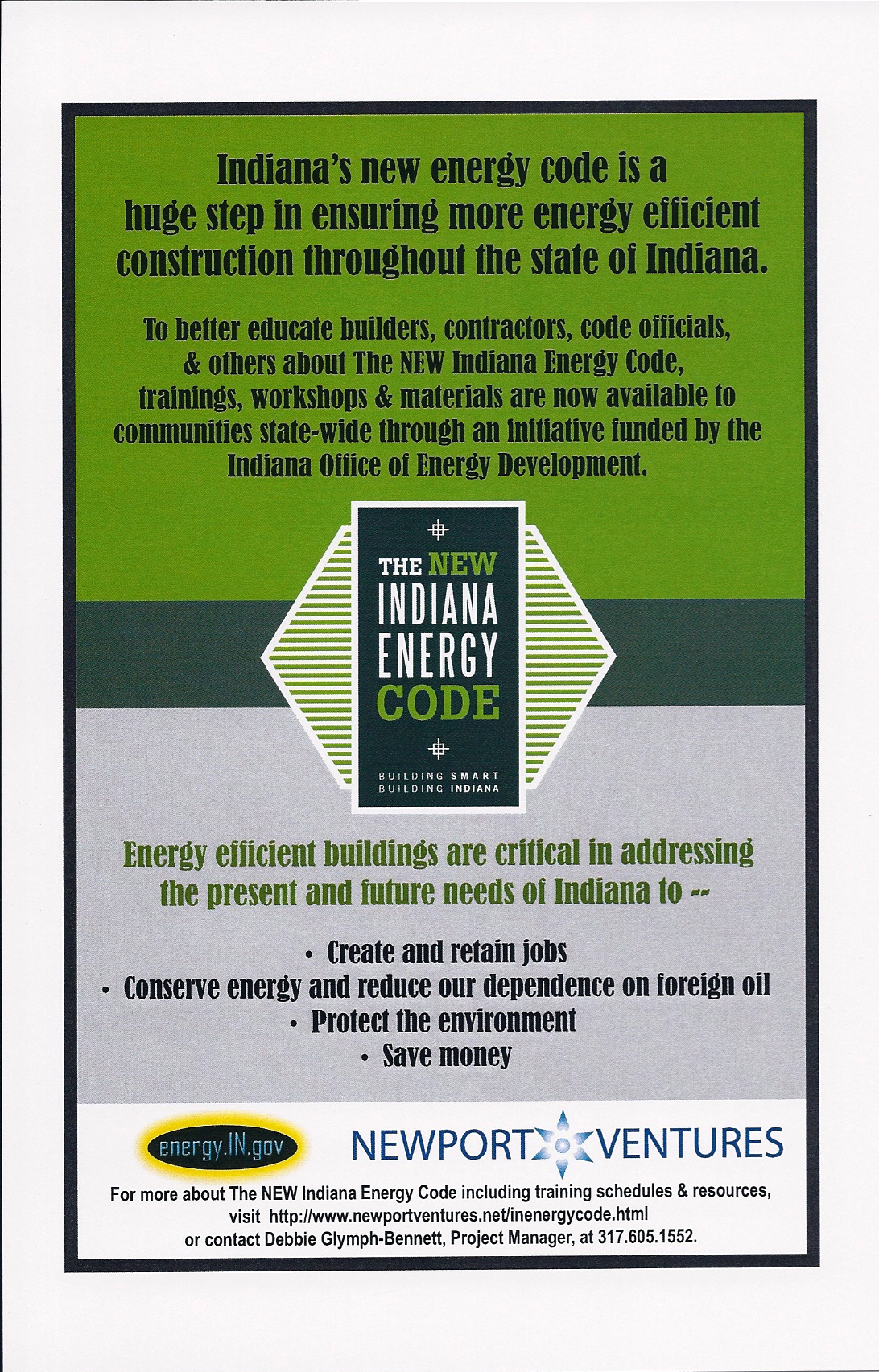
 Last Wednesday I attended a presentation/seminar on the Indiana Energy Code presented by Associated Builders and Contractors of Indiana (ABC) and Newport Ventures. Newport Ventures is supporting the State of Indiana in the adoption of the new Indiana Energy Code by conducting stakeholder meetings, developing a compliance roadmap and conducting training on the new code.
The presentation was informative and will no doubt be useful. Though Easterday Construction would not normally be involved in designing the systems discussed, it is still good for us to have a working knowledge of these things. It helps us understand them when we find them on plans, it gives us the ability to discuss them with clients before the design phase begins, and it also allows us to take the best practices found here and apply them to situations where it is not necessarily required by code.
Some of the things presented were already prevalent in the industry as “‘Best Practices”. These mainly related to insulation standards, optimized framing and building envelope tightness. Others such as changes in electrical systems and HVAC systems for reduced energy consumption have been available, but it has been left to the Owner or Developer’s choice as to whether to pursue them. Many have been promoted by the U.S. Green Building Council and tracked in their LEED Rating System and Certifications in recent years. The Indiana Energy Code is based on standards developed by ASHRAE (The American Society of Heating Refrigeration and Air-Conditioning Engineers). While LEED and ASHRAE share some goals, their standards vary, but suffice to say that following ASHRAE standards are usually the minimum requirements for a project path toward LEED certification.
I have no doubt that all of the standards presented to me on Wednesday will save energy, as defined by the energy necessary to heat, cool, light and generally operate the facility. I was dismayed that when I asked who was researching the Return On Investment (ROI) for these systems, I was told no one. Isn’t it a bit premature to put these practices into law without assessing the final cost? Apparently not, as this was part of a Federal program where Indiana received funds to implement this.
As part of the discussion, the changes to a building HVAC system were discussed. Additional zone divisions will be required. Additional duct sensors, motorized dampers, thermostats (7 day programmable thermostats with off-hour setbacks and controlled overrides only), ducted returns (no return plenums), economizers and heat recovery systems for fresh air intakes including CO2 sensors to determine optimum fresh air requirements and low pressure fan systems will also be required. Again, nothing here struck me as ineffectual for reducing operational energy consumption… But what does it mean if you look at it holistically including construction and maintenance?
- Additional electrical control sensors – additional things to break and things that the average maintenance man won’t be able to service. Optimizing the various control system will require a complicated set-up.
- Ducted returns will require additional sheet metal and associated installation labor.
- The low volume fan systems will require larger ducts and larger heating and cooling units. This could mean additional building height due to dead space between floors for duct work, larger mechanical rooms stealing usable floor space, etc. What about the costs of these additional materials, i.e. the bricks & mortar necessary to raise a building’s height to provide additional system space?
These are just a few of the things that came to my mind during the discussion. Things which could be project killers.
There is no question that Easterday Construction will comply with the new standards. It’s the law now. It currently applies to commercial and industrial projects in Indiana, but we will take what we consider the best of these things and discuss them with residential clients as well. Some of them make sense. Some of them that may not make sense to me today, may do so in the future. I sincerely hope that someone is doing the research to prove that the front end expense (in dollars and energy consumption) of complying with these regulations will pay for itself.