What’s a WECS?

Depiction of the large scale WECS’s that the Concerned Citizens protested at the County Level

Representatives from the Concerned Property Owners of Marshall County requested that Culver change their zoning ordinance regarding WECS’s and as a result, the Culver Plan Commission held a Public Hearing on an ordinance change at their August 2013 meeting.   (WECS is the acronym for Wind Energy Conversion Systems and applies to any device that takes wind energy and converts it to usable forms of energy.)  The initial request was for Culver to match the County’s zoning requirements which currently bans commercial WECS’s and allows residential systems with a Special Use Permit in selective zoning districts.  Unfortunately audience members requested that the ordinance be tweaked to further restrict residential systems as well.  At that time I spoke up and reminded the Plan Commission that they had recently created an A1 – Agricultural District with the intention of mirroring Marshall County’s A1 district.  This was done to eliminate discrepancy protests to extending our Territorial Authority.   The Commission agreed with my argument but still had some reservation so they decided to table the issue.

At the September Culver Plan Commission meeting the topic came up again. Russ Mason, Building Commissioner, had conversations with some farmers and had made some minor tweaks to the height restrictions for WECS’s.  Audience members also spoke up and protested the allowance of WECS’s in residential areas even under the special use requirements.  I again spoke up with two points:

Read more

NFIB “Small-Business Confidence Sputters, Again”

Graphic borrowed from www.nfib.com/sbet

I received the results of an NFIB survey today that I thought would be worth sharing.  You can read the entire report here, but the gist of it is contained in this quote:

“After two months of incremental but solid gains, the Index gave up in June.  This appears par for the course, given that there is no reason for small employers to be more optimistic and lots of things to worry about,”  said NFIB chief economist Bill Dunkelberg.  “Washington remains bogged down in scandals and confidence in government’s ability to deal with our fundamental problems remains low.  Economic growth was revised down for the first quarter of the year and the outlook for the second quarter is not looking good.  Nothing cheers up a small-business owner more than a customer, and they remain scarce and cautious while consumer spending remains weak and more owners are reporting negative sales trends than positive ones.

It certainly doesn’t help that the endless stream of delays and capitulations of certain provisions of the healthcare law adds to the uncertainty felt by owners.  Until growth returns to the small-business half of the economy, it will be hard to generate meaningful economic growth and job creation.”

Read more

Who should lead?

I was invited to attend a work session of the Culver Town Council last night.  The work session was the result of the efforts of MCEDC to energize Marshall County communities to plan and prepare for growth.  Unfortunately last night’s meeting degenerated into random complaints from various attendees about some Culver boards and commissions with very little positive discussion or resolution.  I had invited Jay Bahr, MCEDC‘s new Executive Director, to attend this meeting and was somewhat embarrassed.  It wasn’t exactly what I would have liked him to see with his first introduction to Culver’s leaders.

Image borrowed from Aliexpress.comIn February, MCEDC held our first County-wide economic development summit with attendees representing all of the communities in Marshall County.  As a result of that meeting I had met with several Culver Town Council Members to see what action steps could be taken. My thoughts on this involved encouraging the Town Council to be the pointy head of the spear.  In other words, set an agenda for growth and improvement and pass that mandate down to the boards and commissions that serve beneath them.  Theoretically, the Town Council is the elected body that represents the people and through them the citizen’s will should be enacted by the appointed boards and commissions.  Without a cohesive plan of action to implement, the boards and commissions either proceed on their own agendas or in some cases are rudderless and accomplish no agenda.

There has been some progress.  Retention meetings have been held with Elkay and discussions have been had regarding how to make Culver more accessible to business.  All positive steps, but ones without a cohesive goal.

Image borrowed from Granitegrok.comThe Comprehensive Plan will fill part of this need, but it needs the will of the citizens and their elected officials, the Town Council, to be reflected in that.  Even though completion of the Comprehensive Plan is as much as a year away, the Town Council needs to be gearing up towards implementation and as I’ve tried to express to them, the Comprehensive Plan process can’t be an excuse for doing nothing now.
Last night’s meeting showed a lack of respect for the Town Council’s position of authority in the Town.  It was a good step towards leadership, but it’s clear that they are going to need to TAKE their leadership back.  There will be no shortage of complaints, but complaints don’t fill the leadership void.  Culver’s unofficial motto has always been “Change is bad even when it’s change for the better”.  The Town Council needs to ignore that and be the instigator of change.  Change for the better…

Comprehensive Plan Update

The work on the new comprehensive plan has begun and I attended three meetings in this week.  On Monday evening there was a Steering Committee meeting with Houseal Lavigne where we were given information regarding doing small group outreach.  This was for the Steering Committee to make presentations to groups that are unable to attend the regular community meetings or groups that have special interest.  I honestly do not know how effective this will be since everyone on the Steering Committee is already active in the community as well as their individual businesses but it was an interesting exercise.   I told the Town Manager, Dave Schoeff, that I would be willing to help with one of these, if approached, but I do see that I would go out looking for groups to give presentations.

image borrowed from www.coastalhawaii.com
The Dream of “Affordable Housing”

In conjunction with and immediately following that meeting was the first community meeting.  While participation was less than stellar (only about 25 people were in attendance) there were some consistent themes  that came out of the meeting.  It did not take long for affordable housing to bubble to the top.  Unfortunately affordable housing is a hard one for people to get their arms around and everyone’s definition seems to be somewhat different.  Probably the second most discussed issue which was  touched on several times  was “identity” of Culver, i.e. are we or do we want to be a resort community.  (More on that later.) 

Read more

Excerpt from ABC Construction Economic Update 3-1-13

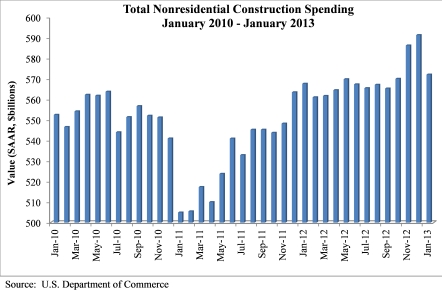
NONRESIDENTIAL CONSTRUCTION SPENDING FALLS 3.3 PERCENT IN JANUARY

As further evidence that the nation’s construction industry continues to struggle, nonresidential construction spending fell 3.3 percent in January, with outlays decreasing to a seasonally adjusted annual rate of $572.1 billion, according to the March 1 report by the U.S. Census Bureau. Year over year, total nonresidential construction spending is up only 0.8 percent (unadjusted for inflation).

Both private and public nonresidential construction spending were down for the month. Private nonresidential construction spending fell 5.1 percent on a monthly basis, but is 4 percent higher compared to one year ago. Public nonresidential construction spending declined 1 percent in January and is 2.7 percent lower than January 2012.

Basu Quote 3-1-13“January’s construction spending decline was particularly alarming because the loss in momentum spread deep into privately financed categories,” said Associated Builders and Contractors Chief Economist Anirban Basu. “In previous months, decreased spending in a number of public spending-oriented sectors like sewage and waste disposal and public safety was roughly counter-balanced by increased spending in intensely private segments, such as power and manufacturing.

“That changed in January, with privately financed segments like power and manufacturing reversing course and experiencing substantial monthly declines in construction spending” said Basu. “The upshot is that nonresidential construction spending is virtually unchanged over the past year.

Read more