All the Talk of Housing Costs

I listen to all the talk on how to reduce housing costs from government officials and am amused and disheartened by the lack of industry involvement and thus understanding of the industry by those proposing cures. Much of the discussion is similar to the other conversations on inflation. (I gave some thoughts on inflation here.) Locally, I have been involved with Jack Davis’s Faith Based Housing Committee, the UWMC Housing Matters group, MACOG’s Marshall County Housing Study, One Marshall County’s Housing & Infrastructure Committee and the newly formed Marshall County Community Development Corporation (MCCDC) of which I’m a board member. Back before this I was on Culver’s Entry Level Housing Committee and the MC Crossroads Housing Committee. In all of these meetings, I can only name one other person from the construction industry, no others from the development industry and only a two or three from the rental industry that have been included. The unfortunate thing is that the industry has been blamed in some of these meetings, making it harder to ask them to consider participation.

The general theory is that the reason for the higher housing costs is all due to scarcity. The study done for the Housing Matters group came up with a deficit of 1,300 dwelling units for Marshall County. There is no doubt that scarcity is a factor, but more housing isn’t the panacea. Assuming costs are totally contingent on demand assumes that housing building contractors are taking advantage and price gouging because they can. In most situations, that is not the case. There are underlying inflation costs that have caused material and labor costs to spiral up. This is a problem that travels up from the bottom of the material supply chain. At a certain point, if demand starts to be satisfied, the incentive to build new housing goes away.

There are couple of other effects that seem to be overlooked. The first of these is the increase in property values. It is often stated in these meetings, that more new housing will make existing housing stock more affordable. Sounds good right? Until you’re the existing homeowner hoping to profit from your home sale. If some of these plans are successful, some who have counted on their home’s value appreciation will see a reduction in their net worth. The second effect is how this will affect property taxes for the county and municipalities. These governmental entities, while understanding the challenge to potential homeowners, have benefited from the increase in property values. While this is tempered by homestead exemptions, it has still been a net benefit as commercial residential property is affected as well.

The bursting of the housing bubble in 2008 has contributed to this problem as well. As so often happens, the pendulum has swung from the easy credit days back then to credit tightening to theoretically prevent another bubble. Homeowners need to show more steady income. Commercial residential developers/builders have to do the same, meeting a higher income to debt service ratio to satisfy lenders.

Add to these things, all of the new energy codes, safety standards and zoning hurdles and you find that building new homes is not always an easy prospect. Locally, there are attempts underway to start a land bank, streamline processes and in some cases provide short-term, low-interest loans. On the national scale, there are ideas bandied about such as 50 year mortgages, releasing government land for home construction and making down payments on a home something you can take from and/or hold in your 401(k) plan. All are interesting ideas, but not necessarily things that will make an immediate difference or be proven to be correct responses quickly.

I don’t see this problem going away quickly. Some of the “solutions” may result in unintended consequences. As is often the case, it may be best to let the market figure it out over time, but to the extent that it can be solved externally, I don’t think it will happen without all the players around the same table.

Veterans Day Celebrations in the Midst of Turmoil – J.R. Gaylor

J.R. Gaylor

With turmoil foreign and domestic, we pause today to celebrate the living veterans for their service, their patriotism, their love of country and willingness to sacrifice in defense of our country. As important as it is to defend ourselves against foreign threats as our veterans have nobly served, there are some very insidious threats we are facing with America against itself.

Specifically, I am referring to the acceptability—by far too many—of the lawlessness we see happening, as well as the twisted logic behind the lawlessness.

We are seeing the direct contrast of the “broken window” theory versus “progressive criminal justice” model.

The theory of the “Broken Window” holds that addressing minor crimes like vandalism, public intoxication, and minor theft creates an atmosphere of order and lawfulness versus “progressive criminal justice” which promotes reforms such as ending cash bail, not prosecuting misdemeanors, and early release of offenders.

The justification behind this “progressive” thought is ‘because someone told a lie, it doesn’t make them a liar’. Or ‘because someone took a bribe, it doesn’t make them corrupt’. In other words, ‘if a crime is committed and no one is responsible, was there actually a crime at all’?

Famously said, “a great civilization is not conquered from without until it has destroyed itself from within.”

Next July 4th, we will celebrate 250 years of the great American experiment of Independence under a Constitutional Republic from which we aspire to form a more perfect union, establish justice, ensure domestic tranquility and provide for the common defense.

Let us aspire to recapture that vision.

J.R. Gaylor President/CEO; ABC IN/KY

Chevron Deference

I wrote a bit on this last January (here) when I first heard the Chevron Deference was up for consideration by the Supreme Court. (Kiplinger’s follow-up article here.) Now there seems to be a huge uproar over this or to paraphrase the words of Charlie Daniels: They’re all out there steppin’ an’ fetchin’, like their heads are on fire and their asses are catchin’… (from Uneasy Rider)

Saying that we’ve always done it this way, fails to recognize that the Chevron Deference is a product of the 80’s, not something springing from the Constitution. It was a case where the courts gave up their constitutional power to interpret laws, ceding it to the administrative agencies. This has been abused by the agencies and aided by lazy lawmakers, who intentionally or unintentionally write ambiguous legislation.

Unfortunately, the agencies are abusing their power over their clients, the citizens of the United States, while also ignoring their bosses, the Senators and Representatives that write the laws. (Check out this video of Democratic Senator, Joe Manchin, schooling Treasury Secretary, Janet Yellen, on the way that agency is disregarding very specific language in a Law he wrote and helped pass.) Unambiguous language in legislation is rare, but even when it’s in place, it requires legislators to be enforcers, as with the above video or citizens to risk their livelihoods taking them to court. The Chevron Deference had been used to give the advantage in these situations to the agencies as the de facto experts.

I seriously feel that the various bureaucratic agencies are being allowed to run the show. Even granting them the benefit of the doubt on knowing a lot about the things they oversee, bureaucracies tend to be invasive. They try and make themselves seem more valuable by growing and inserting themselves into more things. This is true with private bureaucracies and seemingly more so with public bureaucracies. When President Biden said we’re going to add 80,000 more IRS agents, I never heard the IRS say, they could get by with 50,000 or even lets start with 30,000 and see how it goes… No, they gladly accepted the growth, the larger budget and the increase power that came with this.

IRS: You owe us money. It’s called taxes. Me: How much do I owe? IRS: You have to figure that out. Me: I just pay what I want? IRS: Oh, no! We know exactly how much you owe. But you have to guess that number too. Me: What if I get it wrong? IRS: You go to prison. ME: [rifling through papers] Ok this is all kind of confusing, but I think this is how much I owe. IRS: Yikes, looks like you missed a number somewhere. I guess you’re going to prison. ME: [being handcuffed] Can’t argue with justice!Jordan Stratton

As I mentioned on the previous post here, the agencies’ positions and enforcement can swing wildly based on whichever party is in office. Taking the political positions out, at least as much as possible, by putting it back in the hands of the judiciary, seem prudent. Acknowledging their expertise in these things, it would make more sense to bring them in when the law is being crafted rather than waiting until it’s in place and subject to their, sometimes bias, interpretation.

The striking down of the Chevron Deference seems to make perfect sense to me, but only time will tell. While in place, it was interpreted broadly, which caused the problems leading to the Supreme Court’s review. Doing away with it may create a new set of unintended consequences, but with government in general, less is better…

Culver Redevelopment Commission & The Dunes

CRC meeting October 16, 2023

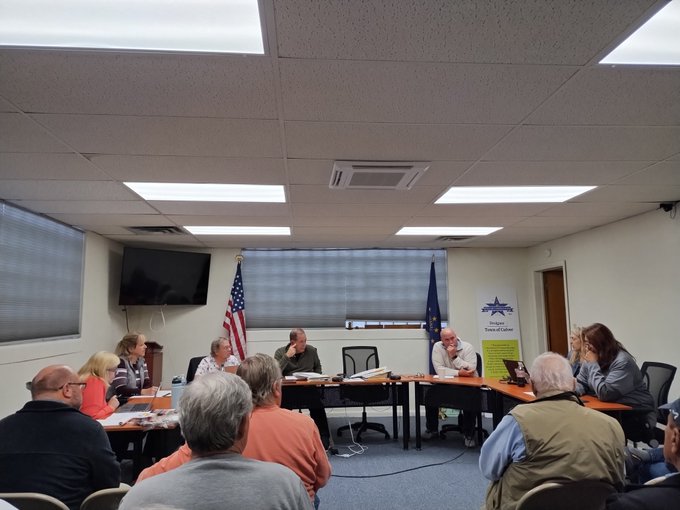
The October 16th meeting of the Culver Redevelopment Commission had a pretty full house and the majority of the meeting was taken up with a Public Meeting (not Public Hearing) on The Dunes. I was pretty proud of Culver as the majority of the questions were well thought out and asked respectfully. There were only a few questions I thought were irrational and even those were asked succinctly and calmly. I was also pleased to see that all of the Town Council members and a few of the candidates for Town Council were in attendance to listen.

Burke Richeson spoke for the Developer and did a nice job. Only getting a little vex’d when another attorney representing opposition spoke. Kevin Danti, Culver Town Manager, did a good job of keeping things moving and controlling the conversation. (I was going to link to Kevin’s page on the town’s website, but it hasn’t been updated.)

USGS Map

There were questions about environmental concerns, but these seemed to center on the effect on Lake Maxinkuckee. It was stated by Karen Shuman, who is on the Lake Maxinkuckee Environmental Council (LMEC), that LMEC had determined that the property is not within the Lake Maxinkuckee Watershed. I’m not sure that’s 100% correct, but it is at least mostly correct. Lake Maxinkuckee’s watershed is not large, but since the lake is mostly sustained by springs, the quality and quantity of ground water is important. That said, besides the lake, there are other environmental concerns, one the bigger ones being the surface runoff flow to the wetlands at the north side of the property and the town well fields just north of the property. Protection of those are critical.

Nearly Full House at the October Redevelopment Commission Meeting

Most of the conversation was well presented and questions were mostly answered with the exception of questions regarding the bond structure. Those got rather deep and ended with an offer from the town to provide a visual chart and breakdown to make the flow of funds more understandable. At this time, an agreement between the Town and Developer has not been reached, so the final numbers remain in flux. Progress is being documented on the Town’s Website in a link to Dunes. They stated a plan to document the questions heard at this meeting as well as others under a Frequently Asked Questions (FAQ) section.

Aside from the bonding, which was confusing to all involved, I was a little confused about the Tax Incremental Financing District (TIF) discussion. This was presented by Marty Oosterbaan, Commission Chairman, and I think most people in attendance didn’t know the right questions to ask. A couple of the things that left me puzzled were: 1) was the new land area for The Dunes being taken into the existing downtown TIF as discussed or would it stand alone; 2) was there one new TIF area or two? There was discussion of a 20yr TIF (residential) and a 25yr TIF (commercial) to cover the areas with rental apartments. How do these fit? There was also a discussion about how this would affect local residents and again, the discussion of taxes were muddy. It was stated that there would be no effect for the life of the TIF, but I don’t believe that to be correct, since there will be a reassessment and taxes levied on the new development which could affect neighboring property.

Another positive I heard last night was the future involvement of Michiana Area Council of Governments (MACOG). Culver is already working with them on the new Comprehensive Plan and have engaged them for help on The Dunes as well. They will be conducting traffic studies, apparently including boat traffic studies. Hopefully they will also step in to fill the Urban Planner role I suggested here before. It would be interesting to see if they address the issue of suburban sprawl and disconnection of subdivisions in Culver I discussed in this post. Would this development be more acceptable if it followed the streets and alleys development grid found on the east side of South Main Street rather than as a controlled access, separate neighborhood? An interesting question…

Though there weren’t pitchforks and torches at this meeting, the tenor of the conversation made it clear that the community is not embracing this project yet. There were comments about screening it so it’s not seen and changing the entrance to face S.R. 17 in lieu of South Main Street, as discussed here before. These ideas treat it as if they expect an eyesore or having nothing to contribute to Culver. While there may be reasonable concerns, the Town government seems to be on a path to address them the best they can. There is good reason to be cautious, but there should also be efforts to take advantage of the positives that could come from this.