Attendees at The Midas Center Reception (Left to Right: Bob Wagner, Brent Martin, Kevin Berger and Marcy EckoffWagner
Congratulations to Andrea Cook and The Midas Center on their move to their new location at 200 North Michigan Street in Plymouth. I attended their Reception on December 17th and it was interesting to see their progress and the various people, some of them old friends, that are involved and were there to help them.
I initially connected to Andrea through her position on the Culver Redevelopment Commission. She has become quite active in the Culver and Plymouth Communities through her business at The Midas Center as well as her two community promotion sites, iHEARTplymouth and iHEARTculver. I have consulted with Andrea and her husband Phil on the status of the historic building they have purchased and we are working with them on a restoration project at the site.
It seems that a day doesn’t go by that I don’t get asked about the status of the Culver Garden Court Project. I’m not sure why I should expect this phase of the project to go any smoother since it took years of promoting the project before finding a generous property owner willing to work with Garden Court for a site. Now that we have a site and the Town is behind the project and HUD has approved the funding, we have hit another wall of bureaucracy.
It is particularly frustrating when President Obama has been talking about expediting shovel-ready projects for the past two years. Is this how you expedite a project???
Time line:
July 2010 – Project Funding Announced: Generally on past projects the funding is determined and announced in the Spring, often in time for us to have an early to mid-summer start. This year the announcement was delayed until late July.
August 1st– Garden Court, Easterday Construction and B.A. Martin Architects meet to discuss finalizing plans. Garden Court attorney applies for the 501(c)3 status with the IRS. (HUD requires that each Garden Court be its own, separate, 501(c)3 non-profit entity.)
August 15 – Plans complete and sent out for bid.
September 1 – Prices in. Budget met. Easterday Construction is ready to go! No 501(c)3 status. Can’t close on property.
September 15 – HUD would REALLY like to have this project close before their year end of September 30th. Can they help expedite the 501(c)3 approval with the IRS? No.
September 30 – HUD year end passes. No 501(c)3 status. Project can’t close.
October 31 – Another month passed. No 501(c)3 status. Project can’t close.
November 30 – Another month passed. No 501(c)3 status. Project can’t close.
December 10 – We had been nursing hopes of still starting but Winter hits with a vengeance. Even with a closing, we would not be able to start, but… No 501(c)3 status. Project can’t close.
Present – As of this time, nothing has changed.
This project is not funded with “stimulus” money. This project falls under HUD’s regular budget. Washington is talking about expediting projects and they can’t even get their regular projects out the door in a timely fashion! Is it any wonder that stimulus money remains unspent 2+ years after it was budgeted?
There are a lot of good people involved with Garden Court Projects. The people at the local level are extremely dedicated to making these projects above and beyond the norm and the genuinely care about their elderly clientele. The Open House for the LaPaz Garden Court we just finished was heartwarming as usual, seeing all of those involved come together in the celebration of a new facility. The new residents were there to help celebrate and seemed thrilled with their new home. And it is a home. Garden Court strives to make it so.
My understanding is that the initial hold up with HUD’s funding was not at the local (Indianapolis) level. The people at HUD in Indy have been wonderful to work with on the last couple of projects. They seem to particularly like Garden Court projects and make a point to introducing the Garden Court representatives to their superiors at HUD when we are there for closings. Our site inspector for LaPaz Garden Court, Vera Atha, was knowledgeable and showed genuine interest in how the final product would serve the elderly residents. This hasn’t always been the case and it was refreshing! We were pleased to hear that we will be working with her again on the Culver project.
The hold up with the IRS is puzzling. As mentioned above, every one of the Garden Court properties is its own 501(c)3 corporation , so this isn’t something new nor is it an unfamiliar entity making the request. The Garden Court attorney has done this in the past, so there should be no issues with paperwork. To the best of my knowledge there hasn’t even been a request for additional information. We are assuming that now that we are into the holidays, it is unlikely that there will be any movement on this until after the first of the year.
To repeat, President Obama wants to expedite shovel-ready projects! How much more shovel-ready can you get??? To paraphrase the MasterCard Commercials:
Project Funding in place? Check!
Property under contract? Check!
Plans complete? Check!
Municipality requirements met? Check!
Budget met? Check!
Contractor ready to start? Check and double CHECK!
One piece of paper from the IRS that is currently holding up the entire project? PRICELESS!
H.B. 1182, legislation defining Complete Streets for Indiana streets and highways, passed the Indiana House but didn’t make it through the Senate earlier this year. This Bill followed a national trend to look at streets in a more holistic fashion, taking into account pedestrians, bicycles and public transportation, rather than just the minimalist approach of expediting the transit of cars from point A to point B. The Complete Streets ideal also looks at issues concerning stormwater control and optimizaton of pavement.
Culver recently received a grant for renovations to Main Street as it runs through the downtown business district. My understanding is that plans are underway to facilitate these improvements. I spoke to Town Manager, Michael Doss, and he did not believe that the Complete Streets standards would apply. (That was shortly after the grant was obtained and now his remarks appear sage-like as the legislation failed to move forward.) Some of the proposed standards may be of value though and hopefully will be considered by the designer. Improvements that make the downtown business district more pedestrian and cyclist friendly should be helpful. We also have a continuing stormwater issue in Culver that could be improved by changes to impervious surfaces in the downtown. Corrections to the existing stormwater system as well as other infrastructure should be considered as part of this project. It would be prudent to make sure that we’re not tearing up the new street in a couple of years to correct underlying problems.
Culver does not have a lot of new road construction planned, so opportunities to employ this type of design is limited. Now that the review of the the Culver Zoning Ordinance is coming to a close, it might be time to revisit the Subdivision Ordinance. That document has not been updated in decades. The Culver Comprehensive Plan is also past due for a review. Some of the new research and trends should be considered for implementation in our planning documents. Even without updates to these planning documents, there is the potential for doing this type of design through PUD’s under the current ordinance – something I would hope to accomplish with Sand Hill Farm.
Marshall County Economic Development Corporation (MCEDC) announced today that it has appointed Jennifer Laurent to be the Executive Director of the organization. Laurent joined the staff in February, 2010 as Assistant Director of Development Finance and has served as Interim Executive Director since June.
“Jennifer was given the opportunity and support of the MCEDC Board to demonstrate her ability to lead the organization” said Roger Umbaugh, Chair of the MCEDC Board of Directors. “At the same time, a national search was conducted and several other impressive candidates were considered. We’re pleased to announce that the Board has approved Jennifer as Executive Director and look forward to her continued successes.”
“I look forward to continuing our important work to keep and grow jobs in Marshall County and positioning the area for new investment” Laurent said. “We have many competitive strengths – transportation access, a high-caliber workforce, beautiful natural resources – and many innovative industries already at work here. But we need to build our regional alliances and development industry contacts to make sure these assets are well known.”
The Plan Commission set up a subcommittee in early 2008 that included the Building Commissioner, a representative from the Plan Commission, a representative from the Board of Zoning Appeals (BZA), a representative from the Town Council, a local contractor, a local realtor and a citizen/taxpayer. This subcommittee was tasked with reviewing the Zoning Ordinance and recommending changes to clean up past mistakes and to address changing issues. (Previously discussed here.) I was asked to serve on this subcommittee as a contractor, though like all the members, I also fell into the category of being a taxpayer in the district. The subcommittee spent nearly two years reviewing the existing ordinance. We literally read each line out loud, discussed it, discussed scenarios that had come before the Plan Commission or BZA regarding each section and then made a determination if changes were warranted. In some cases we even used word searches with the electronic copy to see where a reference might appear in other parts of the document. We actually eliminated quite a few definitions this way for words or phrases that never appeared in any of the rest of the document!
The subcommittee met on a monthly basis on the third Wednesday of each month. The meetings were open to the public and the results were discussed at the following Plan Commission meeting. I think only two meetings were cancelled and of the meetings that occurred, I think I missed two. After each meeting, a copy of the section that was discussed was prepared highlighting additions, subtractions and corrections. Copies were distributed to the subcommittee members, the Plan Commission members and the BZA members for review and comment. Any comments received were discussed at the start of each subcommittee meeting.
Once the subcommittee completed its work, the revised document was submitted as a whole to the Plan Commission. Even though they had reviewed the changes as they were made, they still did their due diligence and spent several additional meetings reviewing changes and making minor revisions. Some things were just a matter of questioning the committee regarding why something had changed. Upon completion of this review, the formal process was started whereby the revised document was made available to the public, advertised and a Public Hearing was held. With very little public input, the document was adopted.
Because this is a Town Ordinance, it also must be adopted by the Town Council. A similar process is required whereby a Public Hearing must be held and it must pass on three readings by the Town Council. The Ordinance was passed on first reading and a Public Hearing was scheduled. At the Public Hearing a citizen expressed concerns, stating that they were unable to attend the Plan Commission Public Hearing and were unable to get their questions adequately answered. The Town Council listened to these concerns and felt they were worthy of consideration. They sent the Ordinance back to the Plan Commission requesting that the citizen’s questions be heard and addressed.
The citizen appeared before the Plan Commission and while not agreeing with all of the answers, left with answers and expressed satisfaction with being heard. No changes were made to the document and it was again returned to the Town Council for approval.
For a good synopsis of the reasons for a Zoning Ordinance and how it should be prepared, there is a document at the Indiana Government website here.
For the actual Indiana Code regarding Zoning Ordinances, see IC-36-7-4 and look specifically at the 600 series dealing with Zoning Ordinances here.
All of that background, to come around to this:
One of the citizen’s concerns was regarding the provisions for Zoning Lots in the Ordinance. This was not a section changed in this revision and according to research completed by the Building Commissioner, this section has been in place since at least the 1983 version of the ordinance. This provision appears in at least two places within the ordinance. Once under definitions:
Zoning Lot – A tract or parcel of land designated by its owner or developer as a tract to be used, developed or built upon as a unit under single ownership or control. A zoning lot may or may not coincide with a lot of record.
And in Section 6.3. – Single Non-Conforming Lots of Record:
In any district in which single-family dwellings are permitted, a single-family dwelling and customary accessory buildings may be erected on any single lot which has been recorded in the Marshall County Recorder’s Office prior to April 12 1983; provided, such lot is in separate ownership; and provided, such lot is not less than 5,000 square feet in area and 50 feet in width at the established building location and is served by both municipal sewer and water; and further provided, there is compliance with all other regulations contained in this ordinance and any other applicable ordinances, regulations, and/or codes of the Town of Culver. This section shall apply only to single-family dwellings. [Emphasis Added]
My understanding of the citizen’s question is, “When an individual owns two adjacent Lots of Record, the overall parcel becomes a Zoning Lot under the Zoning Ordinance. Can said individual sell one of those lots if it is a Lot of Record without existing issues that would create further non-conformity?” The answer given by the Plan Commission to that question was, yes, the parcel could be sold. That satisfied that citizen’s concern. Upon review of this, some Town Council members have expressed additional concerns. Again, my understanding of this concern is, “Why does our Ordinance discriminate against an individual owning two adjacent properties, preventing them from building a second residence on an unencombured Lot of Record, when two separate owners could develop the property with two residences?”
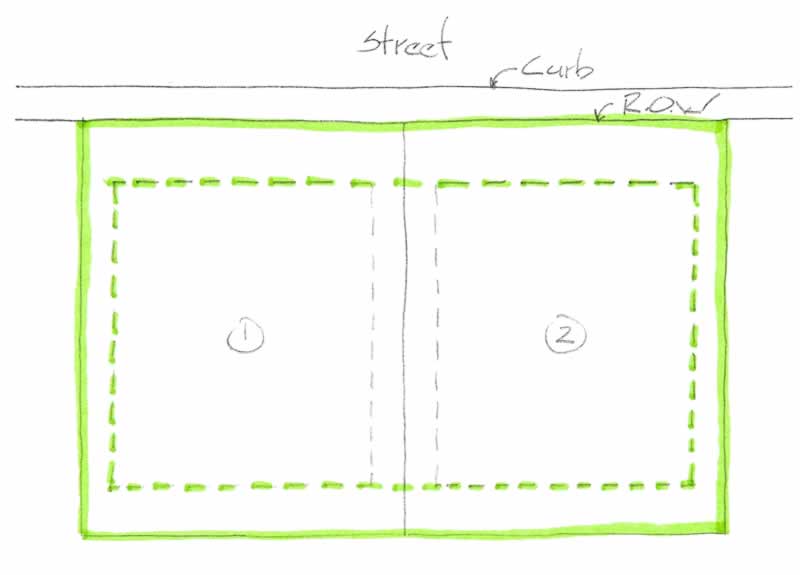
To quickly illustrate the issue, below are lots 1 & 2. For the purposes of the Zoning Lot definition, they could be any adjacent lots or parcels in any Zoning District under one ownership. They might well fall under the Non-Conforming Lot of Record issue in Section 6.3 as well.
Illustration 1 - Adjacent Lots
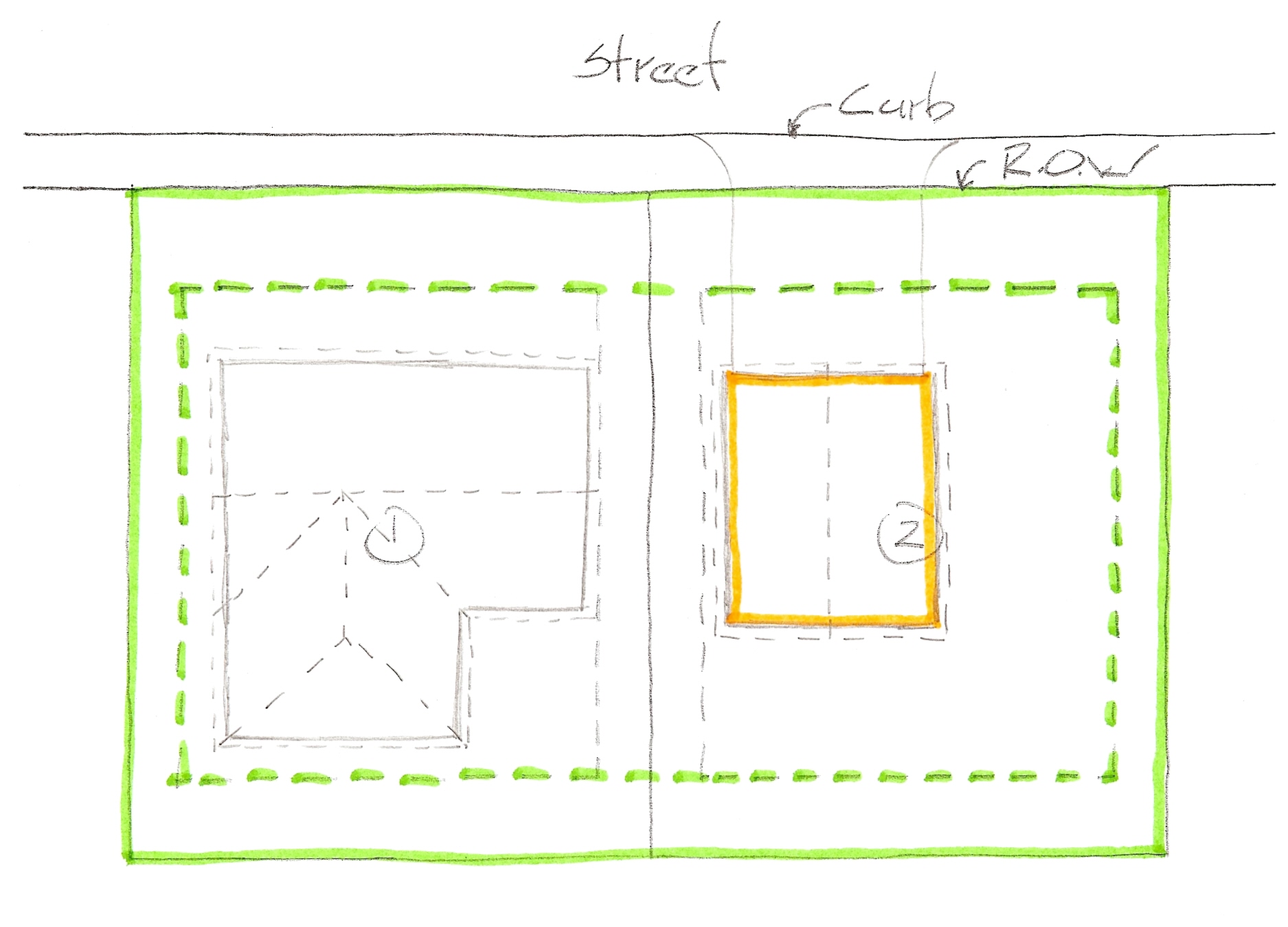
If the lots in illustration 1 were owned by two separate individuals, they could be developed per the zoning standards for each lot in the district in which they lie. If they are under single ownership, they become a “Zoning Lot” as shown in Illustration 2 below:
Illustration 2 - Zoning Lot
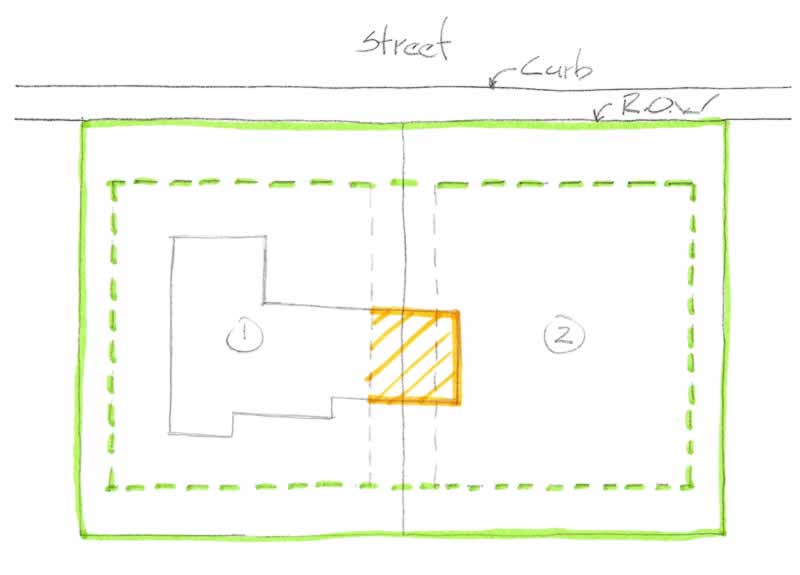
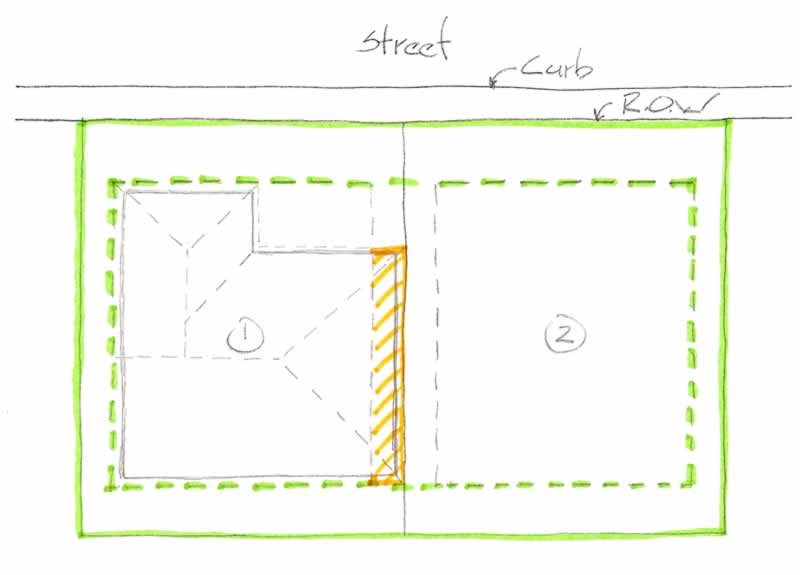
The property lines and setbacks highlighted in green become the governing requirements. The lot line and setbacks between the adjacent lots are no longer considered. This benefits the property owner allowing the entire property to be considered one lot without replatting or variances. The property owner may build across the intermediate setback lines and property lines. (Illustrations 3 & 4) They may have an accessory building (or a garage, a pool, a driveway, a parking area, etc.) on the adjacent lot. (Illustration 5) They also may consider the two lots as one for the purposes of calculating impervious surface. This provision in the ordinance has been used to the advantage of property owners for at least the past 27 years. Arguable, that does not make it right, but removing the provision will affect a large number of existing properties.
I am looking at the following issues:
The existing language allows a property owner who has two or more contiguous parcels to call them one zoning lot and thereby void the interior lot lines and interior setbacks and build across them. (If they have two lots, they can build in the center of the two combined lots on top of the lot line.) If we take the language out, they will be required to replat those lots in order to eliminate the interior lines before they can build. This will require a survey, a new subdivision document and a hearing with the Plan Commission. All of which take time and money. Just the surveyor costs on a simple minor subdivision will run in the $1,000 range. (I checked with a local surveyor.)
Removing this language makes every house in Culver that has already taken advantage of this language and violated those lot lines and setbacks to become a “non-conforming structure”. To make changes to a non-conforming structure requires a variance. This requires a trip to the BZA with all that entails. Again, this takes time and money. Their other option is to replat as described above, but that would generally be even more expensive and time consuming. (Currently because of the necessity to advertise these items twice in the Culver Citizen, if you need to appear before the Plan Commission or BZA you need to have all your documentation to the Town Hall just under a month in advance. If you miss that deadline, you are put off until the next month’s meeting.) A case such as this would have to prove a “hardship” to obtain a variance and that is always a coin toss with how the BZA feel about that and is subject to your neighbor’s input at those meetings.
The issue with this that I’ve heard is that it is unfair that the lot can be sold and someone else could build on it when the current owner would be barred from building another residence on that lot because of the restriction against two dwellings on the same zoning lot. If second lot is “clean”, then it is extremely easy to work within the ordinance requirements. Here are just a few options:
Set up an LLC, Trust or other entity to hold the adjacent property. Two Different Owners.
Deed one lot to wife and one to husband. Two Different Owners.
Deed one lot to parent and one to child. Two Different Owners.
Sell second lot to builder or third party for $1 and buy it back for a buck after construction. We’ve been on projects with the Plymouth Schools (Kindt Soccerplex) and the Plymouth Parks Department (Young Amphitheatre) where this has been done. Two Different Owners.
Sell the lot to a third party for $1 and retain a 99yr lease. Two Different Owners.
A comment was made regarding these options suggesting that they are “cheating” the ordinance. If anything, the “cheat” is the Zoning Lot provision as it now exists. It allows a property owner greater latitude in the use of the property without going through the lengthy and costly requirements of replatting the property as one parcel. But this cheat is a benefit to property owners that I would hate to take away.
With a little internet research I found that similar language appears in other Zoning Ordinances in our area:
City of Plymouth Zoning Ordinance pg 323:
Lot – A contiguous area of land separated from other areas of land by separate description for purpose of sale, lease, transfer of ownership or separate use. It may be a single parcel separately described or a combination of such parcels when adjacent to one another and used as one (1) lot.
Fulton County Zoning Ordinance pg 11-22:
Parent Tract: A lot of record as recorded (location, size, shape, etc) on the effective date of this Ordinance; or a lot as defined by its last conditional transfer of ownership by recorded contract transacted before the effective date of this Ordinance. Multiple lots that are contiguous and owned by one (1) person, persons in partnership, or a company and/or corporation(s) shall be considered one (1) Parent Tract for the purpose of calculating the amount of exempted splits allowed, yet each lot of record, as recorded by its own separate legal description prior to the effective date of this Ordinance, shall maintain its ability to be sold individually as a lot, but only as it corresponds to the said recorded legal description prior to the effective date of this Ordinance. Easements shall not constitute a separation of two (2) or more pieces of land owned by one (1) person, persons in partnership, or a company and/or corporation(s). A lot of record with an existing public road that splits it shall be considered two (2) parent tracts.
Marshall County Zoning Ordinance pg 294 (identical to Plymouth’s):
Lot – A contiguous area of land separated from other areas of land by separate description for purpose of sale, lease, transfer of ownership or separate use. It may be a single parcel separately described or a combination of such parcels when adjacent to one another and used as one (1) lot.
They say it in different ways, but in general they’re saying that two or more parcels, lots, etc. that are contiguous will be treated as one lot. These are professionally prepared ordinances. Our ordinance isn’t unusual.
Here are a few examples of existing situations that will become non-conforming if this language is removed.
Illustration 3 - Residence over the line
The portion of the house highlighted in Orange would be in violation and would become a non-conforming structure. A real world example of a homes that meets the current ordiance requirements, but would be in violation if the Zoning Lot provision is removed can be seen here or here.
Illustration 4 - Setback Encroachment
Illustration 4 shows a home that has taken advantage of the Zoning Lot provision to violate the interior setbacks, but not the lot line. This is an existing problem in the ordinance as it stands since they could still sell off Lot 2 as it has no existing violations. The home on Lot 1 would become a non-conforming structure at that point. (I didn’t trust the GIS to show real world examples of this one.)
Illustration 5 - Accessory Building
Illustration 5 shows an accessory building built on the Lot 2. The home on lot 1 does not have any violations by itself, but without the Zoning Lot provision, the owner would not be allowed to build an Accessory Building on the adjacent lot, be this a shop, garage or whatever. A real world example of this one can be seen here.
There are ways the existing language can be abused. If I were an unscrupulous developer, I could buy two lots, build right up to the internal line between the lots (as shown in Illustration 4) using the combined zoning lot language, sell the second lot which remained clean and then build on it. (Illustration 6, below, shows the ability to sell the clean lot, lot 2, in pink while creating a non-conforming structure on lot 1.) The developer would have gained the additional buildable space on the first lot by violating the setback without getting a variance. The same could be done to skirt our rules on impervious surface. I don’t know if we can ever cover everything. I don’t see how this abuse is prevented in the Fulton County or Marshall County Ordinances either.
Illustration 6 - Selling "clean" lot create a violation on remaining lot
The Zoning Ordinance was returned to the Plan Commission in August. The Plan Commission with help subcommittee members spent about 15 minutes discussing the issue before deciding not to make any changes. Because no action had been taken by the Town Council prior to the September meeting it was discussed again. At least another 30 minutes were spent discussing the pro’s and con’s of the existing language. Points of discussion were:
Removing the provision would increase the workload of the Plan Commission and the BZA handling the non-conforming issues created properties that had taken advantage of the Zoning Lot provision over the past 27+ years.
Removing the provision would increases costs to property owners for the additional Variances or Replattings that would be required.
Is there a way to retain the language for existing properties while requiring replatting for new development on undeveloped lots?
Does the Town Council have actual language they would like to see?
No resolution was obtained and it was determined to continue to wait for the Town Council’s direction. It was further discussed that there are many provisions that have been corrected in the ordinance revision that are going unaddressed while the portion in question is currently in effect under the current ordinance.