Thoughts on Murphy Doors

Murphy Door from themurphydoor.com

I ran across an ad for Murphy Doors that I thought was interesting. I liked some of the pictures of doors to secret rooms hidden behind bookcases a la Batman… and Richard Ford. (Richard had a hidden bookcase door that took him from the the kitchen to the bar in his lake cottage.) And anyway, I’m always intrigued by anything with the Murphy name on it as always reminds me of my grandfather.

The first thought that came to mind was that it seems like a natural fit for a “Tiny Home” solution too. (Yes, despite generally dispising most of the home improvement shows, I do watch that one occasionally.) Few of them seem to use the Murphy Bed solution opting for low-headroom lofts, but any double purpose installation seems to be fair game.

I was particularly intrigued by the idea of using these as a pantry solution. We have pantry cabinets in our home, but without exterior shelves. The idea of a combination of interior and exterior shelves would make that installation more aesthetically pleasing while increasing the functionality.

I was concerned about the hardware strength, but it looks like what they provide is substantial and should do the job. I’m not sure how comfortable I would be installing one in a retrofit situation where I didn’t know how the door framing was completed, but it should be perfectly fine in new construction or in major remodels were the framing could be beefed up or at least verified.

I think the Murphy Door can be a cool solution for the right application and actually become a conversation piece in some locations. Great idea!

Blast From the Past: Restroom Renovations

I have a potential client that asked us about upgrading some institutional restrooms to make them more modern and inviting. They asked us if we had any experience. Of course two projects immediately came to mind. We completed work on the Grace Baptist Church restrooms in 2010. The existing restrooms were functional, but need expansion and modernization. We were able to accomplish that within the tight parameters. We were able to move an adjacent mechanical room to the second floor and expand into that space.

Before
After


In the case of the St. Mary of the Lake restrooms, we changed the chase locations and were able to mostly stay within the same footprint. So yes, we have experience in bringing old restrooms up to code and modernizing their aesthetic!


The Benefits of Building a Custom Home

The Benefits of Building a Custom Home
When it comes to choosing your next home, you may be torn between buying an existing home and working with an architect and builder in order to build a custom home. While pre-existing homes offer the ability to move in right away, they may contain hidden costs, like the need to upgrade appliances, renovate or build additions. Custom homes, by contrast, are completely move-in ready with all the features and square footage you need to make your home comfortable and functional.

1. More Home for the Money
Custom homes can offer more home for the money. When home buyers purchase preexisting homes, they often need immediate maintenance and upgrades. At a bare minimum, you’ll probably find yourself gutting the kitchen and the bathrooms and completely replacing them, which adds to the overall cost of the home. Likewise, the existing home may contain features you don’t want and exclude features you do want.
When you build a custom home, you are only paying for the square footage, features and customization you want in order to maximize the home’s flow and function.

2. Built to Your Specifications
Custom homes can be built to your specifications and your family’s needs. Most preexisting homes include one or two bathrooms and two to three bedrooms. If you have a large or growing family, own your own business or work from home, an existing home may not be able to meet your space needs. Custom homes can be built with as many bedrooms as you need, modern kitchens with all the right materials, home gyms, offices and great rooms and/or gathering rooms that are large enough to entertain friends, family members and clients or coworkers.

3. Better Energy Efficiency
Older homes are not as well insulated and do not typically contain as many green  features, unless the previous homeowners have performed extensive upgrades. By contrast, custom homes can be built to your energy-efficient standards. Instead of fiberglass insulation, you can request spray foam insulation. You can request energy efficient windows, doors and roofing, and you’ll be able to choose between standard hot water heaters and tankless hot water heaters. In some instances, you may even be able to install solar panels on your new energy-efficient roof in order to further reduce your new custom home’s ecological footprint and save money on your energy bills.

4. Appliances Included
Custom homes include the appliances, and you can negotiate with the builder to include upscale or luxury appliances instead of the standard builder-grade appliances. When you purchase an existing home, if the appliances are included, they are often several years old, outdated and may not include the features you desire.

5. Better Privacy
When you decide to build a custom home, you can choose your lot and the style and orientation of your house. This gives you more privacy options than purchasing an existing home. With a custom home, you have the option of setting the home further back on the lot, orienting the home’s design and layout and customizing your landscaping in order to maximize privacy.

6. Move-in Ready
Custom-built homes are ready for you and your family. Once they are finished, you do not have to worry about making upgrades or repairs for several years, and many new, custom homes come with home warranties so that you can have increased peace of mind.

Mixed Materials Fence

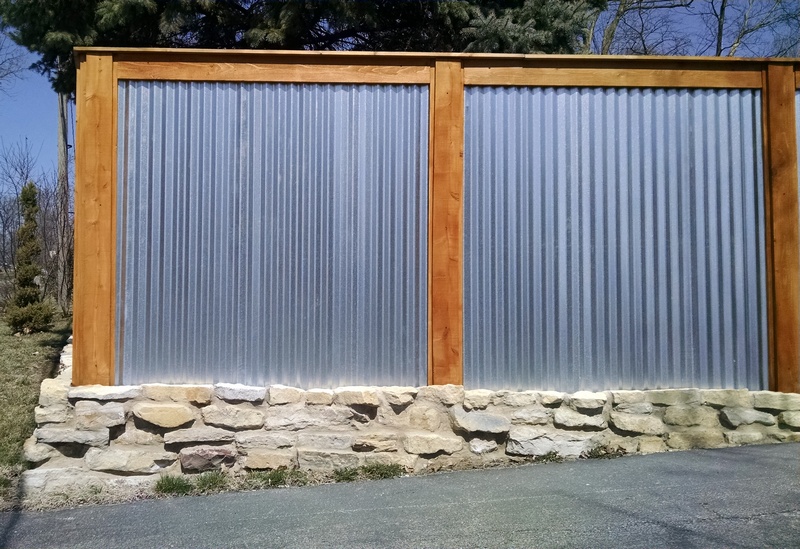
I noticed this fence in Wabash, Indiana and after driving by it for a year or more, I thought it was interesting enough to stop and snap a few pictures. Since seeing it in Wabash, I noticed a similar mix of materials inside Texas Roadhouse in South Bend. There they used it as a booth back at the end of a row of booths. The mix of wood and industrial metal is an interesting contrast that I’m starting to see more and more.

The fence in Wabash is a screening fence for a back yard. No one was home, so I didn’t get permission to look inside, but it would seem to be a great application for a pool. It has the slight limitation of needing to be level, but if that fits your application, I think it’s a creative use that should prove to be durable.

I liked it well enough that I’ve incorporated it into the Sand Hill Farm project. I plan to use this as the dumpster screening wall. It should be durable enough to serve that application well. Dumpster pads are generally level by design, so that limitation won’t apply here.

Dumpsters are a necessary evil, so I thought I might as well make the screening as sexy as possible. It will still have a chain link fence gate, but I’m kind of excited to see how the rest of the surround comes out. As the saying goes, Imitation is the Sincerest Form of Flattery, so I’ll be going for Sincere Flattery in lieu of pursuing Original Design in this case. Swing by and check it out when it’s complete.

Creative ADA Railing Solution

Illustration from www.access-board.gov 505.10.1

Often we’re asked to provide railings for ramps and stairs in public areas. We usually have to explain why the railing used for fall protection is not sufficient per code to meet “handrail” requirements. This is particularly true in a situation where you are attempting to meet ADA standards such as for a ramp. Handrails have specific diameters, heights, returns and extensions that must be met. You can read all about them here. The illustration to the right was taken from that document. Railings for fall protection have different height requirements, have requirements for spindle spacing and often due to the need for lateral strength, have a heavy, reinforced top rail. That top rail often doubles as a protective cap if the railing is wood. This makes the top rail far to wide for a proper grip, even if the other requirements are met.

Once you know the requirements, it’s pretty easy to spot the failed attempts. It’s amazing how many public buildings have these issues. There are several I’ve noticed at municipal structures around Marshall County. (Though fortunately, nothing as bad as the one to the left!) What’s particularly sad is when an obvious attempt at compliance has been made, but the execution has ended up subpar. A contractor is hired without checking references and a “plan” is created based on assumptions, resulting in partial or limited compliance. This often means expensive installations are completed that don’t meet the requirements. Many compliance officers are not as versed in the requirements as they should be.

Custom metal railings can be expensive. Ditto for some of the piece-together plastic systems found online. Because of the varying slopes, and direction changes of ramps, often the specific angles that are needed are not available. I found a creative handrail at the Round Barn in Baroda, Michigan this weekend. In general, wood railings are installed ignoring the code requirements for looped returns at the ends of the stairs or ramp. In this case, the installer mitered a wood railing together to provide a looped return.

I think they can be forgiven for not leveling the railing at the end. The ramp is pretty low slope. The only possible negative I see here is that the bottom corner could still provide a catch point for clothing and the rules would say it should either close the loop or return to the wall. Technically it does close the loop so it may meet the letter if not the spirit of the regulation.

But I want to commend them on finding a creative and cost effective solution to the railing requirements. “Imitation is the sincerest form of flattery” [Charles Caleb Colton] and I will keep this installation in mind in the future when I need a budget solution to the railing requirements.

If you have an ADA compliance situation that you would like us to check out for you, let us know. We are well versed in the requirements and are not too proud to refer you to an Architect or other expert in cases that are outside our expertise and experience.