Community Garden

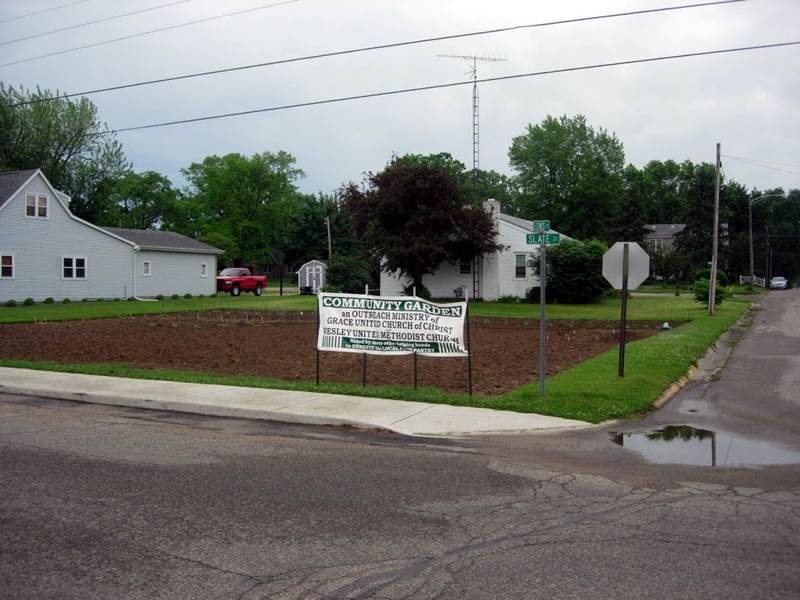
Culver Community Garden at the corner of Slate and Lewis Streets

The Grace United Church of Christ and the Wesley United Methodist Church have started a Community Garden in Culver as part of their outreach ministry.  The garden is at the northeast corner of North Slate Street and West Lewis Street in Culver.  This is the first year for this project at this location.  It will be interesting to observe its success since it is just down the street from our office.

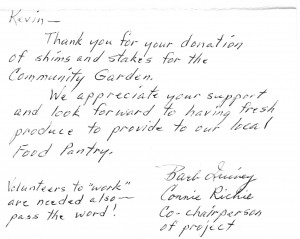
Easterday Construction Co., Inc. has helped support this effort by donating steel stakes for tomato cages and wood stakes for row markers.   We received a nice thank-you note from the organizers.  We are happy to support this community effort and wish the two Churches every possible success with this new undertaking.  We take pride in our community and participate in community efforts where we can.  Many of our employees volunteer their time and skills to make Culver a better place.

As you can see in the note, the organizers need worker bees to help tend the garden.  If you have a green thumb and time to donate, step up to the plate and get your hands dirty!  It’s for a good cause.

Kevin

Culver Elementary School Gymnasium Addition at Plan Commission 4-21-09

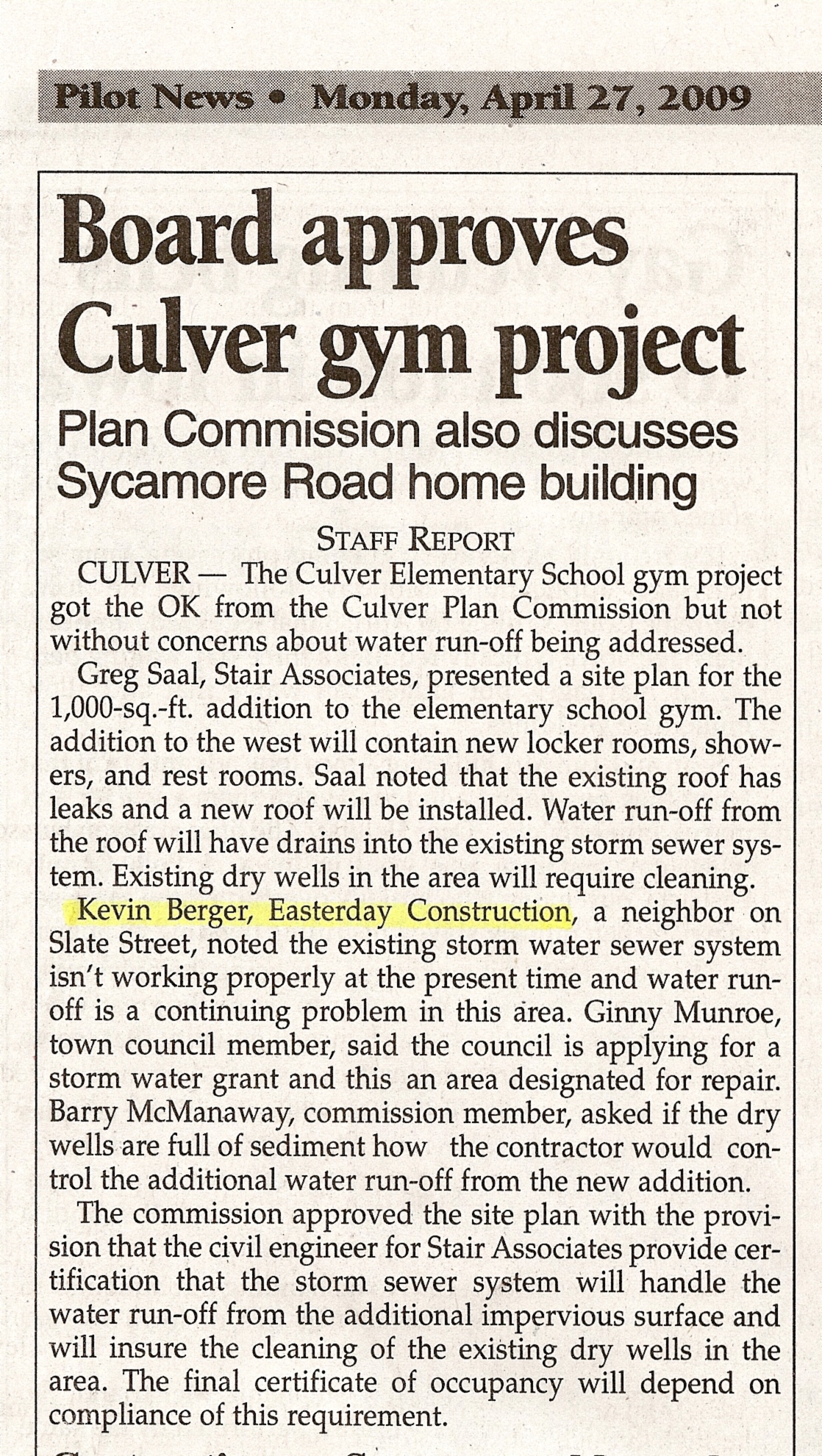
Pilot News Article on CES Gym Expansion
Greg Saal, the Architect from Stair Associates, came to the Plan Commission last week to present the CES Gymnasium site plan for approval.  In his presentation, he indicated that the drainage from the building roof is currently slow, causing water to build up and the roof to leak.  He indicated that the project included measures to get the water off the roof and to the existing storm system quicker.  He also indicated that they did not see a need to improve the existing system as they would be adding less than 1000 sf of additional impervious surface with this project.
I felt the need to speak up.  From my perspective across the street from this project, I know that the current system is not working and has not worked since it was originally constructed.  The existing system is a drywell system.  It is designed to collect the storm water in drywell catch basins in the parking lot and allow it to slowly purcolate into the surrounding soil.  It was constructed at the beginning of the last renovation project and then poor erosion control was exercised, allowing sediment to accumulate in the drywells, reducing their volume and their ability to percolate water into the surrounding soil.  The improvements to the roof water removal system included in this project will change the “time of concentration” used in storm system calculations.  This means that the existing water will reach the drywells quicker, overloading them quicker.
The topography of the site places the new locker room addition in an area that currently bypasses the onsite stormwater system and drains directly to Lake Shore Drive to the south.  My understanding of the presentation was that the additional impervious surface was to be collected and added to the existing onsite stormwater system.
I am not qualified to dispute that the existing stormwater system as designed would be adequate to handle the additional impervious surface.  I do know from observation that in its current condition, the existing system cannot handle the current load, so adding more water and decreasing the time of concentration will only exacerbate the situation.
Rather than tabling the site plan approval until this was resolved, I suggested that the plan be approved with the caveat that the system be cleaned and that a letter certifying that the system was adequate be provided.  This letter would be provided by a qualified civil engineer.  In my opinion, the letter should address the following items:
  1. The letter should be on the letterhead of a civil engineering firm and should be signed by a civil engineer licensed in the State of Indiana.  The letter should include their P.E. stamp certifying the statements in the letter.
  2. The letter should certify that they have inspected the existing system and that it has been adequately cleaned and is working as designed.
  3. They letter should certify that they have reviewed the original design and agree with the assumptions made.
  4. The letter should state those assumptions, i.e., What was the  design storm intensity (10 yr, 25 yr, 100 yr…)?  Was the original design to cover the entire site or only changes made during the project?  What was the design life of the system and maintenance schedule?  Are the soils adequate for the system?  Will cleaning the system make it meet the design standards or will additional remedial work be required?
  5. The letter should then certify that the existing system was overdesigned with adequate capacity for the changes in the Time of Concentration and the additional impervious surface included in this project.

This letter and the completion of any remedial work required should be completed before a Certificate of Occupancy is issued.

I believe that they have been given adequate notice of the requirements and this should not be a problem for them, even if the remedial work is extensive or additional drywells are required.  If for some reason, this becomes impossible to complete before the building is needed for school activities, then a temporary Certificate of Occupancy could be issued.  I would not see a problem bonding this project over to the next year if for some reason funds are not available.  That would protect the Town’s interests and allow the School additional time to secure funding.  Since the project came in well under budget, I don’t see this as a major issue for them.

A Garden Court for Culver

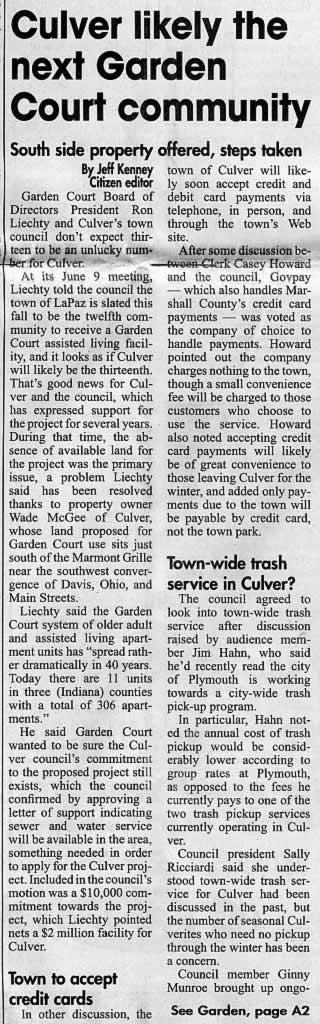
cgc-article-in-culver-citizen-3-26-09I was asked to write an article for the Culver Citizen explaining a little about Garden Court and the positive reasons for bringing one to Culver as well as the obstacles preventing the project.  It was printed in the paper last week along with a sidebar I wrote giving a little description of the umbrella group that is Garden Court.  I have copied  the article and sidebar below:

Read more

Sand Hill Farm – Pocket Towns

Pocket Towns designed by BSB Design of Tampa

Pocket Towns (copyrighted) are a concept I ran across in an article in the January 2009 issue of Professional Builder Magazine.  (Read Article Here.)  They are high density housing on smaller lots (less than 3000 sf).  The homes are pushed to the front and have as little as 5′ side setbacks.  Living space varies from 950 sf to 2400 sf with a mix of one and two story homes.  Read more about them on BSB’s website here.

Becky and I were in Tampa a couple of weeks ago.  Becky had a conference and I tagged along.   I didn’t see the new pocket town neighborhood discussed in the article, but I saw some of the old Tampa neighborhoods that it was modeled after.   Somewhat narrow brick streets with granite curbs. 

Brick Street with Granite Curb

(I’m still trying to figure out how granite curbs were affordable in central Florida at the turn of the century when there wouldn’t be a quarry within hundreds, if not a thousand miles.)   At the end of the block was a library and a service station.  Across that intersection were small shops and a neighborhood grocery store.

Tampa Neighborhood
Tampa Neighborhood

These homes were built on an alley system with no garages or off street parking on the front.  Parking was allowed on one or both sides of the street, but the streets were pretty narrow when there were cars parked on both sides.  Having an alley also allows for utilities to be moved to the back side of the property.  Optimally they would all be buried, but that is usually cost prohibitive and rarely seen in older neighborhoods.  Some of the homes had parking in the rear or even a garage accessed from the alley.

Part of the Green initiative is a move towards smaller homes and more efficient use of the landscape.  The USGBC gives points toward LEED certification for efficient use of land.  Notice the return of the front porch which I discussed here previously.

Town of Culver Brick Street Detail

The streets themselves were interesting too.  In our area, the recommended construction for brick streets have the streets crowned towards a concrete curb and gutter.  This allows storm water to run on the concrete gutter in lieu of across the brick where the brick surface would be eroded and the sand between the brick would be washed away.  Florida is so flat and sandy that very little of the water runs off anyway, so the gutter line isn’t as important.  The brick streets act as a solid driving surface yet a somewhat pervious surface to absorb storm runoff.

Culver’s Wolf’s Dilemma

Can Culver survive Wolf’s Dilemma?  For those of you that don’t know, there are various versions of Wolf’s Dilemma, but basically it goes as follows:

This is the Dilemma.  A random sample of people are chosen to “play”.

  • You are each placed in a separate booth and cannot communicate with each other at all.
  • In each booth is a button and nothing else.
  • You are required to stay in the booth for 5 minutes during which time you can either press the button or not press it.
  • You do not find out if anyone else pressed the button until the 5 minutes are over.

The Payoff

  • If nobody presses the button during those 5 minutes, then each person gets $100,000.
  • If anyone at all presses the button, then:
    • Each person who pressed the button gets $20,000.
    • Each person who did not press the button gets nothing at all.

Except this is Culver.  Everyone knows everyone else.  Does that make it better or worse?

There seems to be a constant battle between the various factions in Culver.  The Mary Means Study that was completed several years ago referred to these groups as tribes and labeled the main tribes as the Academies, Town, Lake and Ag.  Unfortunately the chiefs and their allegances seem to change depending on what the issue is.  Pardon me for not printing my list here, but I think we can all name an issue or squabble.  If I name even one here I’ll be on one side or another of a group or individual with which I have to work!  At times this goes all the way down to issues between individual board or committee members that are unable to work together.

My point is that we all should quit pushing the button! If we work together for the common good, we would all be better off.  Occasionally we do come together for the common good.  The original formation of the Second Century Committee is an example of this for civic groups.  The Culver Union Township Public Library as well as the EMS and Fire that are under a Town and Township partnership are good examples in the public sector.  We should do it more often.