
Culver’s Firemen’s Memorial
 Should it be Firemen’s or Fireman’s? In any case, Culver Union Township Fire Department (CUTFD) is considering erecting a Memorial where they can honor the firemen that dedicated their time and energy to the protection of lives and property in the Town of Culver and surrounding Union Township. They currently have a two memorial plaques on the building for past Fire Chiefs. It would be difficult to install more without changing the prominence, plus since a new building is being considered, a better location/system is needed.
CUTFD Secretary/Treasurer, Dave Cooper, asked me to come up with a suitable design for this project. He asked that I incorporate the bell that currently hangs in front of the Fire Station. They also have a hose cart that they want included. They want an appropriate memorial where markers could be added over time.
 The sketch above (Thanks Mary Ellen!) shows the main memorial wall. It mimics some of the natural field stone work in the existing planter in front of the Fire Station. This is an element that was recommended as a continuing theme in the Culver Design Charrette. The field stone and limestone theme is also seen in the “Welcome to Culver” sign (see picture at left) at the intersection of Lake Shore Drive and Highways 10 & 17 as well as other places throughout town.
 The wall is a curved wall on a 15′ radius which would have their antique hose cart as a focal point near the radius center. The original design called for a paver plaza in front of the memorial with the hose cart (picture to the right) in the center. Currently the firemen are considering using the plaza pavers as a fundraising mechanism similar to what was done at Heritage Park.
 The bell that is currently mounted in the existing planter (See picture to the left) would be relocated to the center of the new memorial. It would be fixed in place as it is now, but it would be more accessible where it could be touched. It will be recessed into the masonry and supported by a steel lintel.
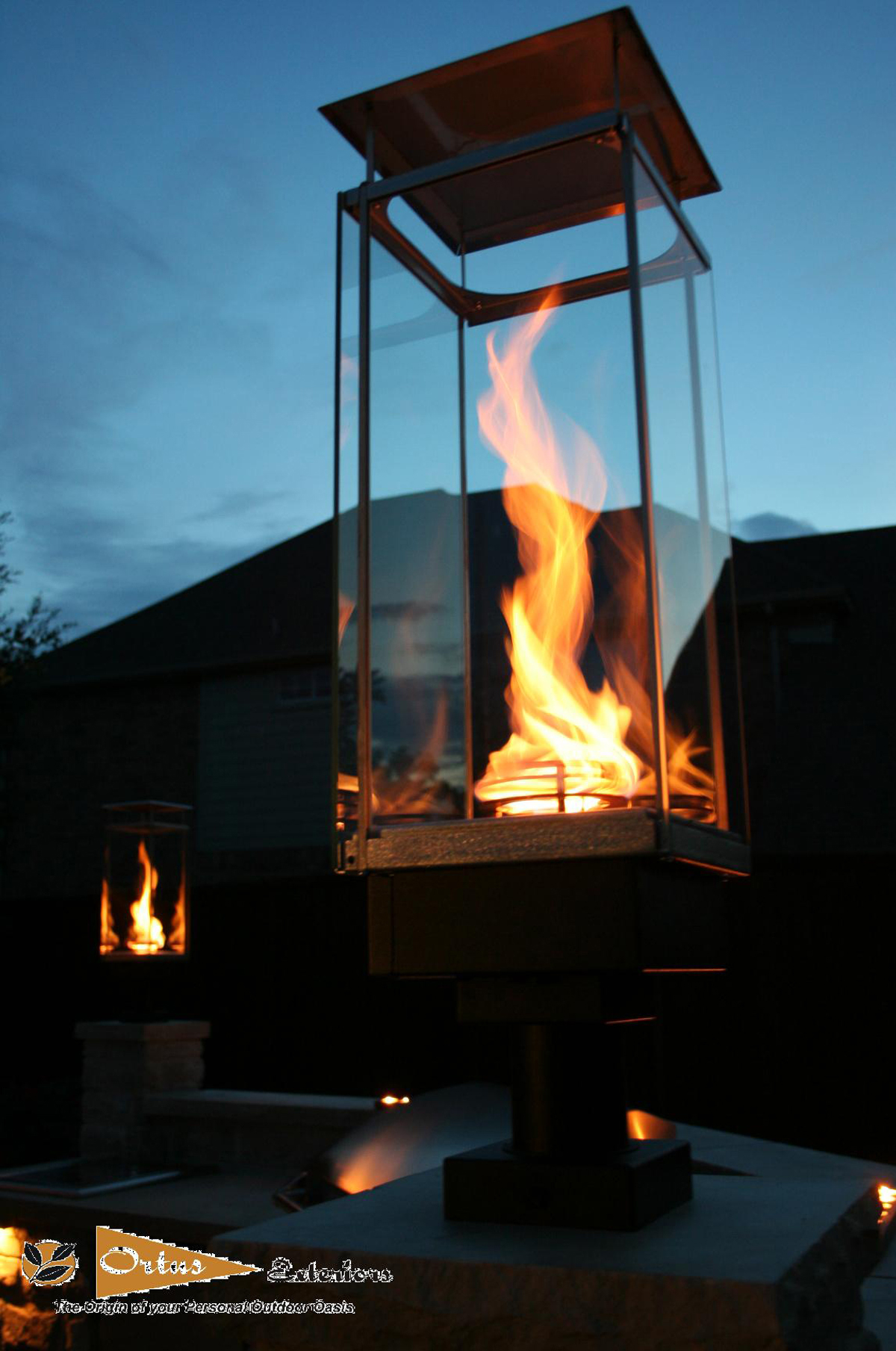 The sketch shows Tempest Torches on the columns at either end. (See the picture to the right.) These are gas fired torches that would draw attention to the memorial. They could be lit for events or special occasions, i.e. Lakefest, Firemen’s Festival, Lion’s Club Corn Roast, Lake Maxinkuckee Film Festival, etc., but remain decorative the rest of the time if they chose not to keep them lit. It seemed fitting to use fire as part of the memorial and it plays into an eternal flame theme. The firemen are considering these, but they could be removed to save expense.
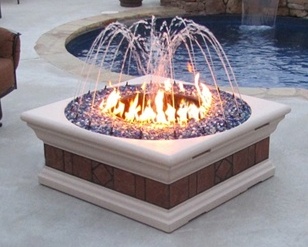 I gave several other options for them to consider, such as a Philharmonic fire and water fountain. What could be better for firemen than a display that includes BOTH fire and water!?! I also suggested the possibility to add benches or possibly a triple pole flag display.
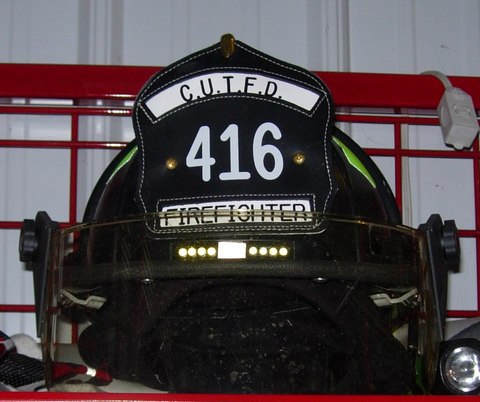 My suggestion for the individual memorial plaques would be to get bronze castings in the shape of the fire helmet badges (picture to the right) used by CUTFD. The plaques could be cast with names, dates, numbers or whatever other symbols of significance they chose. The sketch shows bands of limestone set into the wall where the memorial markers could be anchored. These could be set permanently with inaccessible epoxy anchors.
The firemen would like to place this memorial in the lawn area on the south side of the firemen’s parking lot. I am suggesting that it be placed towards the corner on the west side, angled with its center line 45 degrees to the sidewalk intersection. This would orient it somewhat towards the fire station while keeping the focus towards Lake Shore Drive. This would minimize the disruption to the site, existing trees and ancillary uses such as the Lake Maxinkuckee Film Festival’s donor dinner.
I have suggested that a donor website be created to generate interest in the project and to solicit donations. The generosity of the Culver community is often amazing and possibly a donor that has had their lives touched by these dedicated public servants may step forward with a donation that would cover one of the larger elements. That would make the memorial that much more significant. As always, comments or suggestions are welcome here. Changes are always easier while the project is at the paper stage, so this is the time for input.
United Way Golf Ticket
 The Marshall County United Way has mounted a fundraiser with a benefit… Enjoy a free round of golf at each of six courses in Marshall County!
Get your foursome together and plan a weekly caravan. It’s for a good cause.
Cards may be purchased at the participating golf courses as well as various other community supporters (See the flyer to the right.)
For more about the good work that Marshall County United Way underwrites and the various ways you can add your support, see the flyer here.
The Edgewater Grille
Reading Jeff Kenney’s recent article in the Culver Citizen and The Pilot News about the new Lakehouse Grille in Culver brought to mind our involvement with the creation of its previous incarnation, The Edgewater Grille.

The Edgewater Grille was already operating successfully when the owner/chef approached us about his plans to expand. As Jeff likes to say, “for those of you that remember…” the Edgewater Grille was started in the old Bait Shop, a small white building with an orange roof sitting on the site of the former bowling alley. (At that time the adjacent Lakeview Tavern was under separate ownership.) The Edgewater Grille sign only partially covered the old sign on the roof that said “BAIT”. There were only a few tables because of the limited space, but the business was brisk.
The plan was to fill the entire site with a new restaurant, but keep the original restaurant open as long as possible in the interim. The owner had a vision of what he wanted in his head. With the help of Brent Martin, (B. A. Martin Architect, P.C.) we got that vision on paper and plans approved with the State. Part of this planning was to find a way to stage the project to keep the restaurant open. We accomplished this by phasing the project with the first phase including the restrooms, kitchen, mechanical rooms and some limited seating at the back of the site. As is etched in limestone on on the parapet, construction began in the Fall of 1999.
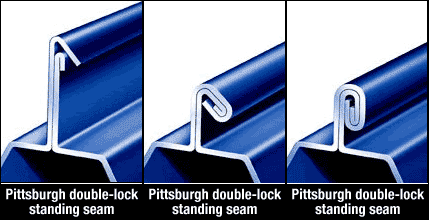
The structure was to be wood framed. This allowed for costs to be shifted and allow the bulk of expenditures on the kitchen and finishes. Exposed wood trusses were used to support a BMC CMR-24 roof. We showed various roof systems to the owner and explained the value of this system for the life of the building. It also allowed a low slope (1/4:12) roof pitch which maximized the interior space without requiring a height variance. BMC (Butler Manufacturing Company) has one of the best standing seam roof systems available in their MR-24 Roof. It uses a Pittsburgh double-lock standing seam with a full 360 degree seamed in place connection. The CMR-24 roof combines the MR-24 roof with rigid insulation board and liner panel to keep the interior clean. Look up the next time you’re there and you’ll notice a step in the roof. The step coincides with the transition between Phase I and Phase II of the project.

The owner wanted a facade that reflected the community. A brick was chosen that mirrored the brick used in the Vandalia Depot across the street. Even some of the details in the brickwork were duplicated in order to enhance that effect. As the facade was installed, the owner liked it enough to expand its use inside, creating a raised platform along the east wall. (It was removed during a subsequent remodel and replaced by a series of booths.) Mr. Martin proposed the tower on the corner to serve not only as an anchor to the structure, but as a metaphorical lighthouse tower since it sits at a bend in Lake Shore Drive.
With the completion of Phase I, the restaurant closed briefly to allow the relocation of some of the kitchen equipment. It quickly reopened in the new location and the old bait shop was torn down allowing the construction of Phase II to begin.
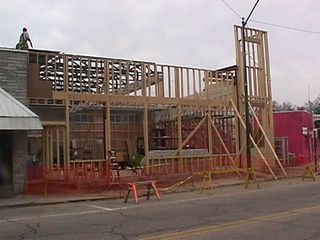
Around the time Phase II was started, the old Lakeview Tavern was purchased, renamed the Lakeview Lodge, and combined with the Edgewater Grille. This allowed for additional seating while Phase II was underway. Phase II went through several changes as construction proceeded. One of the interesting things was the creation of the fountains found on the corners of the raised dais along the west wall. These were commissioned through Susie Black of Black’s Glass in Plymouth. We then added pumps and tubing to create a pool and waterfall effect. The glass was back lit creating a glittering cascade and occasionally a rainbow effect. Unfortunately the water was hard to control and the occasional splatter made them difficult to use when the adjacent seating was occupied.
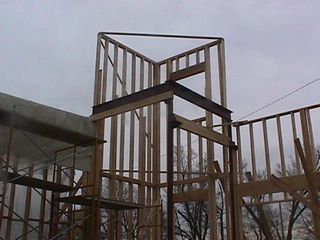
Variances were required along the way to accommodate the silver sign on the corner, the awnings and the entrance stairs and ramp. We also modified the sidewalk to create an accessible curb cut ramp. The restaurant was so popular that the Owner petitioned the Town to make changes and add a crosswalk to handle the pedestrian traffic from the parking areas across the street.
All in all we were quite proud of our involvement with this project. We felt the building fit the restaurant and the restaurant helped usher in an era of fine dining in Culver which we were pleased to be a part of.
Mandate
Random Thought: As we progress into another election season and see how close the polling is, I wonder how is it that we allow politicians on either side to claim a win by 10% or less as a “Mandate”? That’s not even factoring in our country’s level of political apathy where 63% turnout of eligible voters sets a record!
Definition of Mandate from Dictionary.com: “A command or authorization to act in a particular way on a public issue given by the electorate to its representative.”