Community Garden

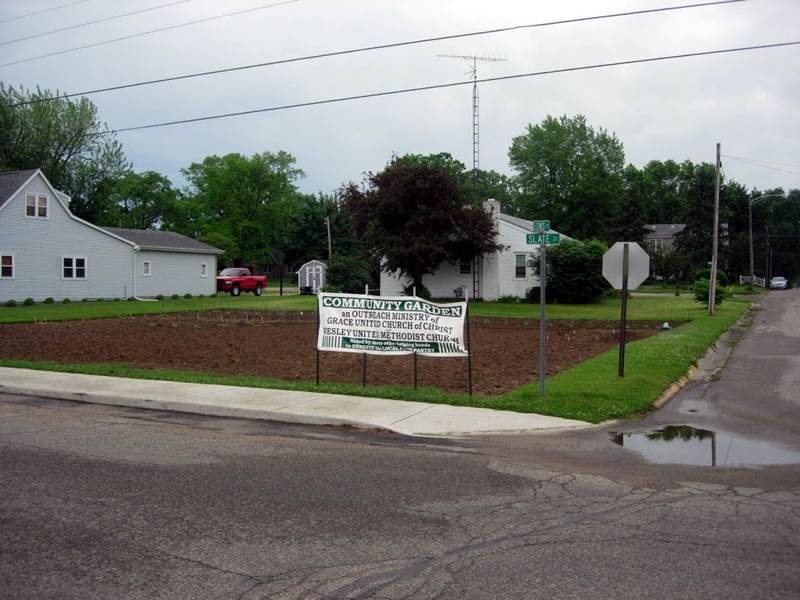
Culver Community Garden at the corner of Slate and Lewis Streets

The Grace United Church of Christ and the Wesley United Methodist Church have started a Community Garden in Culver as part of their outreach ministry.  The garden is at the northeast corner of North Slate Street and West Lewis Street in Culver.  This is the first year for this project at this location.  It will be interesting to observe its success since it is just down the street from our office.

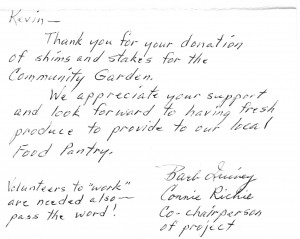
Easterday Construction Co., Inc. has helped support this effort by donating steel stakes for tomato cages and wood stakes for row markers.   We received a nice thank-you note from the organizers.  We are happy to support this community effort and wish the two Churches every possible success with this new undertaking.  We take pride in our community and participate in community efforts where we can.  Many of our employees volunteer their time and skills to make Culver a better place.

As you can see in the note, the organizers need worker bees to help tend the garden.  If you have a green thumb and time to donate, step up to the plate and get your hands dirty!  It’s for a good cause.

Kevin

Water Conservation

Water conservation is not a huge issue in our area, but we’re hearing about it more and more on a national level.  California Governer Scharzeneggar declared a goal of a 20 percent reduction in water use state-wide by 2012.  California currently purchases water from Arizona, but with the continual development expansion in Arizona, particularly in arid areas such as Pheonix, the need for fresh water is a growing issue in the Southwest.  How does that affect us in Northern Indiana?

Read more

Culver Elementary School Gymnasium Addition at Plan Commission 4-21-09

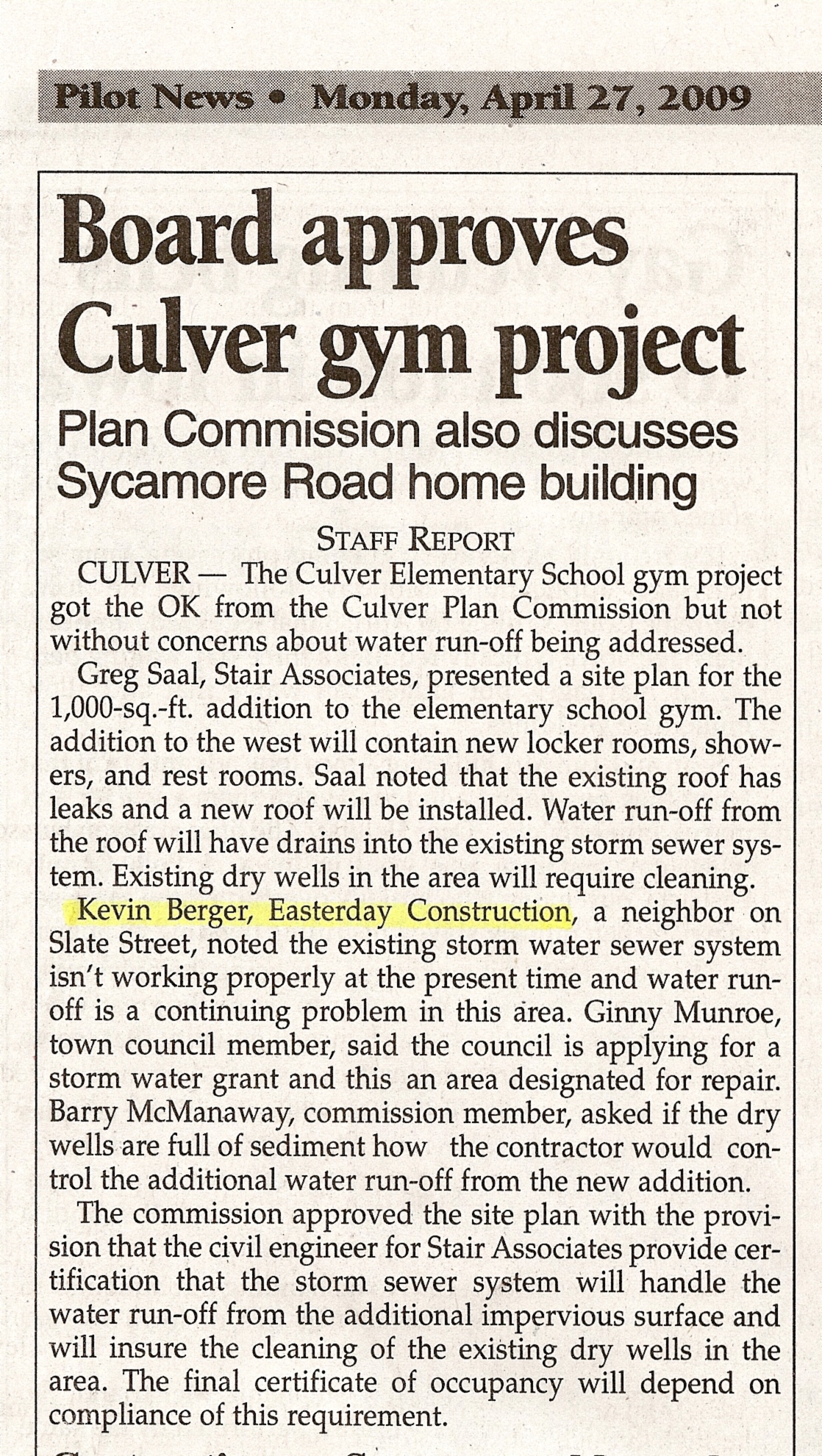
Pilot News Article on CES Gym Expansion
Greg Saal, the Architect from Stair Associates, came to the Plan Commission last week to present the CES Gymnasium site plan for approval.  In his presentation, he indicated that the drainage from the building roof is currently slow, causing water to build up and the roof to leak.  He indicated that the project included measures to get the water off the roof and to the existing storm system quicker.  He also indicated that they did not see a need to improve the existing system as they would be adding less than 1000 sf of additional impervious surface with this project.
I felt the need to speak up.  From my perspective across the street from this project, I know that the current system is not working and has not worked since it was originally constructed.  The existing system is a drywell system.  It is designed to collect the storm water in drywell catch basins in the parking lot and allow it to slowly purcolate into the surrounding soil.  It was constructed at the beginning of the last renovation project and then poor erosion control was exercised, allowing sediment to accumulate in the drywells, reducing their volume and their ability to percolate water into the surrounding soil.  The improvements to the roof water removal system included in this project will change the “time of concentration” used in storm system calculations.  This means that the existing water will reach the drywells quicker, overloading them quicker.
The topography of the site places the new locker room addition in an area that currently bypasses the onsite stormwater system and drains directly to Lake Shore Drive to the south.  My understanding of the presentation was that the additional impervious surface was to be collected and added to the existing onsite stormwater system.
I am not qualified to dispute that the existing stormwater system as designed would be adequate to handle the additional impervious surface.  I do know from observation that in its current condition, the existing system cannot handle the current load, so adding more water and decreasing the time of concentration will only exacerbate the situation.
Rather than tabling the site plan approval until this was resolved, I suggested that the plan be approved with the caveat that the system be cleaned and that a letter certifying that the system was adequate be provided.  This letter would be provided by a qualified civil engineer.  In my opinion, the letter should address the following items:
  1. The letter should be on the letterhead of a civil engineering firm and should be signed by a civil engineer licensed in the State of Indiana.  The letter should include their P.E. stamp certifying the statements in the letter.
  2. The letter should certify that they have inspected the existing system and that it has been adequately cleaned and is working as designed.
  3. They letter should certify that they have reviewed the original design and agree with the assumptions made.
  4. The letter should state those assumptions, i.e., What was the  design storm intensity (10 yr, 25 yr, 100 yr…)?  Was the original design to cover the entire site or only changes made during the project?  What was the design life of the system and maintenance schedule?  Are the soils adequate for the system?  Will cleaning the system make it meet the design standards or will additional remedial work be required?
  5. The letter should then certify that the existing system was overdesigned with adequate capacity for the changes in the Time of Concentration and the additional impervious surface included in this project.

This letter and the completion of any remedial work required should be completed before a Certificate of Occupancy is issued.

I believe that they have been given adequate notice of the requirements and this should not be a problem for them, even if the remedial work is extensive or additional drywells are required.  If for some reason, this becomes impossible to complete before the building is needed for school activities, then a temporary Certificate of Occupancy could be issued.  I would not see a problem bonding this project over to the next year if for some reason funds are not available.  That would protect the Town’s interests and allow the School additional time to secure funding.  Since the project came in well under budget, I don’t see this as a major issue for them.

Slate Roof

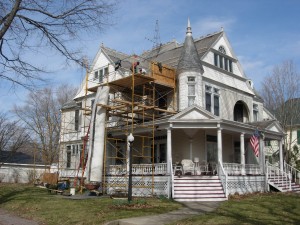
Home on Pontiac Street in Rochester, IN

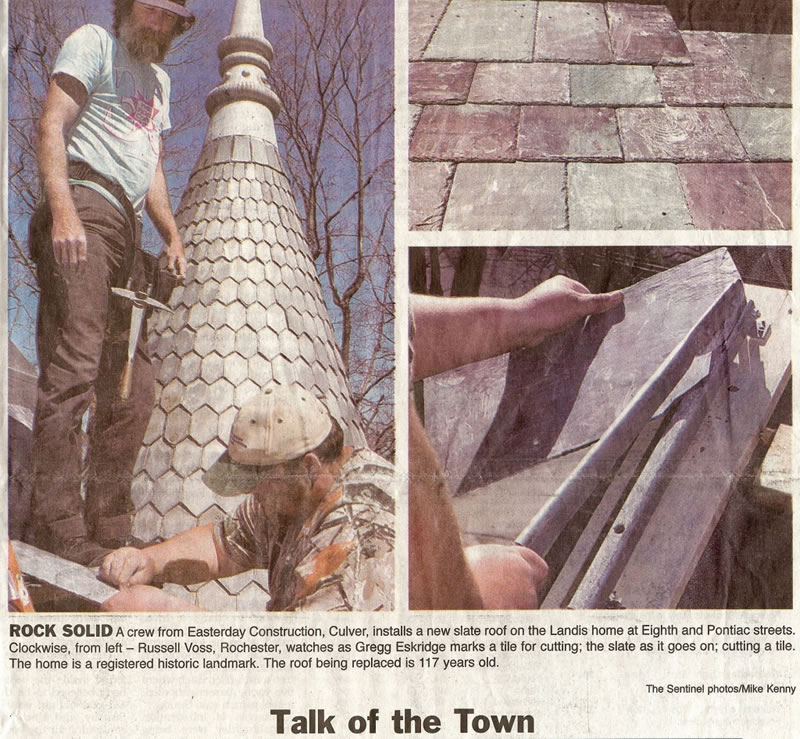
We are currently working on a project to replace a slate roof on a turn of the century home in Rochester, IN.  It has the original slate on it, though it has been patched in places over the years.  We have been surprised at just how badly the existing slate has deteriorated.  We had anticipated taking the slate off shingle by shingle with some breakage, but what we’ve ended up with are pieces not much greater than a couple of inches in diameter and the rest even smaller if not out right disintegrating into a fine powder.  It would appear that a good hail storm would have removed most of this slate without our having to touch it!

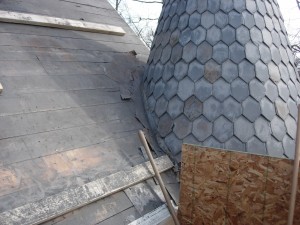
Deteriorating flashings around turret

Another thing of interest we have found is that the fasteners and flashings are galvanized in lieu of copper.  We were aware that the cap flashings were not copper, but we had anticipated the other flashing to be copper.  That would have been the standard for the era.  Instead, the flashings are fairly thin galvanized sheets, generally cut into small pieces.  The nails are gavanized cut nails.  The cut nails have held up well, but most of the flashings have deteriorated and begun to rust where they have been exposed to the elements.

The turret in the picture above has slate in reasonable condition, so it was determined to leave this portion of the roof untouched.  The cutting of the individual slate pieces with the constant changes in size as the turret reduces in diameter would have been extremely time consuming – probably taking nearly as long as half the rest of the roof.  You can see some of the existing flashings around the base of the turret.  Where these flashings are deteriorating, we will installed galvanized step flashings that we can slip under the existing starting course of slate.

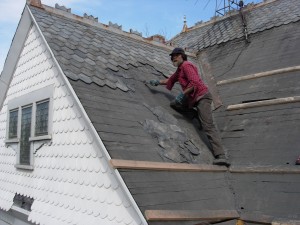
Russell Voss with Easterday Construction using a Slate Ripper to remove old slate from the roof.

The slate is being removed using a Slate Ripper.  This is a versatile tool that slides up under the slate and is used to rip through the nails.   It has sharp hooks to accomplish this and is designed to actually cut through copper nails.   With the galvanized nails, it has generally pulled them out.  This tool is used during slate installation to repair slate pieces that get broken in the process.  It can also be used on completed roofs to help replace damaged slate shingles.  The process is similar to when you remove the nails during demolition.  The Ripper also works as pry bar to lift the shingles when you slide the replacement into place.

Installation of slate is not a quick process.  On this roof we are installing random width slate in two different colors using a 70%-30% mix of purple and green.  This further complicates the installation, but should make for a great look!  I will post more pictures here or on our website when this project is completed.