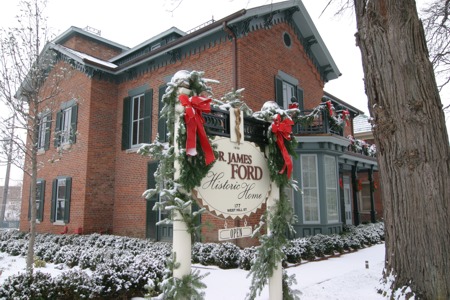
Historic Renovations

We have completed many historic projects over the years.  If you are considering a historic renovation project a 20% tax credit is available as an incentive to encourage you.  The first step is to see if your proposed project qualifies.  Here are the Secretary of The Interior’s Standards for Rehabilitation:

  1. A property shall be used for its historic purpose or be placed in a new use that requires minimal change to the defining characteristics of the building, its site and environment.
  2. The historic character of a property shall be retained and preserved.  Ther removal of historic materials, or alterations of features and spaces that characterize a property, shall be avoided.
  3. Each property shall be recognized as a physical record of its time, place and use.  Changes that create a false sense of historical development shall not be undertaken.
  4. Most properties change over time; those changes that have acquired historic significance in their own right shall be retained and preserved.
  5. Distinctive features, finishes and construction techniques or examples of craftsmanship that characterize a property shall be preserved.
  6. Deteriorated historic features shall be repaired rather than replaced.  Where the severity of deterioration requires replacement of a distinctive feature, the new feature shall match the old in design, color, texture and other visual qualities, and if possible, materials.
  7. Chemical or physical treatments, such as sandblasting, that cause damage to historic materials shall not be used.
  8. Significant archaeological resources affected by a project shall be protected and preserved.
  9. New additions, exterior alterations or related new construction shall not destroy historic materials that characterize the property.
  10. New additions and adjacent or related new construction shall be undertaken in such a manner that, if removed in the future, the essential form and integrity of the historic property and its environment would be unimpaired.

Historic renovation is also one of the most green forms of construction.  Finding a new use for a historic building may well save the structure from the landfill.  Careful analysis should be conducted, though.  Old is not always historic.  Historic structures are notorious for construction cost overrun issues as well as operational costs that exceed those of new construction.  As the project is considered, it must be determined if the project is being approached altruistically or for profit.

Read more

Dormers

Ever wondered what kind of dormers you have on your house?  Or are you thinking of adding dormers to your house and not sure how?  Remodeling Magazine had a quick one page article on adding fitting dormers to an existing house that could help.  A search for “dormers” on their site produce a whole host of useful articles on the subject.

Dormers serve many functions:  They can be purely aesthetic to the exterior elevation, adding curb appeal to the structure.  They can allow light into the interior space.  They can add ventilation.  They can add headroom and usable floor space in cramped attics.  Deciding on what you want your dormer to do is the first step.

In Pursuit of Green

Obtainable Green

 I ran across the above graphic in an article from Multifamily Executive, a magazine I get at the office, titled Obtainable Target by Laura McKenzie.  I’ve written here before about my concerns regarding the cost of “green” vs the claimed savings.  From my experience I have my doubts about the above claims of costs vs returns as well as the exageration rate of concerned contractors.  There is no doubt that in some cases there are legitimate savings to be obtained through green building.  I just want the clients of Easterday Construction to pursue green with their eyes open.  Greenwashing can be found in the form of shams from hucksters as well as exageration by wishfull-thinkng zealots.  Beware of both.  Do the math for yourself.  Easterday Construction Co., Inc. would be happy to help you.

Cordless Tool Tips

Advances in battery technology has made the use of cordless tools on jobsite obiquitous.  The NiCad and NiMH batteries are still the most prominent due to costs, but the new Li-ion batteries are quickly taking over.  Despite their greater costs, they can generally provide more power with lighter weight batteries.  (Be sure to dispose of failed batteries properly.  Most manufacturers have recycling programs allowing the return of batteries that no longer work for recycling.  Cadmium can have a detrimental effect on the environment if not handled properly.)

Along with the advances in the batteries there have been advances in how the tools and chargers manage the batteries.  Sensors in the tools track the draw-down of the battery’s stored power and better manage it.  Chargers optimize the charging time, run refresh cycles to even out battery cell usage reducing the memory effect and some include fans to reduce heat in the charging process. 

All these things are improving the use of cordless tools on our jobsites.  Cordless tools will continue to improve and are the wave of the future for construction workers.

Read more