Georgia Guidestones

Georgia Guidstones
Georgia Guidstones

Last week Becky and I took some time off and went south.  The 5 degree temperatures this morning made us wonder why we came back!

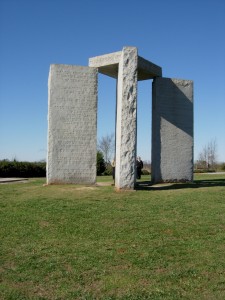
We spent some time in Atlanta with friends and one of the things we did was visit the Georgia Guidestones.  The Guidestones are in Elbert County,  Georgia, east of Atlanta.  They’re on a hilltop out in the country and a little difficult to find.  I had read about them in a newspaper article a while back and we’re always looking for interesting things to do while we’re there.  This was a nice drive and an interesting display.

The stones have a sort of manifesto inscribed on them, which appears to be a blueprint for a new civilization after some catastrophic event.  It is carved into the stones in eight different languages.  They read as follows:

  1. Maintain humanity under 500,000,000 in perpetual balance with nature.
  2. Guide reproduction wisely – improving fitness and diversity.
  3. Unite humanity with a living new language.
  4. Rule passion – faith – tradition – and all things with tempered reason.
  5. Protect people and nations with fair laws and just courts.
  6. Let all nations rule internally resolving external disputes in a world court.
  7. Avoid petty laws and useless officials.
  8. Balance personal rights with social duties.
  9. Prize truth – beauty – love – seeking harmony with the infinite.
  10. Be not a cancer on the earth – Leave room for nature – Leave room for nature.

They have several precise cuts in the stones that have astronomical significance, such as a hole through which the North Star can be seen and and an aperture in the capstone that allows a ray of sunlight to shine through at noon each day.  One of the other interesting things is that there is a time capsule and some inscriptions that remain unfinished, even though, by all accounts, the work was completed per specifications.

It’s unfortunate that some individuals have taken it upon themselves to deface them.  Whatever their intent, the Guidestones are an interesting feature on the landscape.   It’s probably not something I would make another trip to see, but it was worth one visit.

Wikipedia has an entry on the Georgia Guidestones here.  More of the story about how the Guidestones came to be can be found at the Wired Magazine site here.

Outtakes from yesterday’s hearing on Capital Hill

SENATOR LINDSEY GRAHAM, (R-S.C): Can you give me a case in United States history where a enemy combatant caught on a battlefield was tried in civilian court?

ERIC HOLDER, ATTORNEY GENERAL: I don’t know. I’d have to look at that. I think that, you know, the determination I’ve made —

GRAHAM: We’re making history here, Mr. Attorney General. I’ll answer it for you. The answer is no.

HOLDER: Well, I think —

GRAHAM: The Ghailani case — he was indicted for the Cole bombing before 9/11. And I didn’t object to it going into federal court. But I’m telling you right now. We’re making history and we’re making bad history. And let me tell you why.

—————-

GRAHAM: If bin Laden were caught tomorrow, would it be the position of this administration that he would be brought to justice?

HOLDER: He would certainly be brought to justice, absolutely.

GRAHAM: Where would you try him?

HOLDER: Well, we’d go through our protocol. And we’d make the determination about where he should appropriately be tried. […]

GRAHAM: If we captured bin Laden tomorrow, would he be entitled to Miranda warnings at the moment of capture?

HOLDER: Again I’m not — that all depends. I mean, the notion that we —

GRAHAM: Well, it does not depend. If you’re going to prosecute anybody in civilian court, our law is clear that the moment custodial interrogation occurs the defendant, the criminal defendant, is entitled to a lawyer and to be informed of their right to remain silent.

The big problem I have is that you’re criminalizing the war, that if we caught bin Laden tomorrow, we’d have mixed theories and we couldn’t turn him over — to the CIA, the FBI or military intelligence — for an interrogation on the battlefield, because now we’re saying that he is subject to criminal court in the United States. And you’re confusing the people fighting this war.

Watch the an extended clip of this exchange on YouTube here.

Pulaski County Public Library Grand Re-Opening

PCPL Grand Re-Opening Brochure Cover 11-15-09
Grand Re-Opening Brochure

On Sunday, November 15, 2009, I attended the Grand Re-Opening of the Pulaski County Public Library.  They went through a remodeling and addition project over the last couple of years.  While we were unsuccessful in our bid to do the initial project, due to our past relationship with previous head librarian, Katherine Scott, we have been asked to consult on some issues that have developed.  This has led to some miscellaneous small projects.  From this we have developed a relationship with the new head librarian, MacKenzie Ledley.  I was pleased to be invited to their Grand Re-Opening.  I enjoyed hearing the presentations and talking to some of the patrons in attendance.

The Grand Re-Opening was fairly well attended with approximately 40+ people in attendance.  The Library Dedication was conducted by Roberta Brooker, Indiana State Librarian.  She made a nice presentation.  Board President Paul C. Baker presided over the ceremonies and Ms. Ledley unveiled several sculptures that had been donated to the library by a former resident.

This is the second major renovation to the Pulaski County Public Library.  The original Carnegie Library is still the prominent portion of the building visible from the street.  The Carnegie portion of the building is still in use, though mainly as offices and administrative facilities at this point.  A previous 1987 addition houses the library’s geneology section while the new addition houses a new computer lab, children’s section, community room and a several reading rooms.  There is some history written by past librarians here.

Raffle tickets were distributed for chances at door prizes.  They had several gift baskets as well as library logo items that were given away.
Raffle tickets were distributed for chances at door prizes. They had several gift baskets as well as library logo items that were given away.

There were refreshments and door prizes (I didn’t win…) and tours of the library.  Overall the event was interesting and worth attending.  We wish Ms. Ledley, the library staff and the library board all the best as they move into this next era for the Pulaski County Public Library.

History of Construction by S.S. Saucerman

geico-caveman2,400,000 B.C. (10:16 a.m.) Grog, a primitive man, stacks one rock on top of another, thereby performing the first act of construction archaeologists have discovered.

2,400,000 B.C. (10:23 a.m.) Unk, the B.A. from Cave Dwellers Local 369, shows up and claims the work was his.

2,400,000 B.C. (11:37 a.m.) Nok, Grog’s neighbor, trips over Grog’s rocks while going out for his morning newspaper.

2,400,000 B.C. (11:54 a.m.)  The law firm of Urk, Urk, Wonk and Frug is established, specializing in liability and workers comp claims.

1,616,230 B.C. Strange man wanders onto job site with a hyper sense of authority and begins handing out astronomical fines for safety violations.   This intruder is greeted by workers with (and subsequently became know as) “Oh SHIIIIIII….!”  Over the centuries, this label is shortened and becomes simply “OSHA.”

2650 B.C. In the first known example of “value engineering,” Egyptian architects leave nose off of Sphinx of Giza to save money.

2600 B.C. The great pyramids of Giza are constructed. Originally designed as large rectangular structures, Egyptian builders run into stone-supplier strike and run out of product shortly after project begins, thus forcing them to taper down the profile as structure grows, eventually leading to a point at the top.  The engineers are pretty sure nobody would notice.

190 B.C. Following the lead of the builders of the Sphinx in Egypt, Italian designers, in the quest of value-engineering, leave arms off Venus De Milo.

752 A.D. Taverns are invented.

752 A.D. to 1211 A.D. No recordable construction occurs. Experts stumped.

1212 A.D. 100 Years War between England and France is fought for only 87 years, thereby laying basis for determining architects’ billable hour.

1370 A.D. Great tower is erected in Pisa, Italy.

1370 A.D. First drug and alcohol program for construction workers is implemented in Pisa, Italy.

1668 A.D. Though budgeted for $500,000 Swiss francs, the Swiss Architectural firm of Yenney and Yenney messes up plans and specs and project comes in at $1,000,000 after bids.  Y & Y then makes the bold move of charging to revise its own screwed-up plans, giving it even greater additional fees for correcting its own mistakes.  Architects from all around the globe declare, “Wow, cool!”

1708 A.D. Plumb-bob is invented. Bob sues for copyright infringement. Urk, Urk, Wonk and Frug represent. Case still pending.

1752 A.D. Great fire destroys most of Moscow.  Engineer blames electrician.

1803 A.D. U. S. buys all land west of the Mississippi from France.  U. S. later declares it got screwed when it finds there are no sewer and water laterals. Suit is filed.  Urk, Urk, Wonk and Frug represent.  Case pending.

1810 A.D. Schubert tries in vain to finish symphony but architect won’t sign off on punchlist.  Work remains uncompleted.

1869 A.D. Transcontinental railroad is completed with the driving of the Golden Spike at Provotory, Utah.  Spike later removed by landscaper while mowing and whole thing has to be laid out again.

1906 A.D. Massive earthquake topples nearly four square miles of San Francisco.  Building engineers blame design software manufacturer.

1912 A.D. “Unsinkable” British luxury ocean liner is lost in Northeast Atlantic and 1,513 lives are lost.  Engineer blames painters.

1929 A.D. Low-rise jeans invented for plumbers, leading to the siting of many really, really great depressions.

1959 A.D. In historic Kitchen Debate, VP Richard Nixon confers with USSR leader Khrushchev at a U. S. trade show in Moscow.  Pat Nixon ignores the two blockheads and goes with hickory raised panel doors and gold fleck countertop.

1964 A.D. Civil Rights movement leads to ADA. ADA, of course, stands for “Another Dumb Addition” to the cost of construction by politically-correct plebians.

1989 A.D. After an exhaustive third-party review of AIA (American Institute of Architects) contracts and documents–most often used by contractors entering into commercial building projects–it’s officially determined that through the wording of the indemnity clauses included in virtually every paragraph, the architectural community has achieved its long-sought-after goal of having no responsibility for its actions.

1999 A.D. The latest BOCA Uniform Dwelling Code is completed. Six copies are printed and distributed in Cameroon.

2003 A.D. While lounging in his hot tub on an August night, cynical and snotty construction-industry writer S. S. Saucerman is attacked by a pack of lawyers and architects armed with rolled-up blueprints and briefcases.  Officials can only comment, “And the screwy thing was, he was just wearing flippers and a cape.”  After subsequent review, it’s determined that Saucerman deserved it.

LaPaz Garden Court Ground Breaking II

LaPaz Garden Court Ground Breaking

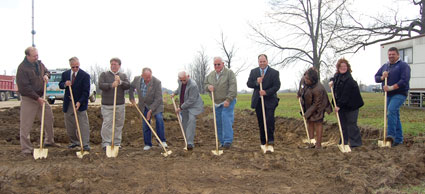
We had the official Ground Breaking for the LaPaz Garden Court yesterday, Thursday, October 29, 2009.  An article and some pictures are in the Pilot News here.  There were about 25 or 30 in attendance, representing various entities that support the project.  This was about 10 days after we began the actual earthwork on the site.  Today’s unfit weather has slowed us down, otherwise we would have been cutting in the footings today.