
We’ve been dealing with ice dams this winter. Several clients have had issues in locations that they have never occurred before. Usually when they call though, the “dam” comes first and the spelling is different… Often it’s unclear if this new occurrence is due to a change in conditions with the building or an unusual weather pattern.
Ice dams are what occur at the eaves on buildings where snow and ice melt on a roof and the resulting water runs to the edge of the roof and refreezes. The dam actually occurs outside the building wall envelope. Unattended, water created by the dam can cause rot to occur on the roof deck and possibly on structural members, it can saturate insulation causing loss of R value, and eventually damage to interior finishes such as drywall, paint and wood trim.
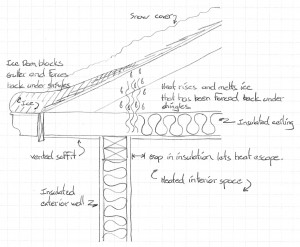
The typical ice dam is caused by a combination of poor attic insulation and poor attic ventilation. Heat escapes from inside of the building and into the attic. The heat in the attic warms the roof and causes the snow on the roof to melt. The water from the snow melt runs down the roof towards the eave. As it passes over the exterior wall where the roof hasn’t been warmed, the water refreezes and an ice dam forms. As the ice dam forms, it stops the water from reaching the eave and escaping. As the water refreezes, it expands and pushes back up the roof and often under the shingles. As it pushes up under the shingles, it breaches the weathertight barrier. As it passes back over the exterior wall, it gets back to the warm area and thaws again. The resulting water then drips in the attic. This is when the water problem occurs and is often the first time the ice dam becomes apparent.