Pitchforks and Torches were out at the Council Meeting
It was a very disheartening meeting of the Plymouth Common Council this past week. What should have been a relatively easy vote for the council, acting on the Plymouth Plan Commission‘s recommendation to rezone property for Garden Court’s GC Horizons project, went nowhere because of misunderstandings, miscommunications and emotional responses. The arguments at the plan commission meeting, some of them not much more than mudslinging, were apparently repeated over the last week, inundating the council with calls, texts and emails. The Plan Director, Ralph Booker, was not allowed to make his presentation nor present the recommendation of the Plan Commission. With no discussion, a motion to deny the rezoning was made, seconded and passed 4 to 2.
Some of the comments from the board after the vote were difficult to hear. It was said that this wasn’t the right location… This site was found after a year of searching, because the council voted down the site we presented last year. We vetted a dozen sites, some turned down by the City in pre-discussions and some because property owners were unwilling to sell or unable to make a decision to sell. This was a good site, following the Comprehensive Plan in a transitional neighborhood, adding apartments and single family homes in an existing neighborhood with apartments and single family homes.
From Ali Riza Kukuk on LinkedIn
The project was conflated with the motels on the north side of town, but not as a solution… just a spreading of the problem. Paraphrasing one statement made, “We (City, Council) should be directing our funds and efforts towards the motel issue instead of this project.” This is a specious argument since Garden Court has not requested any funds from the City. This project would bring in $14MM in outside investment to the community and put a new property on the tax rolls, maybe delayed by an abatement, but still, a property paying taxes above the current farmland rate. There is nothing preventing the City from investing in a different motel solution. These are different projects!
The volunteer Garden Court board stepped up to the challenge of helping with the housing problems in Plymouth with this project. They were encouraged by IHCDA, providing training and offered $14MM in capital investment. It is not the total solution, but it would have been a great first step. Hopefully, the effort hasn’t been completely in vain, but like me, many involved are feeling unappreciated and beaten down. Garden Court’s name has been dragged through the mud throughout these discussions. These were undeserved attacks on their reputation. We’ll see how or if this moves forward. Disheartening…
GC Horizons, Garden Court’s latest project was before the Plymouth Plan Commission last week. There were a lot of people there to speak on both sides. Jamie Fluery did a nice job on an article in the Pilot News that went through a lot of it before the meeting. The drawing from the paper shows the concept plan. Along with the new apartment complex, the City of Plymouth will sponsor some single family homes.
Continuation of Jamie Fleury article from Pilot News
There was a lot of Vitriol spent attacking Garden Court and the potential tenants for these units. Sister Connie spoke in favor of the project and was shouted down at the end. After the meeting she commented, “People look at these things with compassion or fear. Tonight there were a lot of people speaking from a place of fear.”
The proposed zoning change recommendation that was before the Plan Commission passed. That puts the issue before the Common Council this evening and there has been a lot of pressure put on the Common Council Members. I hope they are able to see that the few speaking out don’t represent the majority, but I know it’s hard when you’re being attacked for doing the right thing. Below are three positive letters that were sent to the Common Council stating the case better than I could. I thought it was important to include them here:
From Linda Yoder, Marshall County United Way:
Good afternoon, Plymouth City Council Members,
Thank you for your consideration of the Garden Court Horizons Project. Last week, United Way hosted a review of preliminary findings from the Housing Gap Analysis launched in February 2024.
For those that were unable to attend, attached is a copy of the presentation slides and, for your convenience, a summary of key findings.
Based on data included in the study, your favorable consideration of the rezoning and annexation request on Monday would:
Address a projected housing shortage of 1300 units
Focus on the largest housing need today which is rental units
(Due to multiple factors: high interest rates, high cost of construction making home ownership unattainable for many and a higher than normal % of population under 30)
In addition, a favorable vote will:
Bring $13 million in investment for a mix of 28 low/moderate (affordable) rental units and 8 permanent supportive housing units
Set the stage for a potential READI grant proposal to develop an additional 13 single family housing units for even more state investment in housing shortages
The 2019 Marshall County Stellar Designation opened this door to capture additional state funding through the Indiana Housing and Community Development Authority to address a critical housing shortage.
Michael Fortunato, the Housing Gap Analysis Consultant, shared this summary: The combined effects of a) a large, young renter class emerging, b) another large generation aging in place and therefore locking in the housing supply, and c) suppressed education levels that translate to lower wages overall would create a housing crisis anywhere.
Marshall County’s greatest assets are a) a county working together to be proactive around these issues, and b) a housing supply (with some vacancy) that is still not as constrained as some other neighboring counties.
Those that attended the IHCDA Housing Institute and serving as team members includes: Bowen Center: Zach Cook Bradley Company: Rod Ludwig, Alonda Jenkins
City of Plymouth: Sean Surrisi
Easterday Construction: Kevin Berger
Garden Court: John Myers
SRKM Architecture: Brent Martin, Jeff Kumfer
United Way of Marshall County: Linda Yoder
Additional advocates invited to the team are Jack Davis and Eric Holsopple.
We would be glad to talk with you to answer questions or provide additional information. You can contact me any time (evenings and weekends included).
Best regards,
Linda
####################
From Brent Martin, SRKM Architecture:
Dear Council Members,
As members of the Garden Court team know, I have been reluctant to reach out to plan commissioners or city council members regarding this most recent Garden Court project. I am self-aware enough to know invective is thrown my way as my career as an architect is designing buildings. At the same time, my history with Garden Court goes back over 33 years. Longer now, I think, than anyone else on the team. I guess that makes me “the old man”. Given that, if you’ll allow a bit of a ramble, here’s some perspective.
Mayor Glaub was instrumental in creating Garden Court in the early 1970s. I’ve been told he did so as his elderly mother could no longer take care of her home, wanted to remain in Plymouth, and had nowhere to go. So, the founding of Garden Court was based on providing housing for low-income seniors.
The first projects, Garden Court East & West, were funded by USDA Rural Development, back then called the Farmer’s Home Administration. A bit of history:
During the Great Depression, rural Americans needed the power of electricity that had been established in urban areas. Unfortunately, providing electricity to rural places was cost prohibitive and up to 90% of farmers were not able to access electricity because existing distributors would not build lines to their farms. In 1935, President Franklin D. Roosevelt signed an executive order to create the Rural Electrification Administration.
My Dad remembered when electrical power came to his Mom & Dad’s farm. He told me the deal was the farmers had to get together and set the poles and the REMC would then string the wire and bring in the service, but I digress……..
In 1984-5 Garden Court was approved for what’s called a HUD 202 project for low-income elderly and adults with disabilities of any age. That project is Garden Court downtown, the three-story building on Garro Street.
Then, in 1986 some crazy young architect moved to Plymouth and in 1991 was hired by Garden Court to design what is now known as Neidlinger Garden Court. The Garden Court board was not happy with a three-story building for seniors (no surprise there) and so I was directed to design a single-story building. However, the three-story design was the “HUD Model” and a real donnybrook ensued. (Long and occasionally humorous story there, best told over a beer). As you can see, Garden Court prevailed.
The Rev. Dr. Ronald Liechty was President of Garden Court by this time. He, along with Dean Byers, had the vision of building a Garden Court in every community in Marshall County. A development team of Ron, Dean, Bob Toothaker (Real Estate Management), Scott Huges (Hughes Associates Grant Administrators), and myself was formed to go after funding.
And we were highly successful without much fanfare getting projects funded in Argos, Bourbon, Lapaz, and Culver, along with Knox in Starke County and Mentone in Kosciusko County. While all this was going on we were also successful in funding Fairfield Garden Court and Hurford House Garden Court. You may notice Bremen is not mentioned. That’s because Bremen has a similar 202 project developed by a different non-profit. I would wager Marshall County may be the only county in the state with a facility in each community. That’s something to be proud of.
There is a part of me nostalgic for those development team meetings. The good conversations, the not-so-good coffee, and the real friendships that developed over time. 2024 isn’t 1995, that’s for sure. Not worse, just different. Rev. Liechty is deceased, Bob Toothaker retired, Scott Hughes pretty much out of the grant administration game, but Dean Byers, at 80 years old, is still going strong with Habitat and soon to be our next county coroner!
Since those days, Real Estate Management Corp. is now Bradly Company and has grown to a very large group based in Indianapolis with property management, real estate, and development portfolios. Plymouth is very fortunate Rod Ludwig, a hometown person, is the managing director of multi-family housing for Bradley.
I would be remiss if I did not note over the past 50 years federal agencies have changed the rules for both the development of, and the management of, these properties. And, depending on the funding source, the requirements vary. It’s the nature of bureaucracy. “Use our money, play by our rules.”
You may ask why Garden Court hasn’t expanded low-income senior housing recently? About 15-20 years ago HUD moved the decision making from Indianapolis to Chicago. I’m sure you can deduce where the funding goes now. Garden Court is consistently asking “where is the need?’ And, over the last 4-5 years, they determined there is tremendous need for the housing insecure.
And Garden Court continues to thrive and serve low-income persons, winning awards for excellence and most recently voted Favorite Apartment Complex 4 years running.
Kindly forgive my rambling history, but context and history are important.
As to the current project, here are a few things I’ll mention.
I’ve heard it said Garden Court could sell off this property or develop the whole thing as multi-family. After a 50-year legacy of doing precisely what was proposed for each project, this all volunteer, local non-profit is not going to pull a “fast one”. To say otherwise, ignores reality. Should the tax credit application be successful, we have an understanding with the City to donate the single-family property which becomes part of the match for the City’s proposed READI 2.0 single family housing grant. If not successful, the option to purchase expires.
I have also heard about traffic and of course this project won’t add a whit to issues with school pick up and drop off traffic as the elementary children living there are certainly going to walk to school. I am pleased sidewalks on Lemler to Michigan are planned in the coming year.
The Plan Commission tenders this petition to you with a favorable recommendation after a lengthy public hearing and your plan consultant recommended approval. Those recommendations should carry great weight as these are the people you appointed to make dispassionate decisions removed from political office. They reviewed the request, heard the comments, and then decided. (I’m sure you’ve also heard plenty of comments that aren’t fit to be in the public domain). And your recently adopted comprehensive plan says this:
1)COMPREHENSIVE PLAN: The City of Plymouth’s Comprehensive Plan and any other applicable, adopted planning studies or reports; The new Comprehensive Plan identifies this area to be a Traditional Neighborhood. The traditional neighborhood character area reflects Plymouth’s vision of diverse and inclusive community. This locale offers a range of housing options and living arrangements that cater to every stage of life, all while preserving the historical essence of residential neighborhoods. In this area, you’ll find a harmonious blend of smaller lot single-family detached homes, single-family attached homes like townhomes, apartments, and the versatile option for accessory dwelling units (ADUs). The architectural theme aligns with that of the Transitional Mixed-Use area, where homes stand closer to the street, with cozy front yards.
(from the plan consultant’s report)
In other words, the project is a precise fit to your new comprehensive plan, full stop. Note your plan doesn’t speak to who may reside in any of the mentioned uses. To do so, would be inappropriate at the very least.
I’m also sure you’ve seen Mr. Fortunato’s report on housing and the identified need, crisis really, at the bottom of the demographic ladder. I’m not going to repeat that study, simply encourage you to read it.
And of course, the Economy Inn and Red Rock have become conflated with the Garden Court project. Other than the possibility that a small number of the residents may qualify to move to this new project after going through the coordinated entry process, there’s no connection. None. Having said that, I’d encourage you to accompany Sister Connie or Jack Davis when they deliver food. I suspect you will be surprised to find the vast majority of the residents living there are good people.
Does Plymouth have too much low-income housing? A per capita comparison with Columbia City and Logansport says no. Will property values decrease? Studies in both Kokomo and Plymouth refute that assertion. Garden Court can only meet the need. To deny the need is just not supported by the facts.
Much of the vitriol is driven by fear, although generally people are loath to admit it. All I can say to that is I’ve completed about 25 low-income housing projects over the years, mostly in residential and mixed-use neighborhoods. Some controversial, some not so much. One of the comments I’ve heard from opponents after the project is up and running a few years is often: “I didn’t know it would be like that.”
I understand how difficult a vote can be when you’re being hammered by constituents. Keep in mind the loudest voices are not necessarily reflective of what is best for your community, nor the majority of your community for that matter. Everyone is entitled to their opinion, but the facts matter. I have always believed an elected official should carefully consider what is in the best interests of their community as a whole and then vote that belief.
Thanks so much for your time reading my somewhat rambling thoughts. I urge you to weigh carefully the recommendation before you and evaluate the veracity of comments both for and against this project. I will make myself available this weekend if you wish to contact me.
Brent
####################
From Gary Neidig, ITAMCO
Dear Plymouth City Council Members,
Our community is experiencing a dilemma. Everyone is concerned. Everyone has an opinion. Everyone wants something done. Everyone knows the need is real.
However, we all have a “not in my back yard” concern when it comes to something that is different than what we are accustomed to in our neighborhood.
I have a personal story that speaks to this subject.
A few years ago, I was made aware of a variance being requested for a home in our neighborhood across the street from my home. It was being requested by Pathfinders to open a Group Home.
Some of my neighbors, and myself were not pleased with that possibility, and began to investigate what could be done. After some investigation, we then discovered that there was already a Pathfinder Group home in our neighborhood, and that I didn’t even know about it. The variance was granted, and there have been no problems with the tenants. In fact, the house has been well maintained, and there have been no negative incidences that would have warranted the concerns we had.
I realize that this is a different demographic, organization, and project. However, Garden Court, and Bradley Company have done an outstanding job to vet residents, and to maintain a proper and safe environment.
The affordable housing crisis is a problem for all of us. Allowing the two former motels on the North side to be the nexus for aggregating citizens that are working but lack the resources to get a down payment, or security deposit is not the answer. This is now giving the appearance of a magnet, and is not indicative of what Plymouth has to offer.
Distributed projects like the Garden Court Horizons project are not the final answer, but it is a step in the right direction. If we can work together to create a strategy of helping people that are doing their best to succeed, then our whole community will benefit.
Duane, Don, Shiloh, Randy, Linda, Kayla, Dave, I’ve known you all for many years. You have caring hearts, and you want what is best for our community. We’ve witnessed together our community grow, and have seen improvements in so many areas. Let’s start the process of reducing the blight on the North side by allowing Garden Court to build this project.
Please vote yes for this zoning request.
Gary L. Neidig
President
ITAMCO
6100 Michigan Road
Plymouth, IN 46563.
O: 574.936.2112 D: 574.935.6903
glneidig@itamco.com
“Let the words of my mouth, and the meditation of my heart, be acceptable in thy sight, O LORD, my strength, and my redeemer.”
I’ve written about the Extraterritorial Jurisdiction and the Extraterritorial Boundary here before. You can search the site and come up with a handful of blog posts from the past on this. As a member of the Culver Comprehensive Plan Committee, I lobbied for language that Culver should consider expanding their extraterritorial planning boundary to the 2 mile limit allowed by State Statute. (The language from the draft plan is to the right.) To me, this is a totally reasonable premise for several reasons: 1) Culver already has extraterritorial jurisdiction, just not out the allowable 2 miles. Obviously, it’s something the town has seen value in and has maintained. 2) Culver has annexed land, expanding the boundary of the town without any additional expansion of extraterritorial jurisdiction in those directions. 3) Marshall County is currently considering a county-wide sewer system. Sewer access is one of the main incentives for annexation. 4) The Comprehensive Plan, is just that… a plan. The name of this one is Destination 2040. Is it truly unreasonable to consider planning for the area surrounding Culver sometime over the next 16 years!?
2013 Zoning Boundary (Pink)
The illustration to the right if from an old blog post. It shows the zoning boundary in 2013. The circle around the outside of that shows the approximate location of the 2 mile area Culver could have requested at that time. Since that time, the planning area was reduced and the annexed area was increased. The reason for the reduction in the planning area was the inflexibility of the County’s GIS system and the way Building Permits were issued. This resulted in a negotiation between Marshall County and Culver to change the boundary to follow parcel lines. For the most part, parcels with split zoning per this map were moved completely into Marshall County jurisdiction or Culver jurisdiction following whichever controlled the greater percentage at that time. While I understood the problem, I lobbied that spit parcels should have gone 100% to Culver as they were all within the 2 mile radius. I was a bit frustrated that the split parcel owners weren’t even asked if they might want to be part of Culver’s Planning Jurisdiction.
2024 Zoning Boundary (Pink)
The illustration to the right shows the new zoning boundary as of 2024. This also shows the new annexation lines accounting for The Dunes, the Executive Storage facilities and Culver Meadows. The majority of the area outside of Culver proper is zoned S-1 (More on that later), with a L-1 districts around the lakes and the occasional C-2 and PUD zonings. There would be very little difference in the 2 mile potential area, since the annexations that have occurred are to the west and south where Culver would be limited by the county line. (I think… There maybe options to cross county lines with the blessing of the adjacent county, but that so far outside the bounds of feasibility at this point, that it’s not worth researching.) What isn’t clear in this map, is that part of what was done during the parcel swap was to add an A-1 Agriculture District to Culver’s Zoning Ordinance. The County’s A-1 District and Culver’s A-1 District are nearly identical, by design. The GIS doesn’t even recognize a difference and shows them with the same designation and color.
At some time during the 30 day review period for the Destination 2040 Comprehensive Plan draft, some people read into it, not only the intent to actively pursue planning and zoning expansion, but by some interpretations to pursue annexation of this area. On top of that, in some cases it was construed as an additional 2 miles on top of the current extraterritorial jurisdiction, spreading the planning area even further. The rumors spread and grew. The Culver Town Council held a meeting to discuss this on April 9th. I tried to attend the meeting, but the council chambers were woefully too small for the group that wanted to be heard, so not wanting to stand in the corridor or outside the door, I left. After an extensive discussion with the Comprehensive Plan Steering Committee last week, the original paragraph from the draft (above) was left intact, but the following was added at the end to further clarify the current intent: “At present, The Town of Culver does not have plans to extend its zoning limits. Any future consideration of extending the town’s zoning authority will be done through a partnership between the Town, Union Township, and Marshall County.”
The irony of how this played out is amusing to me. In a nut shell, those outside the town limits do not want to be in the planning area, because they do not have a vote for the elected officials that would make the decisions, and therefore, no influence on what is decided. Yet they appealed to those same elected officials, that they didn’t vote for, and influenced their decision at the expense of those elected officials’ actual constituents. Kinda makes my head spin… Ha!
As always, kudos to those who step up to take the slings and arrows. It sounds like that meeting was rough. I appreciate that they took a step back to consider the language rather than running with a snap decision based on the ire at the meeting. There are also plans to create an advisory committee and have some discussions with landowners in the extraterritorial planning jurisdiction, both the area in it now and the potential expansion area.
The important thing to remember here, that seems to have been lost in the heat of the moment, is that this is a plan… A plan with a 16 year horizon… The things in here are designed to give direction, but it is not set in stone. In regards to expanding the planning jurisdiction, it says, “Opportunities to expand the current extraterritorial planning boundary to its full allowable two mile radius should be explored whenever they arise, and particularly, whenever access to the town infrastructure and resources in the unincorporated areas, contiguous to Culver’s town limits is considered.” Nothing about that says to do it tomorrow. It just means be aware and cognizant of opportunities.
This has gotten long, so I’m ending it here. I will follow up with Part 2 to discuss what inclusion in Culver’s planning jurisdiction could mean to those not in it now. (Spoiler Alert, there are some positives.)
After almost two years of work by local volunteers through various committees with the help of MACOG, the final draft of the new comprehensive plan is available for review here.
A community’s Comprehensive Plan should be revised every 5-10 years. I had advocated for the plan to be revised sooner (I thought Culver’s 2020 Vision had a nice ring to it!), since we completed many of the goals of the previous 2014 Comp Plan through the Stellar Communities funding. Unfortunately, like many other things, Covid stopped early progress on this.
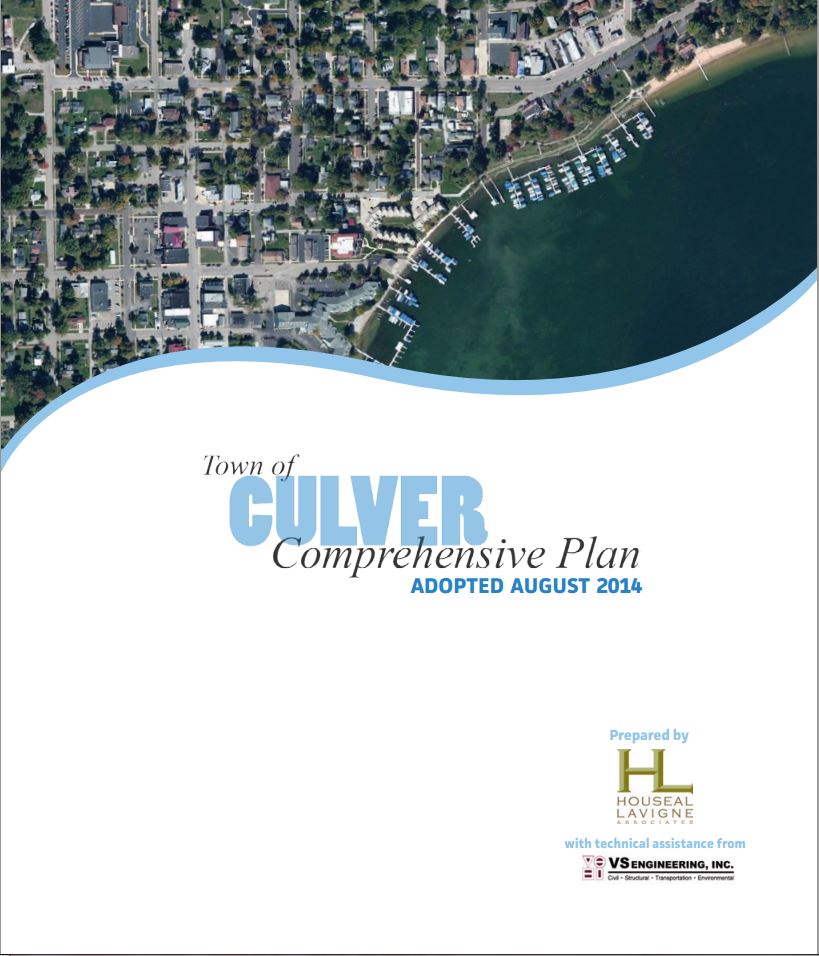
2014 Culver Comp Plan Cover
It is generally the responsibility of the Plan Commission to create a new Comp Plan, but in this case, the Culver Plan Commission delegated this to the fledgling Culver Crossroads group. With the help of MACOG, Culver Crossroads held multiple meetings, public events and other opinion gathering methods to take the pulse of the community and set goals for the future. I’ve participated in this from the start and I believe the new plan captures a lot of vision needed for the future of Culver.
Once the document is finalized, the work needs to continue. The plan is worthless sitting on a shelf. It needs to be revisited often by all branches of Culver government so that its goals can be implemented and its guidance can be observed in the decision making process. Since it was created by the citizens, it should be respected as the new direction for Culver.
This is your last chance to be one of those citizens giving final input before it goes to the Plan Commission and Town Council for adoption. Even if it’s just catching a spelling error or punctuation error, let MACOG know, so this is the best document it can be. This will be our plan for the next 10 years and the face of Culver when new developers, businesses and residents consider locating in Culver.
It always comes as a bit of a surprise when I meet a Lurker in real life (IRL): “So, I’ve been meaning to ask, are you the one that writes the Easterday Construction Blog?” Why yes I am!
So few people actually comment, I generally assume I’m talking to myself. This was the second one in the last few months that said they ran across my blog and ended up going down the rabbit hole of Culver commentaries I’ve posted. So far, all of them have been complimentary of my insight and my writing. Since I’m often sitting here banging something out that I have bit my tongue about in some meeting… that’s positive! I think they even used the term “thoughtful analysis” too. That’s flattering and makes sense. That’s often why I don’t say it at the meeting, i.e. I’m more organized in writing and definitely able to put thoughts together better if I have time to let them simmer. For this reason, I don’t think I ever could be a successful politician. It’s not that I can’t think on my feet, it’s more that I have so many thoughts that pulling together a cogent response takes some time. Whatever comes out of my mouth, spur of the moment, probably isn’t the best answer and definitely isn’t properly fleshed out.
It was good to get some feedback and have a back and forth discussion on some things. Culver politics, Esmie, One Marshall County and, of course, The Dunes, where the main topics of conversation. I learned some things from another perspective and shared a few things that I know better than to put in writing! Ha!
Along with this Lurker/new friend, I was talking to some old friends and they were quizzing me about The Dunes. I was a little surprised about some of the misinformation they had. As a follow up, I sent them a couple of blog links. They obviously went down the rabbit hole as well, since they responded back that Culver should hire me for the Czar position. What’s funny about that is I would (and occasionally do) do that for free. But Culver often doesn’t use the resources it has. There are lots of talented and knowledgeable people in the Culver Community that are not residents. I served on the Culver Chamber of Commerce board for years and it was a joke that of the 10 board members at that time, only 3 of them could actually vote in a Town election. The same thing could be said for a large portion of the Chamber membership in those years. Yet we were people with a passion for moving Culver forward. (During that time, the Chamber spearheaded the Charrette, a new Comp Plan and spawned the Second Century Committee.)
Non-resident Culver talent has been called to participate in things like Culver Crossroads and the Comprehensive Plan Committee. These are great uses of that talent and knowledge, but most of those people that stepped up for those one-time committees, are just a phone call away when Culver is looking at the one-off projects too. The one-offs often have large impacts. Sometimes it seems we fall into the fallacy that you have to be located at least an hour away to be an expert. Culver has paid good money to out-of-town consultants, mostly with good results, but they rarely have the whole picture. They are called in for the one-off project without much understanding of how that project will weave into Culver’s tapestry of history, culture and goals for the future.
Winning an election is a form of a popularity contest. The ability to get elected doesn’t make you an expert in all the things you’ll need to make important decisions on as an elected official. But as a politician, you have shown a talent for rallying people. I would suggest that council members put that political talent to work and surround themselves with a cadre of people that fill the gaps in their expertise. If all the council members pooled their individual cadre of human capital resources, their individual advisory committees so to speak, there would be a standing taskforce of diverse talents that could be called on to help the council move Culver forward. But then, I’m mostly talking to myself…