Nonconforming

While I’m not a fan of conformity in everything, I do tend to be a rule follower. Yes or No rules are fairly easy to follow, but so many rules in the real world don’t easily fall into Black & White, but actually fall into gray areas. Even ones that are clearly yes or no, sometimes cause hardships that need consideration. In the world of Zoning, this is the reason for the Board of Zoning Appeals (BZA). When a building or property doesn’t fit neatly in the box laid out by the Zoning Ordinance, the BZA has the ability to inject some flexibility.

This is a recurring topic with the Culver Plan Commission and it came up again in the January meeting. There is always a laudable effort to reduce the load on the BZA, when the BZA is continually hearing similar requests on which it routinely grants variances. There is a whole chapter in the Culver Zoning Ordinance for this. Chapter 8 is titled, “Nonconforming Structures, Lots and Uses” to try and handle this, but there are times that it is still not enough. The Building Commissioner put forth a proposal that a structure should be allowed to be rebuilt on the same footprint without a variance. Again, this is something that is routinely granted. But I don’t think it is something where a variance should be waived.

As with a lot of our government where there are multiple individuals involved, the BZA is often in the business of finding reasonable compromises. The concept of allowing reconstruction on the same footprint is already a bit cumbersome in practice. Often, the reason for wanting to build back on the original footprint is because that allows continued violations of required setbacks, impervious surface standards or other ordinance rules. Sometimes this is a necessity due to lot sizes, but there can still be issues. Without review, the policy can be abused.

In the past, every nonconforming structure required a BZA review and variance in order to make any changes. The idea was for there to be a review to see if the proposed project could make the structure less nonconforming, if not bring it completely into compliance. This not only gave the BZA the opportunity to review the project, but allowed the neighboring property owners to voice support or concerns regarding the project. The current thinking is that this is unwieldy, but it served a useful purpose.

I have three main concerns with this proposal and the current ordinance:

  1. Chapter 8 is hard to read. It attempts to deal with nonconforming lots, nonconforming structures and nonconforming uses. Often two or more of these issues apply at the same time and the overlapping controls become confusing. For example, a structure housing a nonconforming use cannot be expanded, while a nonconforming structure can be expanded if it doesn’t increase the nonconformity, when the structure is nonconforming because it’s on a nonconforming lot. I would suggest that the chapter establish a hierarchy of priorities to help with these decisions. While each case is different, they are not completely unique.
  2. Chapter 8 should require some stringent guidelines regarding documentation. If reconstruction is to be allowed on the same footprint, then that footprint must require specific documentation before foundations are removed. Documentation should include locating existing overhangs and variations in the foundation line. There is also a provision that the height may not be increased, so this becomes another specific documentation requirement. Don’t allow 8′ ceilings to become become 10′ ceilings and low foundation walls don’t become daylighted basements.
  3. Lastly, I think there should be consideration given to destruction by Acts of God versus demolition for modernization. If a project is literally building back on the same foundation because the house was destroyed by fire or tornado, that is different than tearing everything out and rebuilding on the same footprint because the structure is old. If it is a 100% new structure and there is any way of reducing the nonconformity, even just by inches, the potential for becoming more in compliance should be evaluated and considered.

I think the Building Commissioner is right to ask for clarification and if enough detail is put into determining allowable reconstruction, this is a reasonable thing to delegate to his authority. As it’s written, it’s a minefield and I be concerned about uneven application.

Deposit Dilemma

One of the issues facing entry level workers is the issue of deposits. There is a deposit required for a rental unit. (In the case of a new home buyer, it’s the down payment.) There is a deposit required to get water turned on. There is a deposit required to get the gas turned on. There is a deposit required to get the electric turned on. For someone just starting out, this can be daunting. When someone moves, theoretically they’ll get their deposits back from the previous rental, but not before they have to put them down for the new place.

These have come about due to landlords, municipalities and utilities getting burned by tenants and homeowners skipping out on bills. For that reason, the justification for deposits is there. But… how often is this an issue in the first month when all the deposits are required? I would venture to say that 9 times out of 10, this is an end of occupancy issue, not a starting problem. Theoretically, the landlord renting to the tenant or the bank making the loan on a new purchase have vetted the tenant’s ability to afford their housing choice at least initially.

Riverside Commons Plymouth

The new housing in Plymouth at Riverside Commons is geared towards lower wage earners. People that are good workers with steady income, but not at a level to afford good housing. These units are 100% electric and on city water and sewer, so there are only three deposits required. Unfortunately, Plymouth’s deposit requirement for water is $150. REMC, which provides the electric, has a deposit of $350, plus a $10 membership fee for the co-op. That’s $500+ in deposits without counting the rental deposit. This does not make it easy for a renter to move from substandard housing to the new units. The Paddocks in Culver runs into similar issues qualifying tenants, though I don’t think the start-up costs for water, sewer and electric are quite as high.

So, here’s what I would like to suggest for municipalities:

  1. Municipalities create an account for delinquent and non-payed utilities. To put a number at it, I would suggest $10,000. In lieu of just being a line item, put this into an interest bearing account, so there is some modest growth. (Placing it with Marshall County Community Foundation would be a way to double down on doing good and possibly earn a bit more.)
  2. Set the deposit rate at a number easily divided by 12. For example $120 in lieu of Plymouth’s $150.
  3. Ask for the full deposit at hook-up as done now, with an option for half down and the remainder paid as a surcharge on the first 6 water bills. A convenience fee of a couple dollars could be added if deemed necessary.
    • The Clerk would be better able to answer this, but I would assume that non-payment rarely happens in the first couple of months, but is more likely at the end of service when the tenant or homeowner has moved. By then, the deposit would have been fulfilled.
  4. Put ALL utility deposits in the above interest bearing account.
    • According to this site, there are 3,868 households in Plymouth. So, theoretically, there is an escrow account managed by the Clerk holding $580,200 in water & sewer deposits. If you reduced that to $120, as I suggested, then there’d still be $468,160 at any given time. Ignoring the current interest rate hovering around 5% (MCCF should be better), a 1% return would be $4,642 a year. That could cover quite a few no pays.
    • According to this site, there are 592 households in Culver. (I think that’s pretty low and must be only counting fulltime residents.) Culver only has a $75 deposit, which is only about half again the cost of a minimum water/sewer bill. So, theoretically, there is an escrow account managed by the Clerk holding $44,400 in sewer & water deposits. Under the same conservative 1%, the return would be $444 per year. That’s not going to cover as much, but it would still cover some.
    • I don’t know this, but I assume the current practice is to just mingle this money in the General Fund. That means the initial deposit is tracked for repayment, but any return (interest) on the General Fund account just goes back in the General Fund. If tracked separately, then that interest helps defer any non-payment costs. Obviously less effective in lower population municipalities, but still a factor.
    • I also assume there are older accounts that had smaller deposit requirements, where the deposit has never risen. I’m just using round numbers, so the associated Clerks would probably want to set that straight, but I think the concept is reasonable. While I know that the utilities are supposed to be self-sufficient, every residential unit pays taxes to the municipality and over time, there is some reasonable cost of doing business.
  5. Put all late fees in this account as well. This would act as an additional hedge.

The above isn’t a panacea, but it would help low-income workers with a hand up that shouldn’t hurt the municipality much, if any. If the same principles could be applied to private utilities and maybe even rents, then it would be an equitable way of solving the insurance provided by deposits, while reducing the penalty those deposits put on low income individuals and families. This is just the beginning of a thought on a possible solution… But I think it is something worth consideration and refinement.

Some Things Never Change…

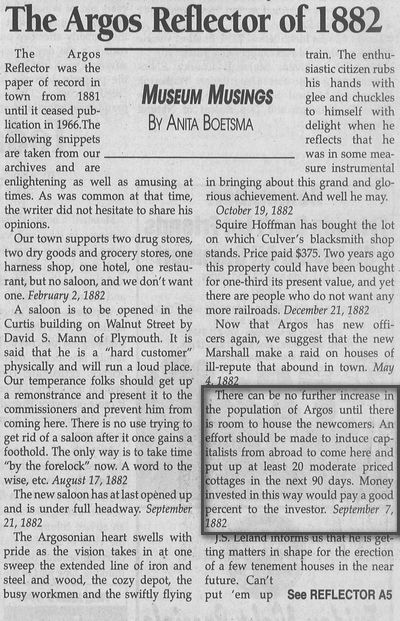
I was amused by a blurb from Anita Boetsma’s article on the Argos Reflector.

I just finished serving on the Comprehensive Plan Steering Committees in Culver and Plymouth right now. This is my 4th and 5th times through this process and housing is always an issue. I know Argos has been struggling with housing issues and according to this article, that struggle has been going on for 140 years!

As is also typical today, the commentator in the Reflector was happy to suggest what others do with their money. “Money invested in this way (housing) would pay a good percent to the investor.” Uh, huh. Other people’s money is easy to spend. I’m sure there would have been further commentary if the writer thought the “good percent” was too good…

I’m reminded of some of the grief I received from the then Culver Town Manager, Street Superintendent and Building Commissioner, who all thought I should be spending more on Sand Hill Farm Apartments and The Paddocks when they were under construction. While their comments were disheartening, it was nice the few times, then Town Council President, Ginny Munroe, publicly reminded them that with all the projects being completed due to Stellar, I was the only one with upfront skin in the game, i.e. making investments and with the potential for losses if things didn’t go well.

Currently, another developer is trying to wind their way through a housing development project in Culver. His project is to be partially funded through a READI grant. As Culver found out when initially looking for a housing developer, there aren’t as many out there as you might think. Culver Sand Hill Farm LLC was created to fill that void. While working on Sand Hill Farm Apartments and The Paddocks, we endured a lot of pushback. Culver’s unofficial motto, “Change is Bad, Even When It’s Change for the Better!” was the theme of many public meetings. The current developer is hearing it all again: The project is too big. The units should be built in a different order. The entrance should be somewhere else. There should be a direct connection to Town. There should NOT be a direct connection to Town. The houses are all going to look the same (stated as bad). The houses should all look the same. There are too many houses and not enough apartments. There are too many apartments and not enough houses. At 300 units, it is a small Town of its own and should provide some services accordingly… and on and on… While the injections of public funds gives the public some say, it still has to be understood that the developer is a for-profit entity and has to make the best decisions for a profitable outcome. Otherwise, why is he doing this? (A question that gets asked at Culver Sand Hill Farm LLC often…)

Housing remains a big issue in both Comprehensive Plans. Plymouth’s was adopted last year. Culver’s is still pending rewrites. In both cases, housing remains front and center, though slightly different approaches have been outlined. Housing is still considered part of the American Dream, but even with that shared vision, everyone has their own ideas about how to achieve that dream and what it looks like.

It’s not too late to make the current developer see the folly of these fights and watch him walk away. Culver Sand Hill Farm LLC sold 12 acres planned for future housing, rather than go through that process again. It’s now going to be a mini-storage facility. Culver Investment Corp. let their PUD expire and have their property for sale. Finding someone else to step up to the Culver’s housing challenge may be hard to do.

Traffic Calming…

It’s interesting that the small town of Culver is having heated conversations regarding traffic calming measures, but that was part of the discussion at the Redevelopment Commission meeting last Monday, 1/15/24. There was actually an impressive turnout for an evening with temperatures in the single digits.

Preliminary Plan for The Dunes development on South Main Street.

I already expressed some concerns about the connections between The Dunes and the rest of Culver here. Since that time, Culver has asked MACOG to fill a portion of the Urban Planner roll I suggested. MACOG is working on a traffic study to predict the impact of The Dunes. Town Manager, Kevin Danti, shared some of those results during the Redevelopment Commission meeting. The main thrust of this was that additional work need to be completed and probably would not be completed until this Summer when they would collect actual busy season data. Note: The plan to the right is old. There is a new one hanging on the wall in the Town Hall meeting room, which is probably out of date too, but closer to the final plan. The one to the right is close enough for representative purposes.

Most of the public comments were a rehashing of concerns expressed before. An interesting bit that caught my attention was the diametrically opposed conversation about the relatively new, pedestrian friendly, traffic calming islands on Main Street and Jefferson Street. Some audience members first expressed concern about additional traffic in the downtown causing safety issues, but then followed that up with complaints that the new traffic calming islands made it difficult for trucks with trailers to traverse these areas. Which is it, folks? Do you want to discourage the heavy traffic in the downtown and make pedestrian crossings safer for shoppers in the business district or do you want to change things to encourage truck and trailer traffic along these routes?

Traffic Calming Intersection Bulb-out

Cities and Towns around the world are looking at ways to make their streets more pedestrian friendly. This makes a lot of sense in business districts. Narrower lanes slow traffic. Corner islands reduce the distance pedestrians have to traverse. Both of these things serve to discourage unnecessary traffic in these areas. All of this fits with the trails that Culver has been adding. If residents are concerned about traffic downtown, don’t they want things that discourage it?

While I’m old enough to remember when Culver had two stoplights, I’m not old enough to remember when they were needed. I don’t remember when or why they were removed, but as a kid, I remember a stoplight at the corner of Main Street and Jefferson Street and a second one at the corner of Ohio Street and Jefferson Street. Now, I don’t remember the last time I’ve been behind more than one car at either of those intersection. We could always bring those back to slow things down…

Roundabout drawing at Davis St/South Main St intersection from the 2014 Comp Plan

The other thing that caught my attention is that while the committee working on this project recognizes the issues at the intersection of South Main Street and Davis Street, the idea of a roundabout has been taken off the table because the street department doesn’t like roundabouts. Really? I am not convinced that it is the best way to go, but it should remain a consideration until a better option comes forward. After all, it was in the 2014 Comp Plan. (I put the link in, hoping that the Town website will be fixed soon.) I am not saying that the street department’s input should be ignored, but I don’t think they should have that kind of veto power.

While Kevin Danti did a fine job of relaying the information at the meeting, I hope there is the opportunity for MACOG to present their ideas to the public directly. As with many things, there is unlikely to be 100% acceptance and agreement, but I’m pleased the effort is being made.

West High Corner

Whew! There’s a lot going on there! Very little of it good… To orient you, if you’re not local, this is the curve north of Lake Latonka, where S.R. 17 begins to run east towards Plymouth and Sycamore Road continues north towards S.R. 30.

Property at SE Corner of West High Intersection highlighted in cyan.

So I don’t bury the lead, the initial reason for writing this was a John Oliver style, “Why is this Still a thing?” rant. I came around this corner from the East the other morning on the way to work, in the dark, to find a school bus stopped to pick up kids from the house on the inside of the curve on the SE corner of this intersection. It wasn’t very visible to me until I was almost on it and it would have been worse for someone coming from the South. The best case for this is this time of year when it’s dark and the bus’s flashing lights are reflecting off of everything. At twilight, the danger doubles down.

This property just recently changed hands. I know things get grandfathered in. I know it’s cold out and kids don’t want to walk far, so the closest point to the house is the preference. But there is a significant piece of property here with an alternate driveway. Barring getting rid of this dangerous driveway, can’t the school bus pick up at the alternate driveway off the curve?

West High Fireman’s Memorial at Night

This intersection has always been dangerous. The memorial at the northwest corner of the intersection commemorates the 5 fire fighters that gave their lives at that intersection in 1982. The truck they were in took the corner too quickly and went into the swamp on the west side of the road. This was the worst single-event loss of life for a single fire fighting unit prior to the 9/11 terror attack. The permanent stone memorial included lighted flags and was dedicated in 2014 It replaced 5 wooden crosses on a utility pole near the crash site. It is somewhat fitting that this memorial is quite striking, yet somewhat eerie when lit up at night.

West High before it’s 2023 demolition.

It will be interesting to see how long the West High Corner moniker remains in use since the referenced school is gone. The Northeast corner of the intersection was home to the West High School, named for West Township. Many people were sad to see the school go away this past year. I have to agree that it was frustrating that it couldn’t be repurposed, but location is everything and is often the case with structures like that, its highest and best use was as a school. I could not find documentation, but my recollection is that the school corporation sold it at auction for $1,500 in 2005. From there, the buyer stripped most of the things of value from the building. It became a door and trim shop after that. The Covid pandemic ended that. Most recently it was purchased by Jackson Salvage, which made it go away… except for the slabs and foundations. All that remains is a memorial with a bell and well along Sycamore Road to commemorate the school’s previous glory.

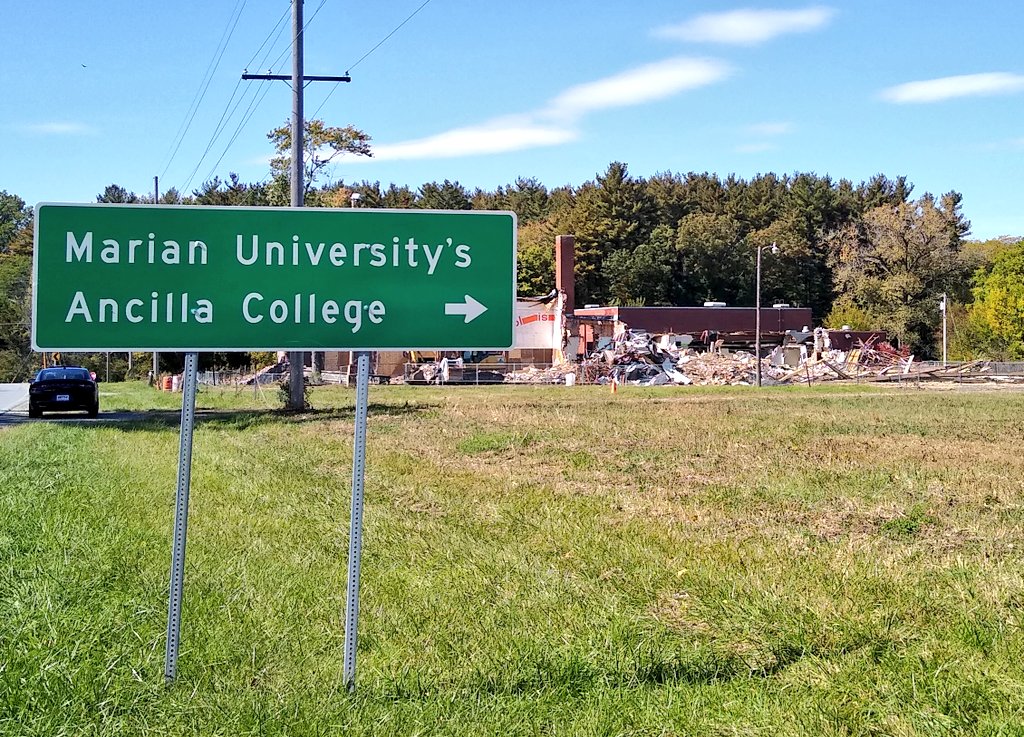
Am I the only one that found the juxtaposition of this crooked MUAC sign pointing at the partially demolished West High building amusing? This sign went up as the building was coming down…
Historic West Township Trustee’s Cabin

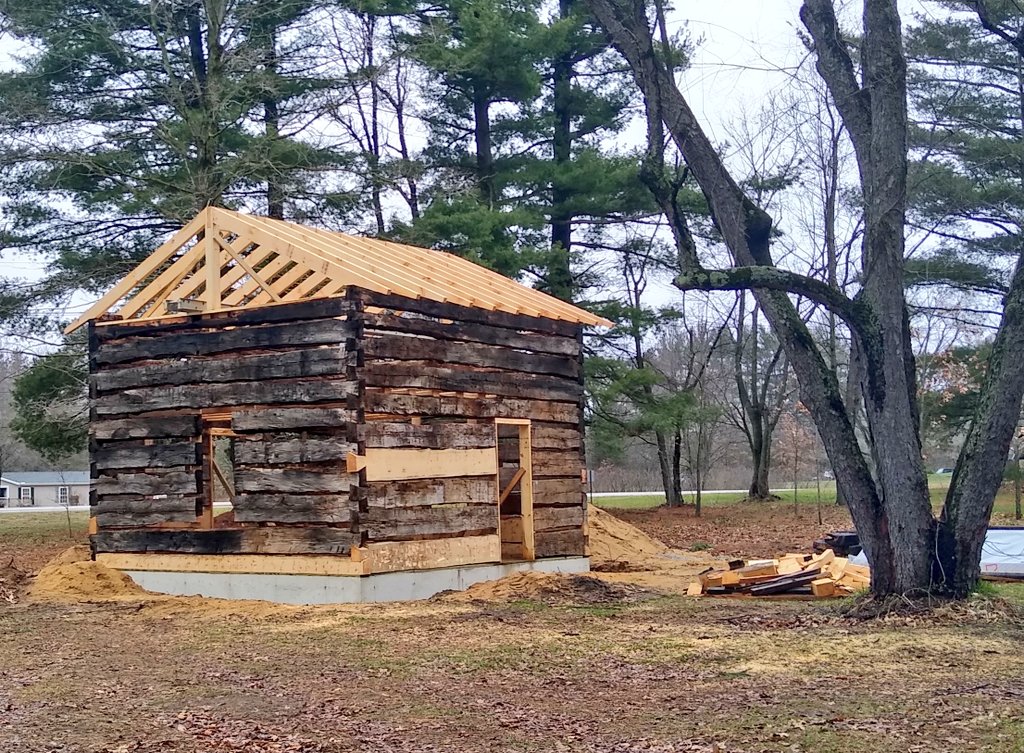
The property on the southeast corner referenced at the beginning of this post was the former location of the original West Township Trustee’s home; a log cabin that was just recently relocated south to Memorial Forest. The picture to the right shows the cabin during reconstruction as new roof framing was placed. The recently formed Marshall County Parks and Recreation Department tried to have it relocated onto the West High site, but there weren’t sufficient funds to make the deal possible.

As attested to by the lost fire brigade, the West High Corner is to be respected. The two exits/entrances onto S.R. 17 from Sycamore Road are also treacherous. From experience, the southernmost connection is the most dangerous and least respected as I often see cars exit or come onto S.R. 17 without stopping. West bound cars cannot see that intersection until they’re into the curve, so if they are taking it quickly, there’s often near misses. In icy winter conditions, this is even worse.

Culver Chamber proposal to extend SR 17 north along Sycamore Rd with a gentle curves to align with Rose Rd

In the mid-1990’s, the Culver Chamber of Commerce petitioned the Marshall County Commissioners to improve Sycamore Road to give Culver more direct access to S.R. 30. For a time, this was a collaborative effort between the Town of Culver, Ancilla College (now Marian College), Culver Academies and Swan Lake Resort. One option for this was to attempt a trade-off with INDOT, changing Sycamore Road into the north end of S.R. 17 and the east/west portion from West High to Plymouth would have become a county road again. This would have had many benefits including an intersection fix at West High, an improved route to S.R. 30 from Culver, fewer driveway accesses, and an easy aerial railroad crossing. At the time, Marshall County had already broached INDOT through MACOG about the Pine Road extension. And also at that time, Plymouth didn’t want to give up the benefits of INDOT maintenance on the main street through the City. (Plymouth is having second thoughts now as their Complete Streets Committee wrestles with the pedestrian issues associated with this.) With the completion of the Pine Road extension to S.R. 17, this initiative is unlikely to be considered. Some of the property that was vacant has been developed, further hindering this right-of-way acquisition.

I don’t see a good solution to this intersection in the near future. At a minimum, I would still like to see something done to eliminate the school bus stop in the middle of a State Highway curve. This intersection doesn’t need another memorial…