Dunes Approvals

The Dunes received a major subdivision plat approval and site plan approval from the Culver Plan Commission on June 18th and from the Culver Town Council on June 26th. This was somewhat a foregone conclusion since Culver has been working with the developer for over a year on this project. It was interesting though that neither entity passed these approvals unanimously.

The preponderance of people in attendance at the meetings were against the project. Some in its entirety, but most in its scale. Some (falsely in my opinion) called the Town to task for not communicating enough and not listening to concerns. (If there is one thing that I would say Culver is above average in, it’s communication with its citizens…) There were also those that attempted to complain on both sides of the issues, saying it was too big, but might be left incomplete; it was being pushed to quickly, but the developer shouldn’t be give 8 years to complete it; it was not planned to be part of the community, but but it should be connected directly to State Road 17, to direct traffic out of community.

I remain generally in favor of the project. I am a little disappointed in the the follow through on requirements the town had placed on the project. The project presentation to the plan commission has been delayed twice because of engineering questions being unanswered. As presented, at the meeting, most of those were answered “in concept”, but details were still not complete. There were also pending questions regarding the projects connection to South Main Street that were not complete. And then there was the statement from the developer that the town would be receiving a lot of money from increased TIF capture on this project which could be directed towards some of the short falls in water and sewer needs. Many of these things affect adjacent property owners, including a wetlands and the town’s own well field, while the money being proposed for water and sewer improvements had previously been suggested for other TIF district needs not connected to this project. I would have liked to have seen all these things tied down before authorizing them to proceed.

I was pleased that many of the questions from the audience were addressed, but I have concerns with their substantiation. I do not in anyway want to speak ill of the developer and their honesty regarding the project, but the answers given were off-the-cuff, having little if any documentation or requirements of follow-through. Many of the questions were, frankly, not the business of anyone but project investors, but the reassurances carried no weight. While I trust that everything said was in good faith, there is nothing that keeps them from changing direction on them if economics of the project suggest better uses of funds. As suggested here before (second to last paragraph), their development agreement included none of the delineated requirements seen in past agreements.

That said, I think many of those protesting this development fail to understand that this project was not a surprise, but something that has been in the Town of Culver’s plans and one of their goals for over a decade. When the Culver Garden Court property was annexed around 2010, the surrounding property was annexed as well. It was rezoned as R-2 to promote housing in that area. When the last revisions to the Culver Zoning Ordinance were completed, R-2 was rewritten to allow higher density developments. The 2014 Comprehensive Plan suggested, due to citizen input, that more housing is needed. The Stellar Communities surveys of 2016 and 2017 indicated more housing is needed. The 2024 Comprehensive Plan still indicated the need for more housing, even with The Dunes under discussion. This was not a project that required a rezoning or multiple variances to make happen. It fits with the planned development of the town.

Do I think things might have been done better? Always. Until I’m appointed benevolent dictator, I will most likely always see alternatives that I would have pursued. (I still have questions about whether it follows the Culver Complete Streets Ordinance, whether there were drywells added, where they drain and who owned them, and whether the wetlands have been properly addressed, etc.) Do I think those in charge were (mostly) following the will of the majority of citizens? Yes.

Sand Hill Farm Apartments – Blast from the Past

I was going through some old posts and ran across this video the Culver Visitors Center created when Sand Hill Farm Apartments first opened: https://drive.google.com/file/d/1ejjSup5eoh-Rfs266NGxjJ2d42b35t21/view You can tell it was early on because the joy john was still in the parking lot! Ha!

Since opening, we have tried to continue to make improvements. We installed an Amazon Hub, a bike rack, a fire pit and firewood rack (which we periodically fill), some pines to hide the ugly Culver lift station, some trees, a new site sign and this year we mulched the parking lot islands and planted creeping thyme, and will be planting some more trees. We’ve also set things up so the residents can access Surf Internet as well as the Mediacom service, which was there originally.

I would still contend that the construction of the Damore Amphitheater and Sand Hill Farm Apartments are what tipped the scale for Culver’s Stellar designation. We want to maintain Sand Hill Farm Apartments with that same leadership going forward.

The Dunes Work Session

There was a work session held Wednesday evening, 5/15/24, to discuss The Dunes project. This was a combined session with the Culver Town Council, Plan Commission and Redevelopment Commission in attendance. Despite being advertised as a work session, they did allow limited questions from the public in attendance. I am not sure how many were watching via Teams, but there were only 7 “public” in the room.

Combined Work Session for the Culver Town Council, Plan Commission and Redevelopment Commission May 15,2024

I attended just to listen. As I have said before, I am generally in favor of this project, but The Devil is in the Details. This is the third project of this type, one of two that has regional matching dollars, that has been come up for the Town in the last 10 years. It’s been interesting to see how these things have morphed over time. Since the meeting, I have been approached by several people, some on opposite sides of the issue, for my thoughts on the meeting. I thought I would include some of my responses to them here.

The meeting was ostensibly to hear the Town’s Engineering Firm, Midwest Engineers, Inc., give their assessment of the drainage plans. Some of what was presented was by the developer’s attorney though, so there may have been some honest miscommunication. That said, it wasn’t corrected by the engineer. As a disclaimer here, I have not seen the drainage study, final plat, or construction plans, so I can only speak to what was presented.

Thoughts on the drainage:

  • There was a question from a plan commission member concerning the adjacent wetlands behind the water treatment plant which currently comes up into adjacent property owners’ yards during heavy rains. The response was that there would be no increase in water volume entering the wetlands, but that it would enter faster. There would be an overflow established for the wetlands routing the water somewhere (town storm drains?). This is one of those where I wonder if there was a misstatement, as the general design of a detention basin is to detain the water and slowly release it at a rate no faster than predevelopment. Flushing the wetlands with a rapid release and an overflow to the storm drain could well be detrimental. This wetland is directly adjacent to the town’s well field, so its health is important. Also, this seems counter to town’s storm water requirements which state, “It is the responsibility of each land owner to insure that any portion of precipitation from such sources as rainfall, snowmelt, or irrigation water that flows over the ground surface be contained within their lot or channeled to an appropriate storm sewer, ditch, or stream.” – Chapter 6, Section 250, page 115. This is tricky. It’s important the the wetlands still receives the pre-development runoff (contrary to the ordinance), but does not get flushed with a rapid release of runoff.
  • There was a discussion about making the pond deeper. Deeper will increase the volume held, but won’t necessarily increase the rate of absorption, which they stated they are counting on. The depth in comparison to the wetlands is important and the plantings and maintenance of this detention pond is critical, else the bottom seal and no longer provide absorption. I trust that Midwestern Engineers is considering the possibility of multiple 100 yr storms and the possibility of 500 year storms, since their occurrence is a possibility.
  • There were questions about the start of earthwork before Culver approvals. It was stated that they didn’t require any Culver approvals and they had the State approvals required for this work. It wasn’t clear if they had obtained an erosion control permit from Culver. I believe that should have been required and applied where it might be stricter than the State. – Chapter 6, Section 050, H, page 87
  • There was discussion of possibly adding large drywells. Drywells are generally pervious vessels such as manholes, vaults and oversized pipes which detain some of the water and allow for absorption into the surrounding soil. They work well when they are maintained, but cease to work if they are allowed to clog. They only work in suitable soils. The addition of drywells would move this maintenance from the HOA (responsible for the detention pond) to the town, as they would become part of the built storm system, dedicated to the town with the streets. A potential alternate solution would be the creation of small drywells associated with the downspouts on buildings and the creation of rain gardens and/or bioswales to slow water flow and increase absorption.
Minimum Lot Area Chart for Culver’s R-2 District

Thoughts on size:

  • There was audience pushback on the size of the development. The concern being that the addition of “300 doors” (the developer’s term), will cause traffic problems, tax the municipal systems and generally be disruptive to Culver as we know it. I tend to trust the numbers provide by town officials on this. We have been assured that the sewer and water capacity is not only adequate, but there will remain excess capacity for other future projects. Town officials have also cited demographic numbers showing that if all of these new units are filled with fulltime residents, that will only bring our number of fulltime residents back to the mix of the 1980’s. I am most interested in the utility capacity, as I would hate to see us with limited capacity if something comes up we really want. As mentioned in this post, Culver Meadows is still hanging out there as well.
  • There was audience pushback on the the “surprise” involved with this development. The land involved was annexed in the 2010’s to promote its development. The R-2 zoning district was rewritten in the 2010’s to allow greater density. Finding ways to add housing to Culver has been a goal for decades at this point. It’s hard to justify the pushback when it’s been in the plans for that long and came up again as a major goal in the current comprehensive plan. There is some question of the development size. It was stated as 60 acres in the meeting, but the parcels on the GIS add up to 65 acres. (Are the roads being discounted?) Either way, worst case scenario, if all 300 doors were counted as single family residences, then 300 units x 7,500 sf (from R-2 Lot area chart) = 51.65 acres. They are well under the density allowed. The only question here is the division of lots and whether each of the proposed lots stays below the density standard. I am guessing they’re safe on this.

Thoughts on traffic:

  • There were audience concerns about the added traffic in the downtown and the desire to reroute this development’s traffic out of town. I was pleased to hear that the downtown merchants had been surveyed and they were in favor of the additional traffic downtown. They see this as a benefit to them. As I previously wrote in this post, I think development around the perimeter of Culver should be directed in and efforts should be made to make new residents part of the community, rather than creating our small version of Suburban Sprawl.
  • The financing was discussed and the additional funds coming to Culver through the TIF can be used to address infrastructure issues that may come up from this. This is one I do take some exception to. I am not privy to current plans and negotiations, but I am concerned that street improvements may require additional right-of-ways as discussed in this post. Even if these aren’t required for The Dunes, there was discussion of the development occurring further south on Tamarack Road and 19th Road. If this is an area of expansion, provisions for improvements should be obtained from this developer now. There would be little effect on their project, but could make a huge difference in addressing future needs. I fully understand the town’s position, i.e. they don’t know what might be needed until the problems arise, but having additional right-of-way now would prevent eminent domain problems in the future. As discussed in multiple comprehensive plan meetings, municipalities need to do their best to plan for 50 to 100 years from now and not do things that can’t be easily rectified in the future.
  • Under things not discussed, but I thought should have been… I still have concerns that the new street across South Main Street from Tampa Street does not line up with Tampa Street. I think this is creating a dangerous intersection. I also think this is the time to address the Davis Street/South Main Street intersection. On that issue, there is scuttlebutt that a possible solution is to end Ohio Street as a cul-de-sac. That should be part of this discussion now, as well.

Thoughts on costs:

  • There were questions on what this will cost Culver Taxpayers. I trust the town officials that they have negotiated this so there are no out of pocket costs to the current taxpayers and that the additional captured tax funds will be adequate to fix any problems and provide excess for other things beneficial to Culver. My only concern here is whether that will be burnt up addressing the infrastructure issues posed above.
  • Under things not discussed, but I thought should have been… In the previous development agreements mentioned above, there were more requirements put on the developer. When Culver put money toward the street construction, the naming of the street was by the town, not the developer. The other two agreements included requirements for part of the developments to have housing cost controls. The Dunes developer is receiving $1.3MM in READI funds as well as TIF bond funds from the Town. The Dunes developer has been very upfront in meetings that this project is not affordable housing. It is market rate housing. While the town (rightly in my opinion) believes that additional housing availability should have the effect of lowering overall housing costs, there is a question as to whether the developer will proceed with later phases of this development if that happens. If increased capacity lowers demand, the premium available for new housing may be lower as well. I do not foresee this, but it should be part of the discussion. Lowering housing costs is a double edged sword for current residents as well. While many of them balk at the tax increases associated with the rise in assessed value, they are pleased with the appreciation in value when they sell.

These are the main points and I think I will leave it here. If something else comes up, that I think should be mentioned, I may make some edits.

Revisiting the Extraterritorial Jurisdiction of Culver (Part 1)

I’ve written about the Extraterritorial Jurisdiction and the Extraterritorial Boundary here before. You can search the site and come up with a handful of blog posts from the past on this. As a member of the Culver Comprehensive Plan Committee, I lobbied for language that Culver should consider expanding their extraterritorial planning boundary to the 2 mile limit allowed by State Statute. (The language from the draft plan is to the right.) To me, this is a totally reasonable premise for several reasons: 1) Culver already has extraterritorial jurisdiction, just not out the allowable 2 miles. Obviously, it’s something the town has seen value in and has maintained. 2) Culver has annexed land, expanding the boundary of the town without any additional expansion of extraterritorial jurisdiction in those directions. 3) Marshall County is currently considering a county-wide sewer system. Sewer access is one of the main incentives for annexation. 4) The Comprehensive Plan, is just that… a plan. The name of this one is Destination 2040. Is it truly unreasonable to consider planning for the area surrounding Culver sometime over the next 16 years!?

2013 Zoning Boundary (Pink)

The illustration to the right if from an old blog post. It shows the zoning boundary in 2013. The circle around the outside of that shows the approximate location of the 2 mile area Culver could have requested at that time. Since that time, the planning area was reduced and the annexed area was increased. The reason for the reduction in the planning area was the inflexibility of the County’s GIS system and the way Building Permits were issued. This resulted in a negotiation between Marshall County and Culver to change the boundary to follow parcel lines. For the most part, parcels with split zoning per this map were moved completely into Marshall County jurisdiction or Culver jurisdiction following whichever controlled the greater percentage at that time. While I understood the problem, I lobbied that spit parcels should have gone 100% to Culver as they were all within the 2 mile radius. I was a bit frustrated that the split parcel owners weren’t even asked if they might want to be part of Culver’s Planning Jurisdiction.

2024 Zoning Boundary (Pink)

The illustration to the right shows the new zoning boundary as of 2024. This also shows the new annexation lines accounting for The Dunes, the Executive Storage facilities and Culver Meadows. The majority of the area outside of Culver proper is zoned S-1 (More on that later), with a L-1 districts around the lakes and the occasional C-2 and PUD zonings. There would be very little difference in the 2 mile potential area, since the annexations that have occurred are to the west and south where Culver would be limited by the county line. (I think… There maybe options to cross county lines with the blessing of the adjacent county, but that so far outside the bounds of feasibility at this point, that it’s not worth researching.) What isn’t clear in this map, is that part of what was done during the parcel swap was to add an A-1 Agriculture District to Culver’s Zoning Ordinance. The County’s A-1 District and Culver’s A-1 District are nearly identical, by design. The GIS doesn’t even recognize a difference and shows them with the same designation and color.

At some time during the 30 day review period for the Destination 2040 Comprehensive Plan draft, some people read into it, not only the intent to actively pursue planning and zoning expansion, but by some interpretations to pursue annexation of this area. On top of that, in some cases it was construed as an additional 2 miles on top of the current extraterritorial jurisdiction, spreading the planning area even further. The rumors spread and grew. The Culver Town Council held a meeting to discuss this on April 9th. I tried to attend the meeting, but the council chambers were woefully too small for the group that wanted to be heard, so not wanting to stand in the corridor or outside the door, I left. After an extensive discussion with the Comprehensive Plan Steering Committee last week, the original paragraph from the draft (above) was left intact, but the following was added at the end to further clarify the current intent: “At present, The Town of Culver does not have plans to extend its zoning limits. Any future consideration of extending the town’s zoning authority will be done through a partnership between the Town, Union Township, and Marshall County.”

The irony of how this played out is amusing to me. In a nut shell, those outside the town limits do not want to be in the planning area, because they do not have a vote for the elected officials that would make the decisions, and therefore, no influence on what is decided. Yet they appealed to those same elected officials, that they didn’t vote for, and influenced their decision at the expense of those elected officials’ actual constituents. Kinda makes my head spin… Ha!

As always, kudos to those who step up to take the slings and arrows. It sounds like that meeting was rough. I appreciate that they took a step back to consider the language rather than running with a snap decision based on the ire at the meeting. There are also plans to create an advisory committee and have some discussions with landowners in the extraterritorial planning jurisdiction, both the area in it now and the potential expansion area.

The important thing to remember here, that seems to have been lost in the heat of the moment, is that this is a plan… A plan with a 16 year horizon… The things in here are designed to give direction, but it is not set in stone. In regards to expanding the planning jurisdiction, it says, “Opportunities to expand the current extraterritorial planning boundary to its full allowable two mile radius should be explored whenever they arise, and particularly, whenever access to the town infrastructure and resources in the unincorporated areas, contiguous to Culver’s town limits is considered.” Nothing about that says to do it tomorrow. It just means be aware and cognizant of opportunities.

This has gotten long, so I’m ending it here. I will follow up with Part 2 to discuss what inclusion in Culver’s planning jurisdiction could mean to those not in it now. (Spoiler Alert, there are some positives.)

Destination 2040 – Culver Comprehensive Plan

After almost two years of work by local volunteers through various committees with the help of MACOG, the final draft of the new comprehensive plan is available for review here.

A community’s Comprehensive Plan should be revised every 5-10 years. I had advocated for the plan to be revised sooner (I thought Culver’s 2020 Vision had a nice ring to it!), since we completed many of the goals of the previous 2014 Comp Plan through the Stellar Communities funding. Unfortunately, like many other things, Covid stopped early progress on this.

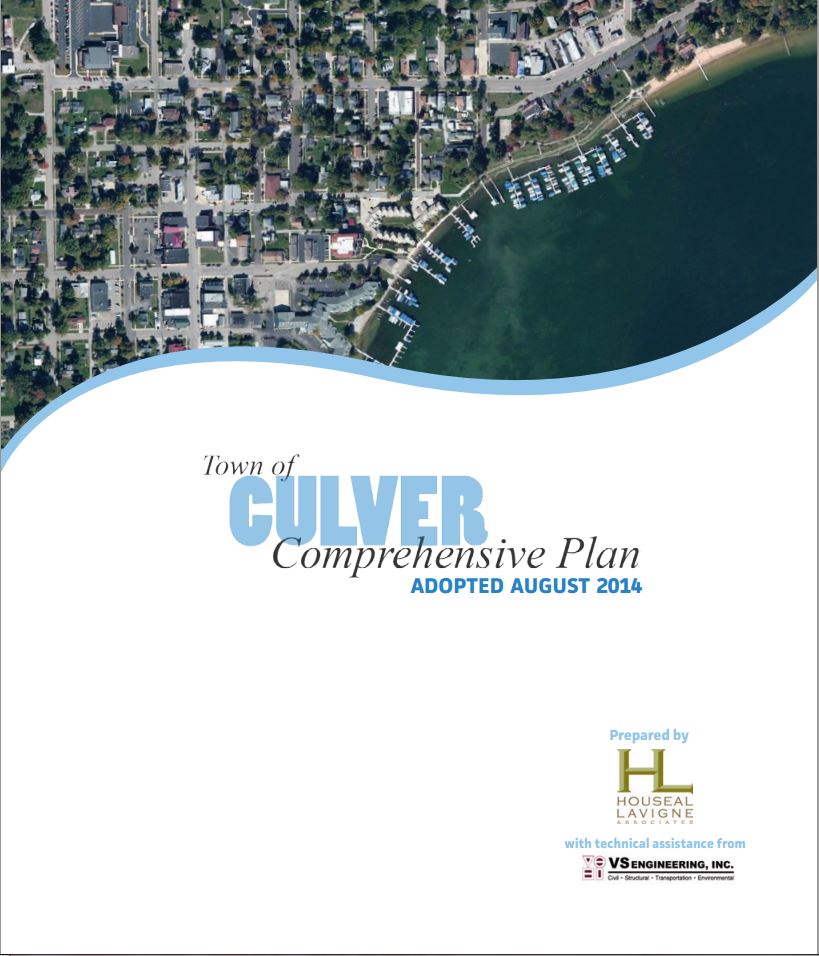
2014 Culver Comp Plan Cover

It is generally the responsibility of the Plan Commission to create a new Comp Plan, but in this case, the Culver Plan Commission delegated this to the fledgling Culver Crossroads group. With the help of MACOG, Culver Crossroads held multiple meetings, public events and other opinion gathering methods to take the pulse of the community and set goals for the future. I’ve participated in this from the start and I believe the new plan captures a lot of vision needed for the future of Culver.

Once the document is finalized, the work needs to continue. The plan is worthless sitting on a shelf. It needs to be revisited often by all branches of Culver government so that its goals can be implemented and its guidance can be observed in the decision making process. Since it was created by the citizens, it should be respected as the new direction for Culver.

This is your last chance to be one of those citizens giving final input before it goes to the Plan Commission and Town Council for adoption. Even if it’s just catching a spelling error or punctuation error, let MACOG know, so this is the best document it can be. This will be our plan for the next 10 years and the face of Culver when new developers, businesses and residents consider locating in Culver.